To choose a mesh conveyor belt for fruit and vegetable washing, start with the smallest product pieces you need to retain, the water that must drain away, and the conveyor layout. Then confirm that the complete belt, including its edges, joint and accessories, suits the food-contact and cleaning conditions. Selecting a belt by mesh count or overall dimensions alone can miss important differences.
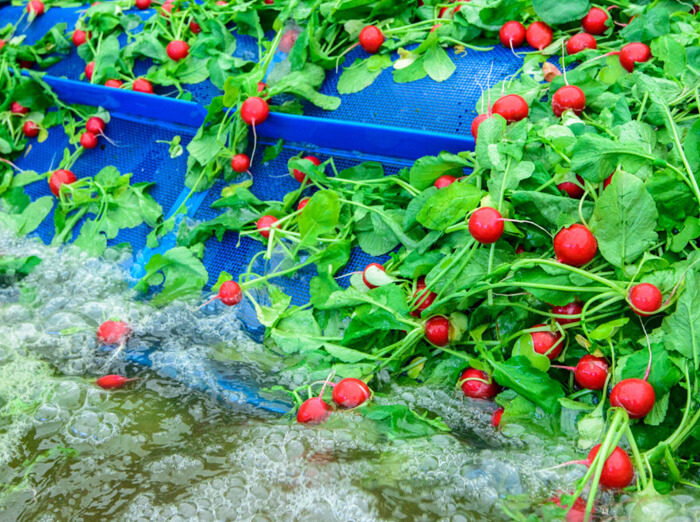
Vegetable washing application with a cleated mesh conveyor belt. |
Identify whether the belt carries produce under sprays, lifts it from a wash tank, or provides a draining section before the next machine. The open mesh supports the product while allowing water to pass through. Washing action comes from the surrounding process, such as sprays or agitation; the belt itself does not establish the effectiveness of cleaning or disinfection.
Also identify what happens after discharge. A belt feeding another wet process may have a different drainage target from one feeding packing equipment. State whether you need to remove free-draining water or achieve a specified surface-moisture condition. Gravity drainage alone may not meet the latter requirement.
This guide covers washing and draining conveyors. A belt used to press juice or sludge into a filter cake, or to operate over a vacuum filtration system, needs a separate equipment-specific assessment. Similar product names do not make those belts interchangeable. |
Aperture means the clear opening between adjacent yarns. Check both directions: warp is the lengthwise yarn system of the fabric, and weft runs across it. Openings can be rectangular, so one dimension does not fully describe the mesh. | Mesh count describes the number of yarns or openings per unit length, according to the specification convention. PFM SCREEN's product table lists warp/weft counts in wire/inch and aperture separately in millimetres. The count is not the hole size, and it is not a dimension in millimetres. |
Start with the smallest acceptable pieces in the production mix, including normal variation after cutting. Shape, orientation and flexibility also matter: a long, thin piece or a folded leaf may behave differently from a firm, rounded piece. Treat aperture as a selection parameter, not an absolute filtration rating or a guarantee of zero product loss.
What to check with representative produce
| Product condition | Selection priority | Practical check |
|---|---|---|
| Whole, firm produce | Support, drainage and transfer stability | Check rolling, rollback and discharge behaviour at the intended loading. |
| Diced or sliced produce | Retention of the smallest acceptable pieces | Check losses through the mesh, at the joint and across transfer gaps. |
| Leafy or flexible produce | Support without trapping leaves or stems | Check folding, snagging, mesh coverage and release at discharge. |
| Soft or easily damaged produce | Gentle support and handling | Inspect for marking or damage at loading, cleats, joints and discharge. |
Open area is the percentage of the mesh surface occupied by openings. It helps compare fabric geometry, but it does not state how much water will drain from a loaded washing conveyor. |
Leaves covering the openings, accumulated debris, product-layer depth and belt supports beneath the mesh can all affect the available drainage path. Belt speed also changes the time available for draining. If water carries over to the next machine, check these conditions and the drain outlets before assuming a larger aperture will solve the problem.
Compare candidate meshes using representative produce and the intended water flow, loading and belt speed. Record both retained product and discharge condition. A clean mesh sample passing water freely is only an initial check.
PFM SCREEN's reinforced polyester dewatering mesh conveyor belts use PET polyester mesh as standard, with PA nylon available as a special option. TPU or PVC side-edge sealing and joint-area reinforcement are standard construction features. The mesh material and the edge material are separate choices.
Sealed edges help protect cut yarn ends and reduce fraying. They still need suitable clearance and inspection; reinforcement does not correct an edge that continually rubs against the conveyor frame.
| Cleats or baffles: consider them where produce rolls or slides back on an incline. Confirm height, spacing and clearance around the conveyor return path. | Corrugated sidewalls: consider them where lateral spillage needs control. Check usable carrying width, transfer points and cleaning access. |
| V-guides: match the guide profile and position to the conveyor's grooves. Guides assist tracking on a correctly aligned conveyor. | |
PFM SCREEN supplies these options to the agreed drawing. Request the structures your process needs and check how each will pass around rollers and through the cleaning arrangement.
PFM SCREEN offers factory-prepared stainless steel alligator-style lacing, wire hook lacing and staple fasteners, which connect on the conveyor. An endless joint is completed before shipment and arrives as a closed loop, so the machine must allow that installation method. Other joint arrangements can be discussed.
Check joint profile, product contact, cleaning access and compatibility with the smallest roller and transfer arrangement. Obtain the applicable operating-tension and roller requirements for the selected construction; a fabric breaking-strength value is not an allowable running tension.
Confirm finished width and the required closed-loop circumference. If measuring an open belt, state the measurement endpoints and joint allowance rather than assuming its cut length equals the finished circumference. Shut down and isolate the conveyor before hands-on measurement or inspection. |
Assess the finished belt, including mesh, edge seals, joint, guides, cleats and sidewalls. Neither the polymer name nor the belt colour establishes suitability for a particular food-contact application. Ask for supporting documentation relevant to the supplied construction, food type and intended contact conditions. |
Provide the actual belt-contact temperature during production and cleaning, the exposure duration, and whether contact is wet, dry or involves steam. A dry-heat statement should not be treated as approval for continuous hot-water service. |
Identify cleaning and sanitizing agents, their concentrations, temperatures and contact times. Confirm compatibility with all belt components and access to joints and attachment areas. Cleaning effectiveness and material compatibility are separate checks; the plant's cleaning procedure must address both. |
You do not need to know the original mesh model to start. Send PFM SCREEN:
| The produce type, whether it is whole or cut, and the washing or draining stage. | Photos of the conveyor and close-ups of the mesh, edges and joint. |
| Belt width and length information, if known, with the measurement method. | Operating and cleaning conditions, especially heated contact or chemical exposure. |
For a replacement, also describe what the current belt does well and what needs improvement. Photos or a sample can help identify the construction.
Before approving a new configuration, agree how to check product retention, drainage at the required throughput, product damage, tracking and cleaning access. Use representative operating conditions and acceptance criteria suited to your line. This makes the selection a documented comparison rather than a visual match.
Still Have Questions? Contact PFM SCREEN Directly. Share your application, photos and available belt dimensions so we can assess the configuration for your washing line. First response within 1 business day (Beijing time). WhatsApp: +86 153 6967 9157 Email: polyestermesh@pfmscreen.com |