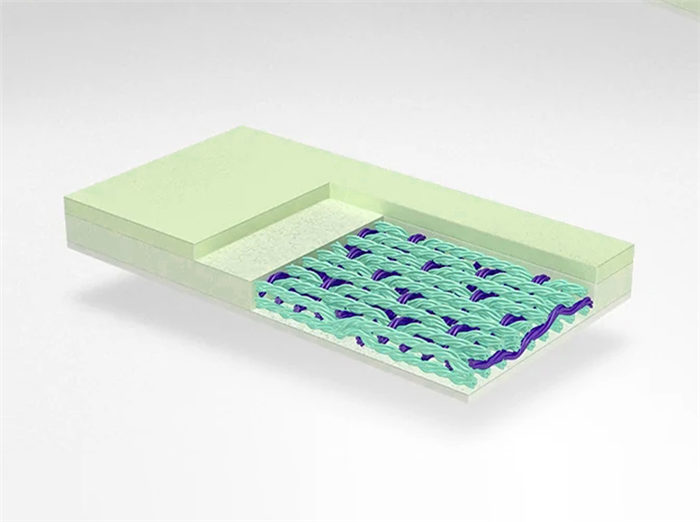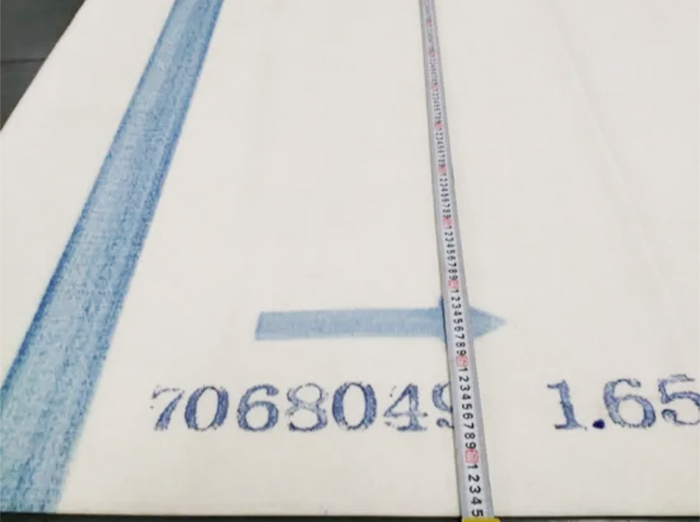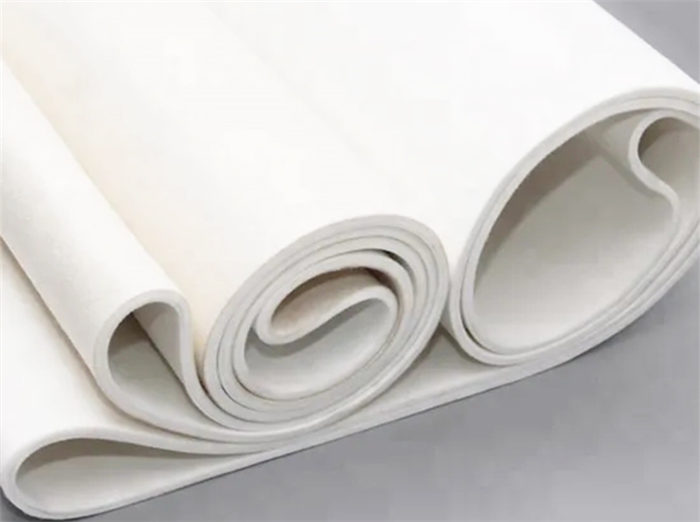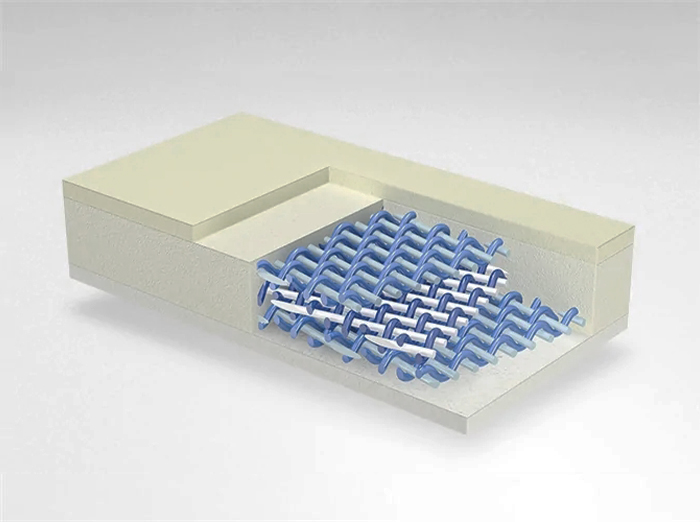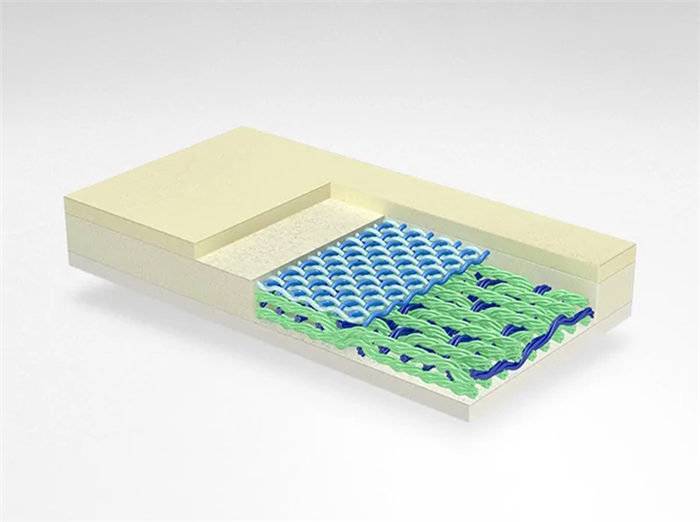
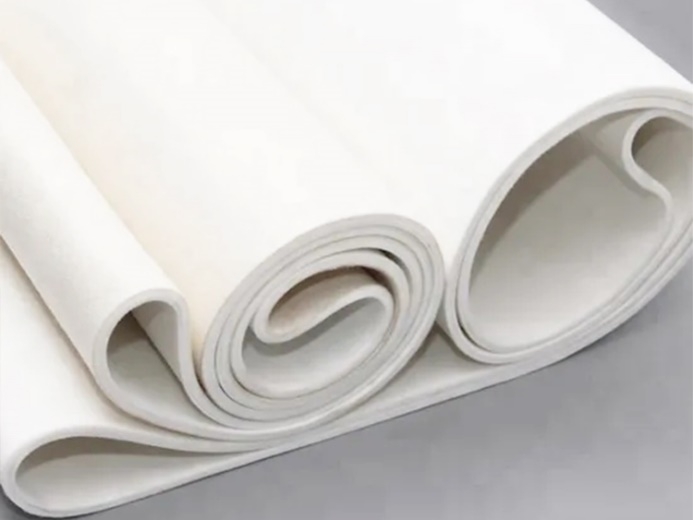
PFM Screen's Double Layer BOM Press Felt features a 1+1 composite double-base structure — two woven polyester mesh layers of different thickness bonded together, with high-grade batt needled on both faces. The composite base delivers significantly higher void volume, tensile strength (≥3000 N/5cm), and structural stability than single-layer construction.
Description
PFM Screen's Double Layer BOM Press Felt is a high-performance batt-on-mesh felt engineered for the more demanding positions in the press section — vacuum suction presses, groove presses, multi-presses, and large-diameter nip-roll presses. The defining feature is its 1+1 composite double-base structure: two woven base meshes of different thickness bonded together before needling. This composite base more than doubles the void volume available compared to a single layer felt, enabling the felt to absorb and transport significantly more water per nip pass without losing structural stability.
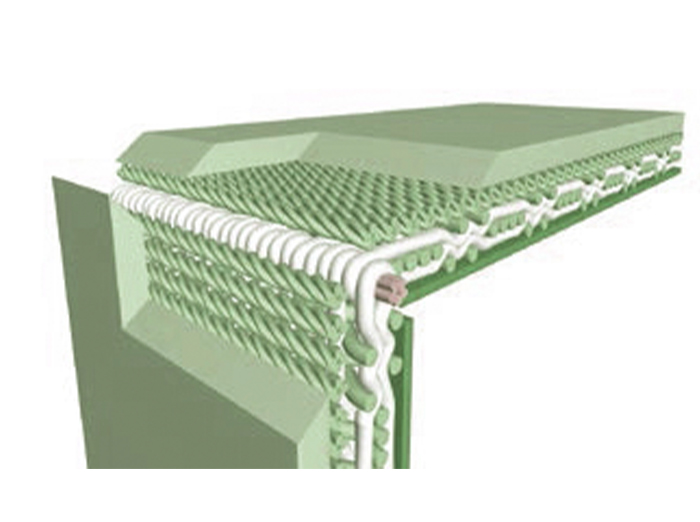
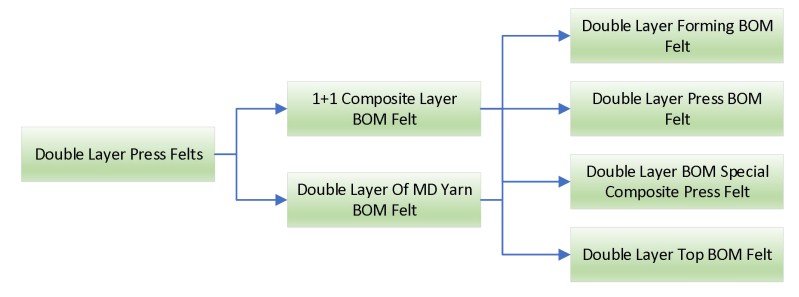
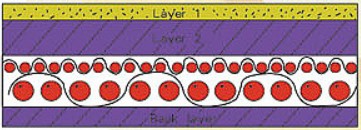 Variant A: 1+1 Composite Structure Two base meshes woven from different yarn diameters are combined — a finer upper mesh for batt support and a coarser lower mesh for drainage and structural strength. Provides the highest void volume, best mark resistance, and is the most versatile double-layer construction. | 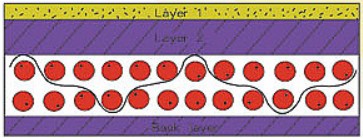 Variant B: Double Layer MD Yarn Structure The machine-direction (MD) yarns are doubled within a single weave — creating a reinforced base that delivers exceptionally high tensile strength and elongation resistance. Preferred for high-speed machines and positions with high CD tension variations. |
Both base variants can be modified in construction and yarn sizes to suit specific machine configurations. PFM Screen selects the optimal variant and adjusts batt composition based on your machine type, press position, paper grade, and operating speed.
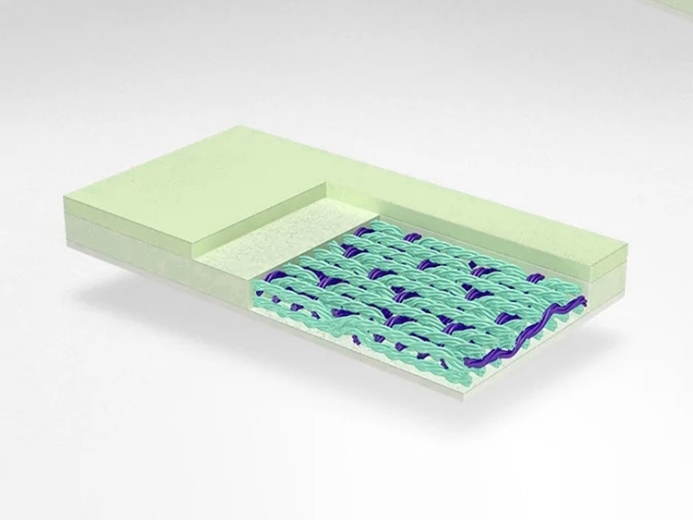
On vacuum suction presses, groove roll presses, and blind-hole roll presses, the perforated roll surface creates a pressure differential across the felt. Single-layer felts can deform into the perforations, imprinting their pattern onto the paper surface — producing visible marks. The double composite base structure of PFM Screen's Double Layer BOM felt is stiff enough to bridge the perforations without deforming, eliminating mark transfer while still maintaining excellent water drainage through the felt.
| Property | Single Layer | Double Layer (This Page) | Triple Layer |
|---|---|---|---|
| Base structure | Single mesh | 1+1 composite | 1+2 / 2+1 / 1+1+1 |
| GSM range | 700–1200 g/m² | 950–1450 g/m² | 1450–1750 g/m² |
| Tensile strength | ≥2000 N/5cm | ≥3000 N/5cm | ≥4500 N/5cm |
| Elongation | ≤1% | ≤0.6% | ≤0.6% |
| NIP pressure range | ≤80 kN/m | 60–200 kN/m | ≥200 kN/m |
| Max. machine speed | ≤800 m/min | ≤1000 m/min | ≤1000 m/min |
| Vacuum mark resistance | Limited | Excellent | Excellent |
| Blind-hole mark resistance | Limited | Excellent | Excellent |
| Best press type | Plain / nip roll | Suction / groove / vacuum | Shoe press / high-nip |
Specify Your Double Layer BOM Press Felt — Quote Within 24 Hours Share your press type, NIP load, machine speed, paper grade, and felt dimensions. PFM Screen responds with a full specification and pricing within one business day. WhatsApp: +86 153 6967 9157Email: polyestermesh@pfmscreen.com |
Feature
PFM Screen's Double Layer BOM press felts are engineered for the most demanding press positions on modern high-speed paper machines. The 1+1 composite base delivers a step-change in void volume, tensile strength, and structural integrity over single-layer construction — enabling longer felt runs, better dewatering, and superior mark resistance at NIP loads of 60–200 kN/m.
01 High Void Volume The 1+1 composite base creates greater internal void space than single-layer construction, absorbing and transporting more water per nip pass for consistent high dewatering efficiency. | 02 Tensile Strength ≥3000 N/5cm 50% higher tensile strength than Single Layer BOM — withstands the drive and tension loads of vacuum suction, groove, and multi-press configurations at speeds up to 1000 m/min. | 03 No Vacuum / Groove Marks The composite base bridges suction holes, grooves, and blind holes — the felt surface does not deflect into the perforations, preventing mark transfer to the paper sheet. | 04 Low Elongation ≤0.6% 40% less elongation than Single Layer BOM — the composite base resists dimensional change under high NIP loads, maintaining consistent sheet caliper and stable felt tension over the full run. |
● Double-layer composite base fabric — 1+1 or double-MD-yarn structure, both variants available ● High press resistance — handles NIP loads from 60 up to 200 kN/m without compaction ● Good flexibility — composite base remains flexible through rolls and guide rolls without cracking or delaminating ● Excellent permeability 30–110 CFM — adjustable permeability profile matched to drainage requirements | ● Structural stability — composite base resists deformation and width change under machine tension ● Widely applicable — covers printing papers, newsprint, technical papers, packaging papers, and high-grade boards ● GSM range 950–1450 g/m² — broad weight range to match machine type and paper grade ● Customisable base construction — mesh count, yarn diameter, and batt composition adjusted per specification |
≥3000 N/5cm Tensile 50% stronger than single layer | ≤0.6% Elongation Stable under 60–200 kN/m NIP | 1000 m/min Max. Speed Handles high-speed press sections | Zero Mark Defects Vacuum, groove & blind-hole mark-free |
Application
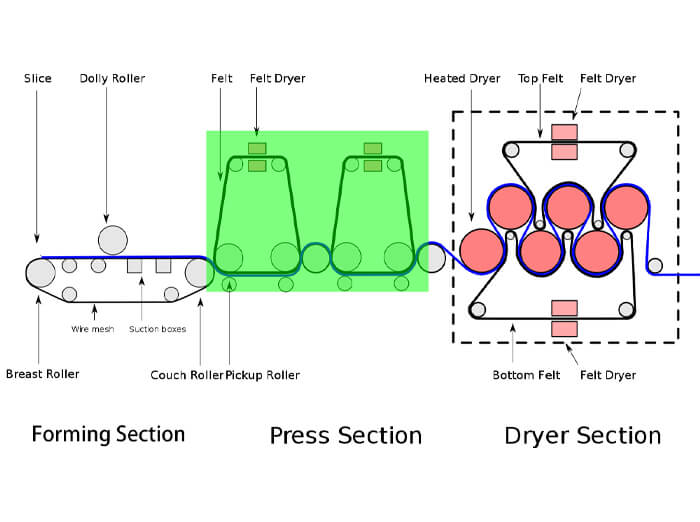
Double Layer BOM press felts are specified for the mid-to-high performance press positions on multi-cylinder, fourdrinier, super-forming, and gap-former machines. Their combination of high void volume, tensile strength, and structural rigidity makes them the correct choice when single-layer felts compact too quickly or when the press type imposes marking risks at NIP loads above 80 kN/m.
| Press / Machine Type | Compatible | Notes |
|---|---|---|
| Groove roll press | ✓ | Primary application — composite base bridges grooves, preventing groove marks on paper |
| Vacuum suction press | ✓ | Handles suction-side vacuum load without felt deformation or marking |
| Blind-hole press | ✓ | Resists blind-hole mark transfer — composite stiffness prevents felt-into-hole deflection |
| Multi-press (multi-nip) | ✓ | High tensile handles the re-tensioning demands of multi-nip configurations |
| Large-diameter nip-roll press | ✓ | Model 47525 series optimised for large-roll press positions with extended nip dwell time |
| Multicylinder machine press | ✓ | Second press positions on multicylinder machines running at 800–1000 m/min |
| Superposition wire / nip wire | ✓ | Press and forming positions on superposition wire machines |
| Shoe press | △ | Marginal at the upper end — shoe press loads consistently above 200 kN/m require Triple Layer BOM |
≤1000 m/min Max. machine speed | 60–200 kN/m NIP line load range | ≥8 g/m² Min. paper basis weight | 9 Models Standard configurations available |
| Paper Grade | Basis Weight | Recommended Model |
|---|---|---|
| High-grade printing & writing paper | 50–120 g/m² | 47505, 47523 series |
| Newsprint | 40–52 g/m² | 47505, 47523 series |
| Technical paper | 40–200 g/m² | 47503, 47505 series |
| Packaging paper | 60–150 g/m² | 47501, 47502, 47521 series |
| Kraft paper | 60–150 g/m² | 47501, 47502, 47504, 47521 series |
| Corrugating medium | 80–180 g/m² | 47501, 47504, 47524 series |
| Paper board / white board | 150–400 g/m² | 47522, 47525 series |
| High-grade board (large roll press) | 200–400 g/m² | 47525 series |
| OEM Brand | Machine / Press Types | Typical Press Position |
|---|---|---|
| Valmet | OptiFlo Gap, SymFlo, OptiPress, SymPress, ValPress II | 2nd & 3rd press, suction press |
| Voith | DuoFormer, NipcoFlex, TF (Tissue), PolyFlex | 1st suction press, 2nd press, grooved roll |
| Andritz | PrimePress XT, PrimeDry, Gap Former | Suction press, grooved press, multi-press |
| Beloit (legacy) | Bel-Baie, Bel-Press, Converflo | All press positions on vacuum and groove presses |
| Chinese domestic OEMs | Multicylinder and fourdrinier machines | All suction and groove press positions |
Specifications
GSM 950–1450 g/m² GSM tolerance ≤±4% | Tensile Strength ≥3000 N/5cm MD direction, standard test conditions | Elongation ≤0.6% Under standard press load conditions |
Air Permeability 30–110 CFM Adjusted per machine drainage requirements | Width Variation ≤±2 cm Stable width across full machine width | Base Structure 1+1 Double Layer Mesh Two-layer composite (1+1 or double MD yarn) |
| Model | GSM (g/m²) | Structure | Suitable Paper Grades |
|---|---|---|---|
| 47501 | 950–1300 | Double layer mesh | Corrugating papers, kraft papers, packaging papers |
| 47502 | 1000–1100 | Double layer mesh | Corrugating papers, kraft papers, packaging papers |
| 47504 | 900–1100 | Double layer mesh | Corrugating papers, kraft papers, packaging papers |
| 47505 | 1100–1400 | Double layer mesh | Writing & printing papers, newsprints, packaging papers, kraft papers |
| 47521 | 950–1300 | Double layer mesh | Corrugating papers, kraft papers, packaging papers |
| 47522 | 1000–1100 | Double layer mesh | Kraft papers, paper boards |
| 47523 | 1200–1500 | Double layer mesh | Writing & printing papers, newsprints, packaging papers, kraft papers |
| 47524 | 900–1100 | Double layer mesh | Corrugating papers, kraft papers, packaging papers |
| 47525 | 1200–1500 | Double layer mesh | Big roll press: high-grade packaging papers, paper boards |
* Custom GSM, width, length, and batt composition available. Contact PFM Screen for current model data and lead times.
Q1: What is a Double Layer BOM press felt and how is it different from a Single Layer BOM felt? A Double Layer BOM press felt uses a composite double base — either a 1+1 construction (two separate mesh layers combined) or a double MD yarn structure (doubled machine-direction yarns in a single weave) — rather than the single mesh of a Single Layer BOM felt. The composite base delivers approximately 50% more void volume, 50% higher tensile strength (≥3000 vs ≥2000 N/5cm), and lower elongation (≤0.6% vs ≤1%). This structural upgrade allows Double Layer BOM felts to handle higher NIP loads (60–200 kN/m vs ≤80 kN/m), higher machine speeds (≤1000 vs ≤800 m/min), and vacuum/groove/blind-hole press types without transferring marks to the paper. |
Q2: What is the difference between 1+1 composite structure and double MD yarn structure in double layer BOM felts? The 1+1 composite structure consists of two distinctly woven base meshes — typically of different yarn diameters — combined into one felt before needling. This gives maximum void volume and the best flexibility. The double MD yarn structure doubles the machine-direction yarns within a single woven fabric without separating them into discrete layers. This approach gives the highest tensile strength and the best elongation resistance, at the cost of slightly lower void volume. PFM Screen recommends the 1+1 composite for suction and vacuum press positions where marking resistance is the primary concern, and the double MD yarn for high-tension applications where dimensional stability is the priority. |
Q3: How does Double Layer BOM press felt prevent vacuum marks, blind-hole marks, and groove marks? Vacuum marks, blind-hole marks, and groove marks occur when the press felt is soft enough to deflect into the perforations of the roll under press load. When the felt (and the wet paper sheet on top of it) deforms into the holes or grooves, the paper absorbs the shape of those perforations as caliper or density variations. PFM Screen's Double Layer BOM felt uses a stiffer composite base that spans the perforations without deflecting into them — the felt maintains a flat, even pressure plane across the paper surface, eliminating mark transfer. The 1+1 composite base provides 50–100% more bending stiffness than a comparable single-layer base. |
Q4: What is the maximum NIP line load for Double Layer BOM press felts? PFM Screen's Double Layer BOM press felts are designed for NIP line loads from 60 kN/m up to 200 kN/m. At the lower end of this range, they outperform Single Layer BOM felts by maintaining void volume under sustained press load. At the upper end (180–200 kN/m), they approach their structural limit — if NIP loads consistently exceed 200 kN/m, a Triple Layer BOM felt with a 1+2 or 1+1+1 composite base is recommended to prevent premature compaction and maintain dewatering efficiency throughout the felt run. |
Q5: Which paper grades are Double Layer BOM press felts most suitable for? Double Layer BOM press felts cover a broad range of paper grades from ≥8 g/m² basis weight. The most common grade applications are: high-grade printing and writing papers, newsprint, technical papers, packaging papers, kraft papers, corrugating medium, paper boards, and white boards. For tissue and ultra-light papers (≤35 g/m²), Single Layer BOM felts are usually preferred. For very high-grade coated boards and papers requiring shoe press dewatering (≥200 kN/m), Triple Layer BOM is recommended. Double Layer BOM occupies the centre of the market — the most versatile choice for the majority of commercial paper grades. |
Q6: What is the large void volume of Double Layer BOM felt, and why does it matter for dewatering? Void volume in a press felt is the total empty space available to temporarily hold water as it is squeezed out of the wet paper sheet during the nip. The 1+1 composite base of Double Layer BOM felt creates substantially more internal void space than a single mesh base — the two layers together have more total yarn cross-section, and the space between the layers adds additional reservoir capacity. Higher void volume means the felt can absorb more water per nip pass, sustaining high dewatering rates even as the felt ages and the surface batt gradually compacts. A high-void-volume Double Layer BOM felt maintains consistent drainage rates over a significantly longer run life than a compacted single-layer felt. |
Q7: What are the full technical specifications of PFM Screen's Double Layer BOM press felts? PFM Screen's Double Layer BOM press felts are manufactured to the following standard specifications: GSM 950–1450 g/m² (tolerance ≤±4%); tensile strength ≥3000 N/5cm; elongation ≤0.6%; air permeability 30–110 CFM (adjusted to machine requirements); width variation ≤±2 cm. Base structure: 1+1 composite double-layer mesh or double MD yarn, monofilament polyester. 9 standard models are available (47501–47525 series), covering corrugating and kraft papers to high-grade board grades. Custom GSM, permeability, batt composition, and dimensions are available. |
Q8: Can PFM Screen supply custom width and length Double Layer BOM press felts, and what is the lead time? Yes. All PFM Screen Double Layer BOM press felts are manufactured to customer specifications — there is no catalogue of standard widths or lengths. Provide your machine make, model, press position, felt width (pin-to-pin), felt length, and target GSM/permeability, and PFM Screen will issue a specification sheet and quotation within 24 hours. There is no fixed minimum order quantity. Standard lead time is 2–4 weeks after drawing confirmation, with rush orders accommodated where production scheduling permits. Contact PFM Screen via WhatsApp (+86 153 6967 9157) or email (polyestermesh@pfmscreen.com). |
Ready to Order? Get Your Custom Specification & Quote Within 24 Hours Tell us your press type, NIP load, machine speed, paper grade, and felt dimensions — PFM Screen will recommend the right double layer model and issue a full quotation within one business day. No fixed MOQ. WhatsApp: +86 153 6967 9157Email: polyestermesh@pfmscreen.com |