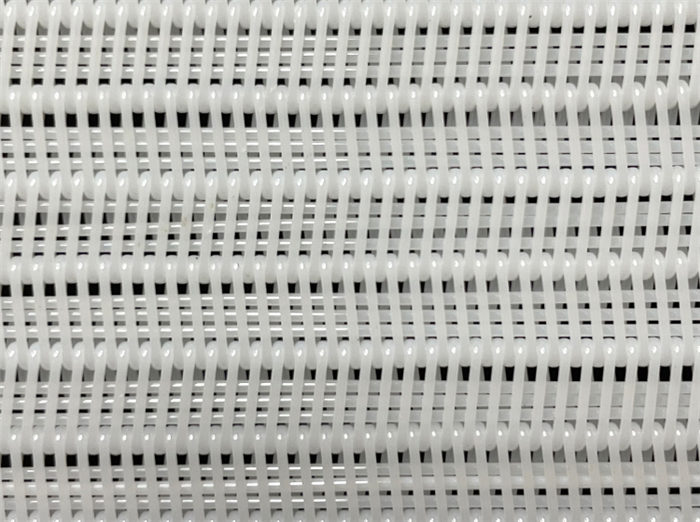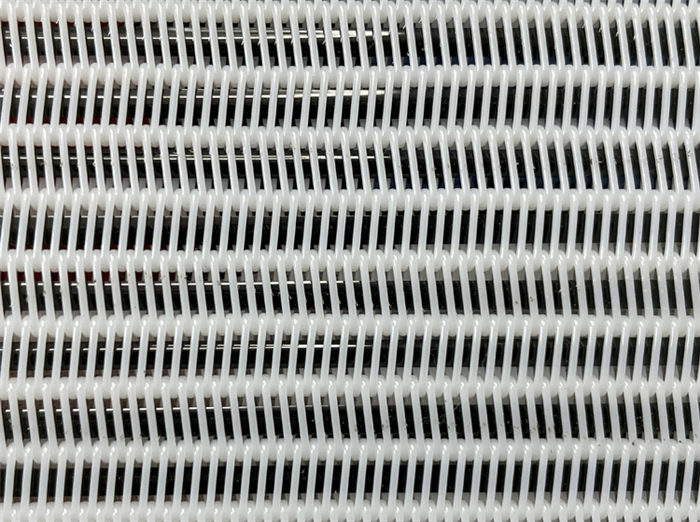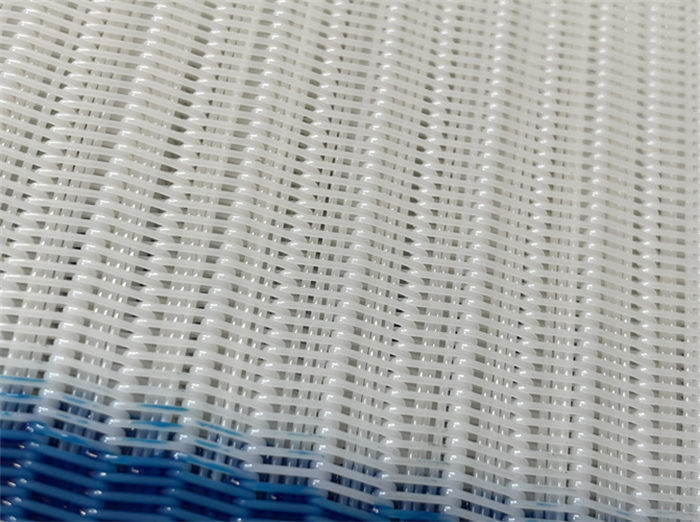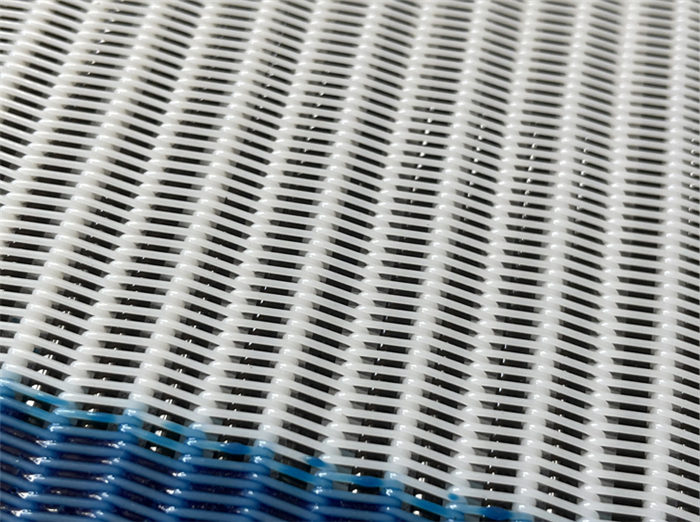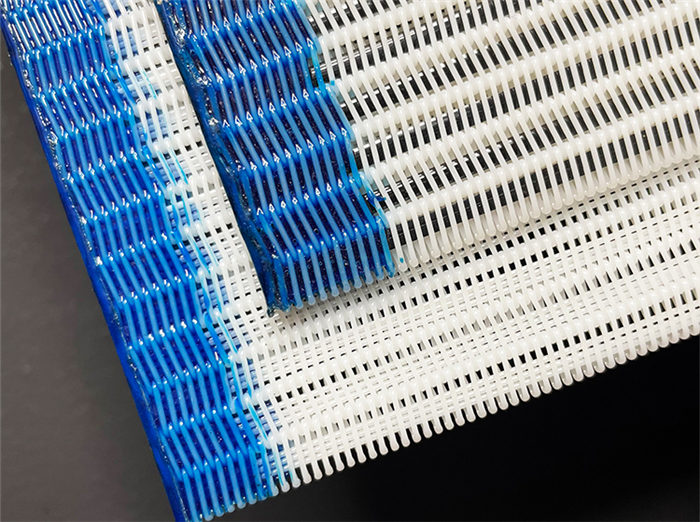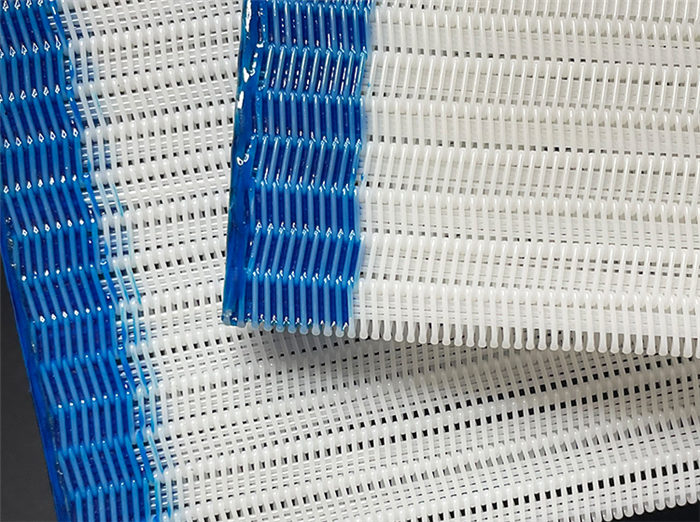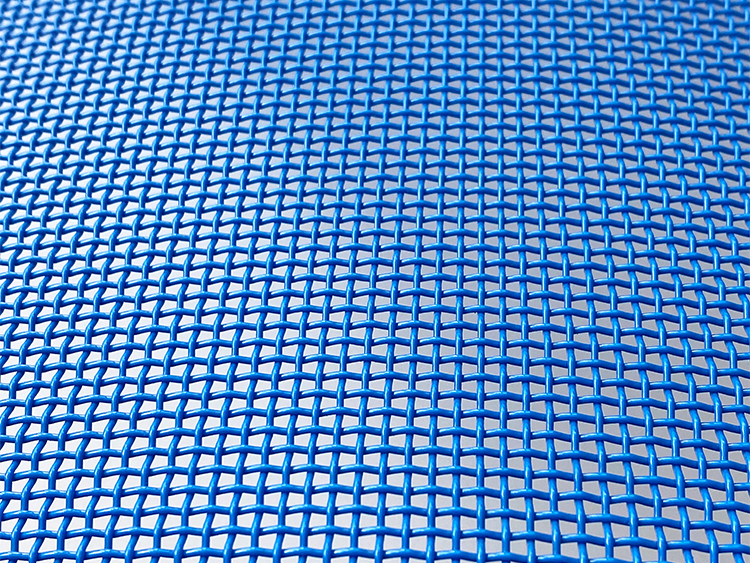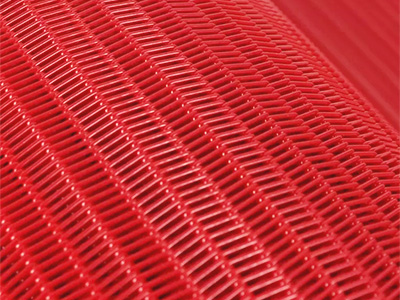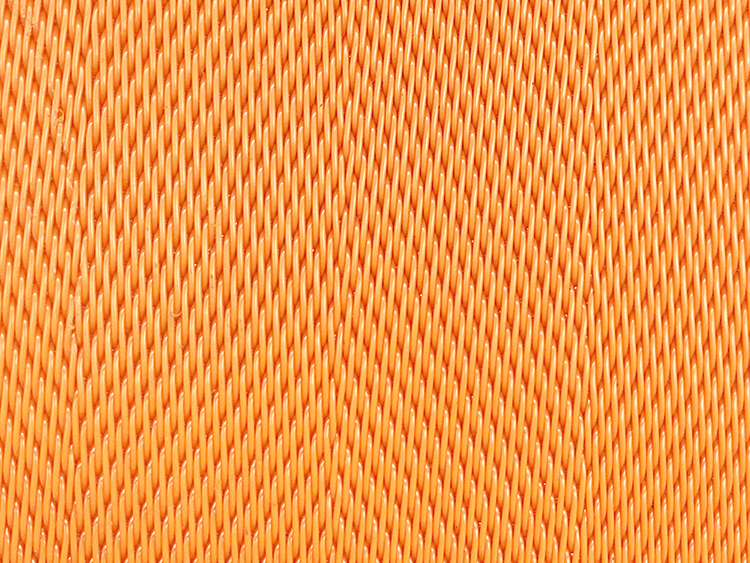
PFM Screen's Polyester Spiral Mesh Press Filter Belts are engineered for belt filter press dewatering — combining an interlocking spiral loop construction with inserted filler yarns to deliver controlled air permeability, seamless belt connections, and long service life. Available in 12 standard models (small, medium, large loop) across widths 200–5000 mm, with polyester or alkali-resistant PA monofilament, round or flat inserting bars, and fold-back or cut-glued edge reinforcement. FDA-certified materials available for food and pharmaceutical applications. Custom belt dimensions engineered to your machine specifications.
Description
PFM Screen's Polyester Spiral Mesh Press Filter Belts are constructed from precision-drawn abrasion-resistant polyester monofilament spirals, interlocked with connecting pins and reinforced with inserted filler yarns. The filler yarn system controls air permeability below that of standard open spiral fabrics and reduces material loss through the belt surface — making these belts the preferred choice for belt press filter dewatering across municipal sludge treatment, mining, chemical, pharmaceutical, food, and pulp & paper applications.
Unlike woven filter belts that rely on mechanical clipper seams (AISI 304/316 stainless fasteners), the spiral construction creates a seamless belt connection by interlocking the spiral loops at each belt end with a single connecting pin. This eliminates the clipper seam — the most frequent failure point in belt press operation. Where woven belts with clipper seams prematurely fail under high nip-pressure cycling, PFM Screen spiral press filter belts deliver a structurally integrated joint that matches the tensile strength of the belt body itself.
| Feature | Spiral Mesh Press Filter Belt | Woven Filter Belt (Clipper Seam) |
|---|---|---|
| Joint Type | Seamless interlocking spiral coil connection — no hardware required | Clipper / alligator fastener (AISI 304/316 stainless) |
| Joint Strength | Strength equivalent to belt body — no weak-point seam | Clipper seam is the primary failure point under high nip pressure |
| Permeability Control | Filler yarns inserted in spiral loops — engineered permeability at manufacture | Fixed by weave pattern — limited post-manufacture adjustment |
| Solid Retention | Filler yarns reduce surface openings — lower fine-particle loss in filtrate | Aperture depends on weave count — variable fine-particle pass-through |
| Replacement Trigger | Belt body wear — seam is never the limiting factor | Most often caused by clipper seam failure, not belt fabric wear |
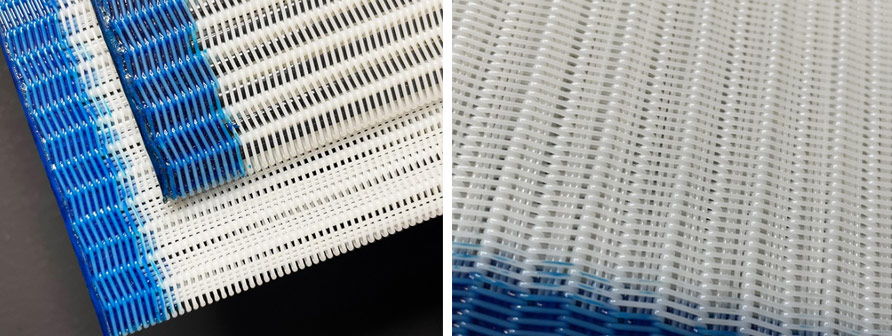 | In a standard open spiral belt, the gaps between interlocked spiral loops create a relatively large open aperture. PFM Screen inserts additional monofilament filler yarns into the cavities between spiral loops — reducing the effective open area while preserving the tensile strength of the spiral base structure. Reduced air permeability — filler yarns restrict flow through the belt, optimising cake formation and reducing fine-solid loss in the filtrate Improved solid retention — smaller effective aperture means more solids are retained on the belt surface for higher dry solids content in the filter cake Consistent performance — spiral geometry maintains uniform aperture through the full service life, unlike woven belts that can distort under sustained belt tension Filler material options — round monofilament (0.60–1.2 mm), flat wire (2.1×0.80 or 2.1×0.88 mm), or conductive carbon wire for anti-static applications (model 6890B5) |
01 Eliminates Seam Failure Interlocking spiral coil joint matches belt body strength — the most common cause of belt press downtime is removed entirely | 02 Engineered Permeability Filler yarn density is set at manufacture to deliver the exact air permeability value your belt press filtration process requires | 03 Superior Abrasion Resistance Abrasion-resistant polyester monofilament engineered for high-pressure nip zones, roller contact, and doctor blade scraping in belt press filtration | 04 Flexible Glued Edges High-strength flexible adhesive edges resist delamination and deliver reliable belt tracking through continuous high-pressure press cycling |
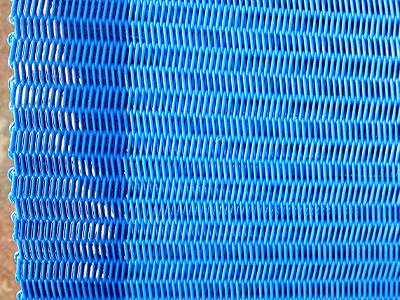 Fold-Back Yarns Glued Edge ● Edge yarns folded back and encapsulated in high-strength flexible adhesive ● Thicker edge profile — improved lateral support for flat-roller belt tracking systems ● Higher abrasion resistance at the belt edge zone ● Recommended for belt presses with standard edge-guide channels | 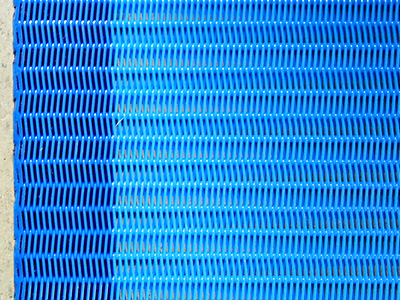 Cut Glued Edge ● Belt cut to precision width; edge sealed with flexible adhesive compound ● Clean, thin edge profile — preferred for tight belt-guide channels and close-tolerance belt press systems ● Chemical-resistant adhesive grades available for acidic or alkaline process environments ● Suitable for the majority of standard belt press filter machine configurations |
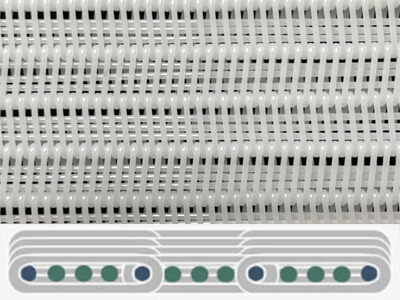 Round Inserting Bars Standard circular cross-section connecting pin — distributes load uniformly across the full width of the spiral loop. The most widely specified configuration for general belt press filtration applications across wastewater, mining, and food industries. | 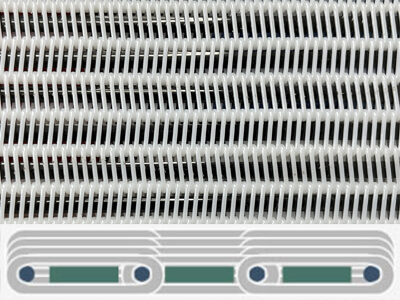 Flat Inserting Bars Flat cross-section connecting pin — lower profile at the seam zone reduces belt surface irregularity at the join. Preferred for precision belt press machines with tight nip clearances and applications requiring minimal thickness variation across the full belt length. |
Get a Custom Spiral Press Filter Belt Quote Within 24 Hours Share your belt press machine brand and model, belt width, loop size preference, filler yarn type, and edge type — PFM Screen will recommend the correct spiral model and provide full specifications and pricing within one business day. WhatsApp: +86 153 6967 9157Email: polyestermesh@pfmscreen.com |
Feature
Spiral Loop Structure — Three Size Classes Spiral loops are manufactured in three size classes: small (5.2 mm loop pitch, spiral ø 0.5 mm), medium (7.15–8 mm pitch, spiral ø 0.68 mm), and large (8–12 mm pitch, spiral ø 0.9–1.2 mm). Loop size controls the nominal aperture and base permeability range — select based on the solid particle size and required filtration fineness for your belt press process. | Filler Yarn Permeability Control System Monofilament filler yarns (ø 0.60–1.2 mm, 3 or 4 per loop) or flat wire filler yarns (2.1×0.80 or 2.1×0.88 mm) are inserted between spiral loops to reduce air permeability below the base spiral structure. A conductive carbon wire filler option (model 6890B5) delivers anti-static performance for specialty applications. Filler yarn selection is the primary engineering lever for matching belt permeability to your process requirements. |
Seamless Interlocking Belt Joint Both ends of the spiral belt terminate in spiral coils that interlock directly with each other via a single connecting pin — creating a joint that is part of the belt structure rather than a surface-mounted mechanical fastener. This joint flexes identically to the belt body, does not concentrate stress at the seam, and consistently outlasts clipper seam joints on high-pressure belt press filter machines. The spiral seam is the preferred choice wherever clipper seam failure is the root cause of premature belt replacement. | High-Strength Flexible Glued Edges Both fold-back yarn and cut-glued edge types use a high-quality adhesive that is both mechanically strong and highly flexible. The adhesive encapsulates edge yarns and firmly anchors filler yarns against lateral displacement under the high lateral stress of belt press operation. Chemical-resistant adhesive grades are available for acidic or high-pH process environments and aggressive belt wash cycles. |
| Loop Class | Typical Application | Recommended Models | Air Permeability Range |
|---|---|---|---|
| Small Loop (5.2 mm pitch) | Fine solid retention, pharmaceutical filtration, low-permeability press filtration | 5080A1 | 4480 m³/m²h |
| Medium Loop (7.15–8 mm pitch) | General sludge dewatering, wastewater treatment, chemical & food filtration — broadest model selection | 6890A1, 6890B1, 6890B2, 6890B3, 6890B4, 6890B5 | 5760–10000 m³/m²h |
| Large Loop (8–12 mm pitch) | Mining & mineral dewatering, sand washing, pulp & paper — coarser solid-liquid separation | 9090A1, 90110A1, 10090A1, 120130A1 | 5000–7500 m³/m²h |
| Alkali-Resistant (PA Nylon) | Caustic wash systems, high-pH industrial sludge, alkaline chemical filtration | PA90110A2 | 6240 m³/m²h |
2600 N/cm Max Belt Strength Model 120130A1 rated at 2600 N/cm warp tensile strength — engineered for high-tension, large-format belt press filter applications in mining and mineral processing | 12 Standard Spiral Models Small, medium, and large loop classes in polyester and alkali-resistant PA monofilament — covering the complete spectrum of belt press filtration requirements | 10000 m³/m²h Peak Permeability Model 6890B5 with conductive carbon filler wire delivers the highest air permeability (10000 m³/m²h CFM 625) in the range — for high-throughput belt press filtration |
Abrasion Resistance Precision-drawn abrasion-resistant polyester monofilament withstands the continuous roller contact, doctor blade scraping, and high-pressure nip zones inherent in belt press filter operation | Chemical Resistance Polyester monofilament resists a broad range of acids, organic solvents, and cleaning chemicals. The PA (polyamide) variant provides additional alkali resistance for caustic wash and high-pH process environments | FDA / EC Compliance Spiral press filter belts for direct food contact applications are available in FDA 21 CFR and EU EC 1935/2004 compliant materials — suitable for juice pressing, food dewatering, and pharmaceutical filtration |
Application
PFM Screen's Polyester Spiral Mesh Press Filter Belts are deployed across a wide range of industrial solid-liquid separation and dewatering processes where a seamless, high-strength belt connection and precisely controlled air permeability are essential to continuous operation. The spiral construction — free from mechanical fastener seams — makes these belts the preferred direct replacement wherever clipper seam failures drive premature belt change-out and unplanned downtime on belt press filters.
Municipal Wastewater & Sludge Dewatering ● Belt press dewatering of primary and secondary sludge from municipal wastewater treatment plants ● Gravity thickening of biological sludge ahead of anaerobic digestion ● Dewatering of digested sludge for landfill disposal or agricultural use ● Industrial effluent sludge dewatering for volume reduction and disposal | Mining & Mineral Processing ● Tailings slurry dewatering in gold, copper, iron ore, and coal processing ● Sand washing and classification — water recovery and fine-solid capture ● Phosphate, potash, and mineral concentrate belt press filtration ● Ceramic, kaolin, and silica slurry dewatering |
Chemical & Pharmaceutical Industry ● Chemical slurry dewatering and solid recovery in batch and continuous processes ● Pharmaceutical API and intermediate filtration — FDA-compliant belt materials available ● Pigment and dye manufacturing filtration and dewatering ● High-pH alkaline environments — PA nylon alkali-resistant variant (PA90110A2) | Food & Beverage Processing ● Fruit juice pressing and dewatering — apple, pear, grape, citrus, ginger ● Vegetable mash pressing for puree and juice production ● Starch and sugar extraction filtration ● FDA 21 CFR / EU EC 1935/2004 compliant belt materials for direct food contact |
Pulp & Paper Industry ● Paper mill effluent sludge dewatering ● Fibre recovery from white water and process effluent streams ● Coating slip dewatering and pigment slurry filtration ● Secondary fibre processing and newsprint sludge dewatering | Industrial Sludge & Biosolids Treatment ● Industrial process sludge dewatering for volume reduction and compliant disposal ● Biosolids dewatering for agricultural land application (class A/B biosolids) ● Rendering and food processing by-product sludge dewatering ● Textile, tannery, and printing effluent sludge treatment |
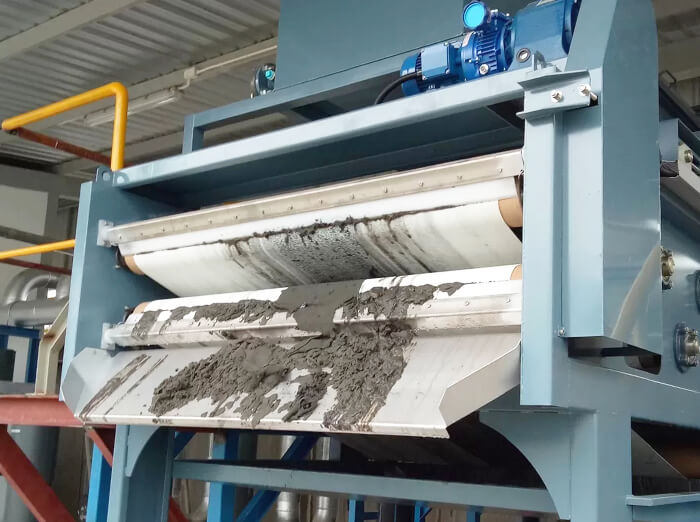 Sludge Dewatering — Belt Press Filter Spiral press filter belt running on a belt filter press machine for municipal or industrial sludge dewatering. The seamless spiral joint eliminates seam failure as the leading cause of belt replacement downtime. | 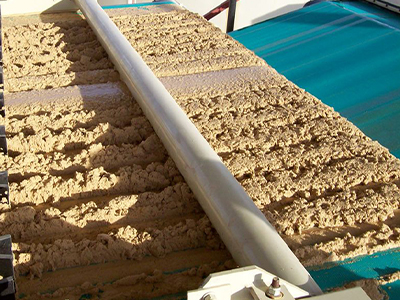 Sand Washing — Mineral Dewatering Large-loop spiral press filter belts (9090A1, 90110A1) for sand washing and mineral processing dewatering — high abrasion resistance and robust spiral construction for demanding coarse-solid applications. |
PFM Screen supplies spiral mesh press filter belts as direct replacements for OEM belts on belt press filter machines from all major global manufacturers. Provide your machine brand, model, and current belt dimensions — PFM Screen will specify the correct spiral model, width tolerance, and edge type for your equipment.
| Brand | Country | Common Belt Press Models | Typical Belt Width |
|---|---|---|---|
| Andritz | Austria | BFP, DA-series, Thune Eureka | 0.5–3.5 m |
| HUBER Technology | Germany | RBF Belt Filter, BT Gravity Belt Thickener | 0.5–3.0 m |
| Komline-Sanderson | USA | KSD Gravity Belt Thickener, Belt Filter Press | 0.5–2.5 m |
| Alfa Laval / Nordic Water | Sweden | B-Press, Nordic Water Aquarius | 0.5–2.5 m |
| Parkson | USA | Dynabelt Gravity Belt Filter | 0.5–2.5 m |
| BELLMER | Germany | WPR-S, BFP-C, NipcoFlex | 0.5–3.0 m |
| BDP Industries | USA | 2DP, 3DP Belt Filter Press | 0.5–2.5 m |
| Diemme / FLSmidth | Italy / Denmark | Belt Filter Press, Pneumapress | 0.5–2.0 m |
* Brand names used for reference purposes only. PFM Screen is an independent supplier of spiral mesh press filter belts. Provide your machine brand, model, and current belt dimensions (width, circumference, edge type) for an exact replacement specification.
Specifications
PFM Screen offers 12 standard spiral mesh press filter belt models, covering small, medium, and large loop sizes in abrasion-resistant polyester and alkali-resistant PA (polyamide) monofilament. All models are available in custom widths from 200 mm to 5,000 mm in any required belt circumference length. Provide your belt press machine brand, model, and current belt dimensions for an exact replacement specification.
| Loop Class | Model | Loop Width (mm) | Spiral Ø (mm) | Pin Ø (mm) | Filler Material | Strength (N/cm) | Weight (kg/m²) | Thickness (mm) | Air Perm. (m³/m²h) | CFM (127 Pa) |
|---|---|---|---|---|---|---|---|---|---|---|
| Small | 5080A1 | 5.2 | 0.5 | 0.8 | Round 0.60×3 | 1800 | 1.5 | 2.1 | 4480 | 280 |
| Medium | 6890A1 | 8.0 | 0.68 | 0.9 | Round 0.80×4 | 2000 | 2.0 | 2.45 | 6080 | 380 |
| Medium | 6890B1 | 7.15 | 0.68 | 0.9 | Round 0.90×3 | 2000 | 1.9 | 2.45 | 5760 | 360 |
| Medium | 6890B2 | 7.15 | 0.68 | 0.9 | Round 0.80×3 | 2000 | 1.85 | 2.45 | 7750 | 484 |
| Medium | 6890B3 | 7.15 | 0.68 | 0.9 | Flat Wire 2.1×0.80 | 2000 | 1.8 | 2.45 | 9000 | 563 |
| Medium | 6890B4 | 7.15 | 0.68 | 0.9 | Flat Wire 2.1×0.88 | 2000 | 1.85 | 2.45 | 8000 | 500 |
| Medium | 6890B5 | 7.15 | 0.68 | 0.9 | Conductive Carbon Wire | 2000 | 1.6 | 2.45 | 10000 | 625 |
| Large | 9090A1 | 8.0 | 0.9 | 0.9 | Round 0.90×3 | 2300 | 2.3 | 3.03 | 7500 | 468 |
| Large | 90110A1 | 10.0 | 0.9 | 1.1 | Round 1.0×4 | 2000 | 2.4 | 3.15 | 6240 | 390 |
| Large | 10090A1 | 8.0 | 1.0 | 0.9 | Round 1.0×3 | 2000 | 2.5 | 3.6 | 5000 | 315 |
| Large | 120130A1 | 12.0 | 1.2 | 1.3 | Round 1.2×3 | 2600 | 2.85 | 4.3 | 7500 | 468 |
| Alkali-Resistant (PA) | PA90110A2 | 10.0 | 0.9 | 1.1 | Round 1.2×3 | 2000 | 2.25 | 3.15 | 6240 | 390 |
* Custom widths (200–5000 mm) and belt circumference lengths available. PA model uses alkali-resistant polyamide (nylon) monofilament. All specifications subject to manufacturing tolerances. Air permeability measured at 127 Pa differential pressure. Contact PFM Screen to confirm filler wire diameter for PA90110A2.
Q1: What is a spiral mesh press filter belt, and how does it differ from a woven filter belt? A spiral mesh press filter belt is built from polyester monofilament wires formed into interlocked spiral coils connected by inserting pins — not woven on a loom like a conventional filter belt. The structural difference that matters most for belt press filtration is the joint: a spiral belt connects belt-end to belt-end by interlocking the terminal spiral coils with a single connecting pin, creating a seamless joint with strength equal to the belt body. A woven belt requires a mechanical clipper seam (stainless steel alligator fastener) to close the belt loop, and this clipper seam is statistically the most common failure point in belt press operation. Spiral belts also incorporate inserted filler yarns that allow permeability to be precisely engineered at manufacture — a capability not available with woven filter belts. |
Q2: Why do clipper seam filter belts fail early, and how does the spiral construction solve this? In belt press filtration, the filter belt passes through a series of rollers under high nip pressure while under significant belt tension. The mechanical clipper seam is a stress concentration point — it experiences both repeated bending and the full nip-pressure load every time the seam passes through a roller nip. Over time, the metal fastener fatigues, and the seam fails — often long before the belt fabric itself is worn out. A PFM Screen spiral press filter belt removes this failure mode entirely. The belt ends are joined by interlocking the same spiral coils that form the belt body; the joint flexes identically to the belt, distributes stress uniformly, and does not concentrate load at any single point. Service life is limited by belt body wear — not seam failure. |
Q3: What are filler yarns, and why do they matter for filtration performance? In a standard open spiral belt, the gaps between interlocked spiral loops create relatively large openings through the belt. PFM Screen inserts additional monofilament filler yarns into the cavities between spirals during manufacture — reducing the effective open area. The filler yarn system achieves three key process improvements: (1) lower air permeability to optimise cake formation and reduce fine-solid loss in the filtrate; (2) better solid retention — the reduced aperture keeps more solids on the belt surface for higher dry-solids content in the filter cake; and (3) consistent performance — the spiral geometry maintains uniform aperture through the service life, unlike woven belts that can distort under sustained tension. Filler yarn diameter, count, and material (round monofilament, flat wire, or conductive carbon wire) are selected to engineer the specific permeability value your process requires. |
Q4: How do I choose between small, medium, and large loop sizes? Loop size selection depends on the solid particle size in the feed slurry, the required filtration fineness, and the belt press operating conditions. Small loop (5080A1, 5.2 mm pitch) provides the finest effective aperture and lowest permeability — suited for fine-solid pharmaceutical filtration and low-permeability press applications. Medium loop (6890 series, 7.15–8 mm pitch) is the most versatile class and covers the widest range of general dewatering applications: municipal sludge, wastewater treatment, chemical processing, and food industries. Six model variants within the medium loop class allow fine permeability tuning via filler yarn selection. Large loop (9090A1 to 120130A1, 8–12 mm pitch) is preferred for mining and mineral processing, sand washing, and pulp & paper applications where coarser particles are processed, high belt strength is required, and higher filtrate throughput is more important than fine-solid retention. Contact PFM Screen with your feed solid particle size distribution, belt press machine type, and required throughput for a model recommendation. |
Q5: What is the difference between round monofilament, flat wire, and conductive carbon wire filler options? Round monofilament fillers (ø 0.60–1.2 mm, 3 or 4 per loop) are the standard option — circular cross-section yarns that fill the spiral cavities and reduce air permeability in a controlled and predictable way. Flat wire fillers (2.1×0.80 mm or 2.1×0.88 mm, models 6890B3 and 6890B4) have a rectangular cross-section that fills more cavity volume with less thickness penalty, resulting in higher air permeability (8000–9000 m³/m²h) compared to equivalent round filler configurations — a good choice when higher liquid throughput is needed while maintaining solid retention. The conductive carbon wire filler (model 6890B5) is a specialty option that provides anti-static belt performance (10000 m³/m²h, maximum permeability in the range) for applications where static charge build-up on the belt is a process or safety concern. |
Q6: Can PFM Screen spiral press filter belts replace the belts on my existing belt press machine? Yes. PFM Screen manufactures spiral press filter belts to your exact replacement dimensions — belt width, total circumference length, loop pitch, connecting pin type, and edge type — to fit your existing belt press filter machine from any major manufacturer, including Andritz, HUBER Technology, Komline-Sanderson, Alfa Laval, Parkson, BELLMER, BDP Industries, Diemme / FLSmidth, and others. Where the OEM originally supplied a woven belt with a clipper seam, a PFM Screen spiral belt can serve as a direct structural replacement with the benefit of a seamless joint. Provide the machine brand, model, and current belt dimensions (width, circumference, edge type, and inserting bar type) for an exact specification and quotation. |
Q7: When should I specify the PA90110A2 alkali-resistant variant instead of standard polyester? Specify the PA90110A2 when the filter belt will be exposed to sustained alkaline conditions — caustic soda (NaOH) wash systems, sludge streams with pH above 10–11, or industrial processes involving prolonged high-pH contact. Standard polyester monofilament performs well in acidic and neutral pH environments but degrades under sustained strong alkali exposure through hydrolysis. PA (polyamide/nylon) monofilament provides significantly improved alkali resistance while delivering comparable filtration and tensile performance. The PA90110A2 uses the same 10 mm loop pitch and 0.9 mm spiral diameter as the polyester 90110A1 model for direct dimensional comparison. Contact PFM Screen with your process pH data and chemical environment details for a material compatibility assessment before specifying. |
Q8: What is the minimum order quantity (MOQ) and lead time for spiral press filter belts? PFM Screen accepts orders from a single custom belt to full production volumes — there is no fixed minimum order quantity. Standard lead time for custom-engineered spiral press filter belts is 2 to 4 weeks after full specification confirmation (belt width, circumference length, spiral model, filler type, inserting bar type, and edge type). Urgent replacement orders can often be accommodated on shorter timelines. Contact our team via WhatsApp (+86 153 6967 9157) or email (polyestermesh@pfmscreen.com) with your belt specifications for a formal quotation and confirmed delivery timeline within 24 hours. |
Ready to Order? Get Your Custom Spiral Filter Belt Specification Within 24 Hours Send us your belt press machine brand and model, belt width, circumference length, spiral model or loop size, inserting bar type, and edge type — PFM Screen will respond with a full specification and pricing within one business day. WhatsApp: +86 153 6967 9157Email: polyestermesh@pfmscreen.com |