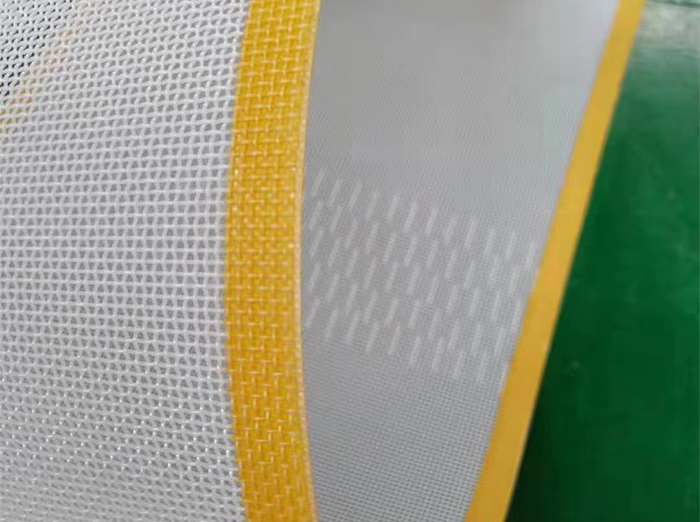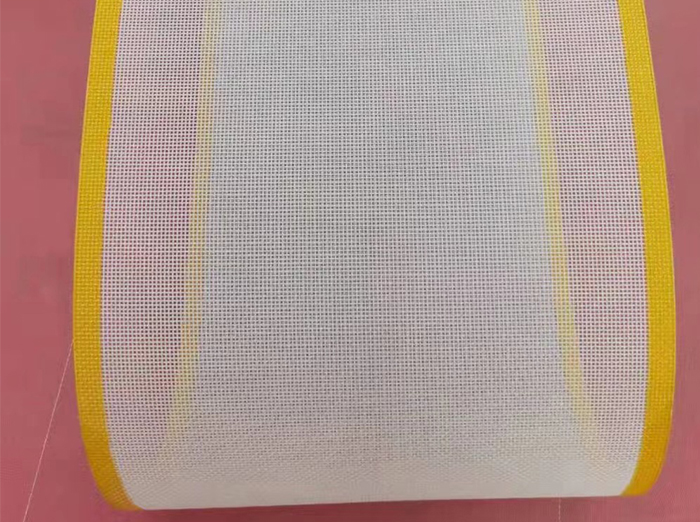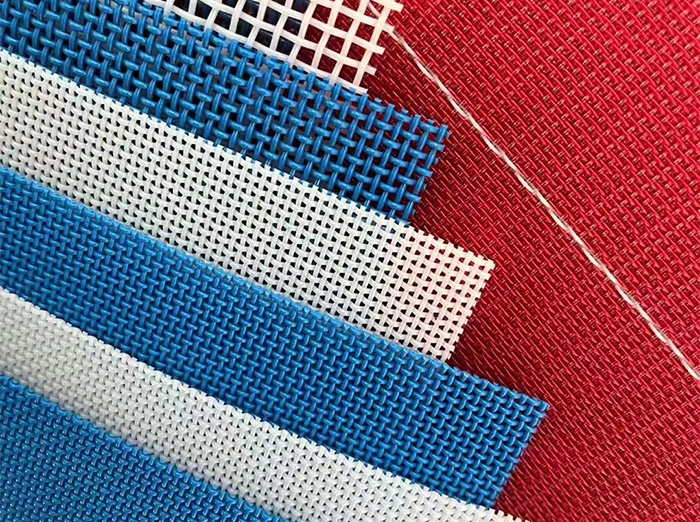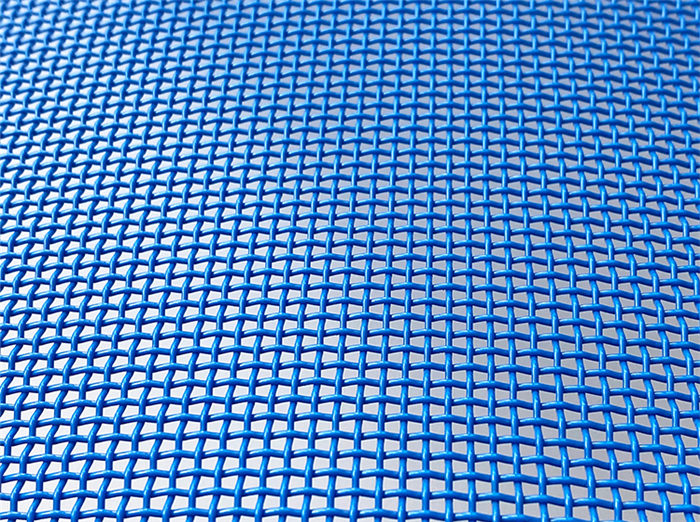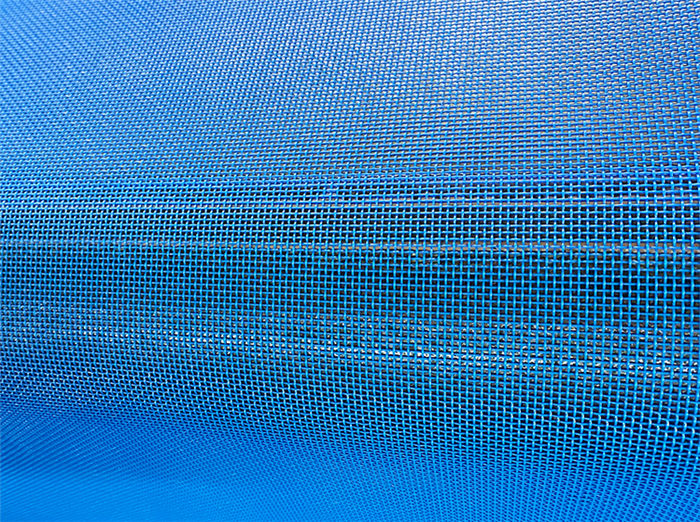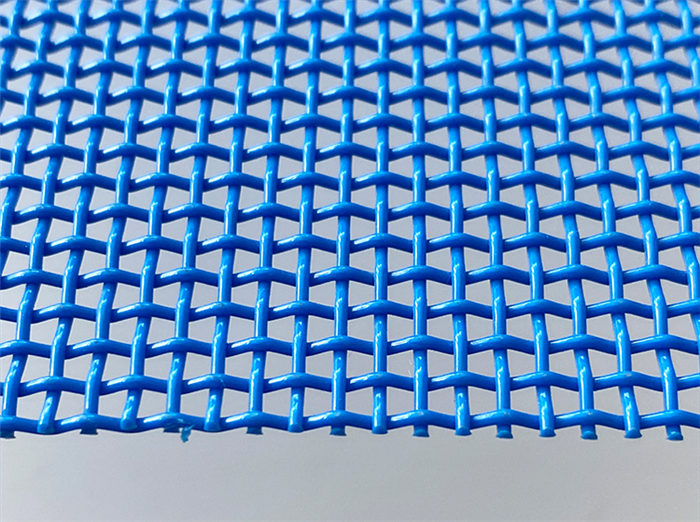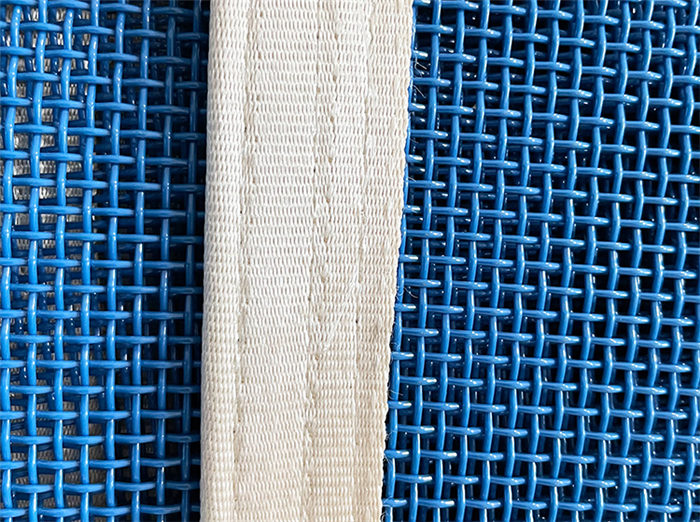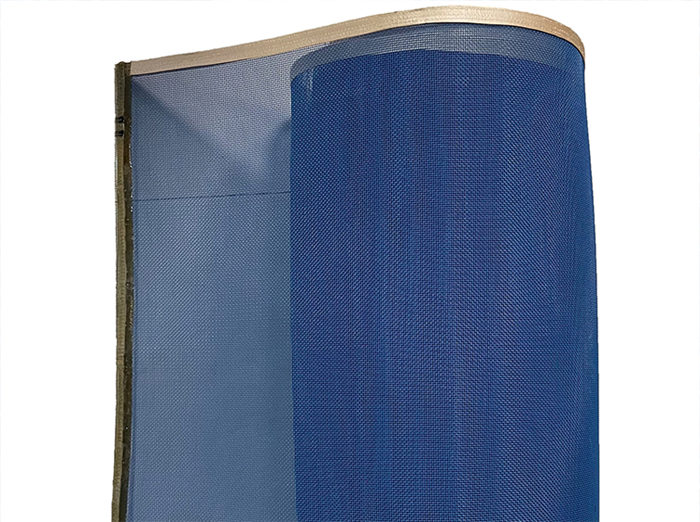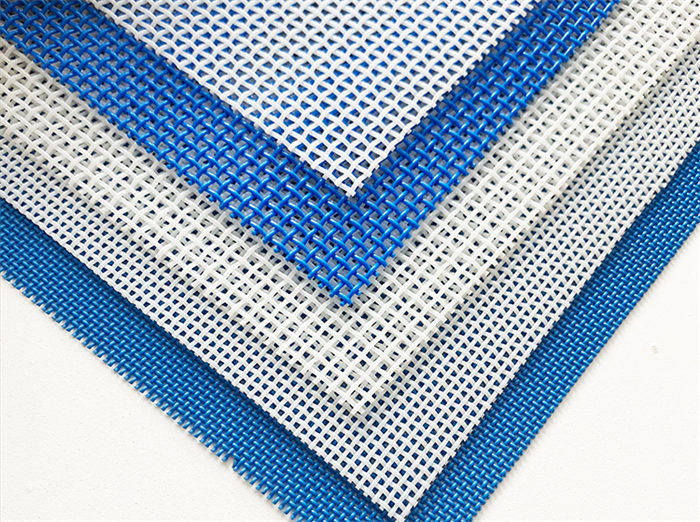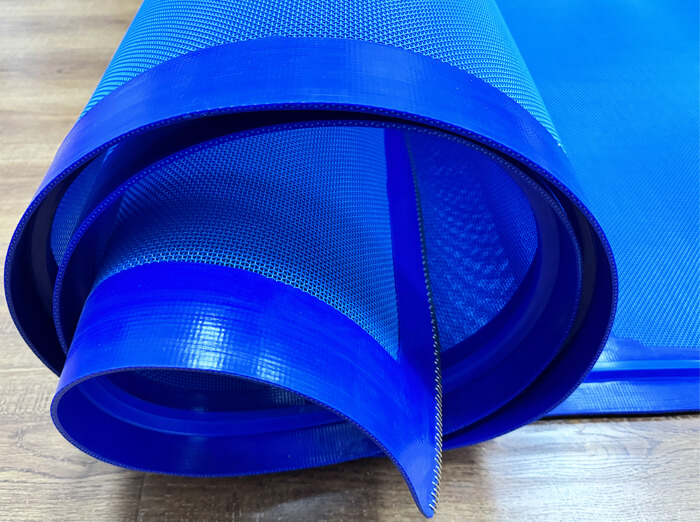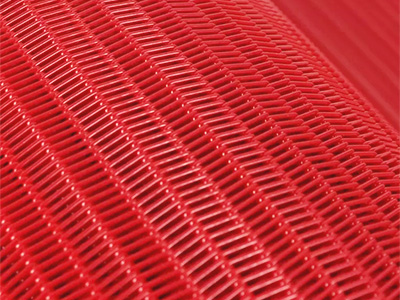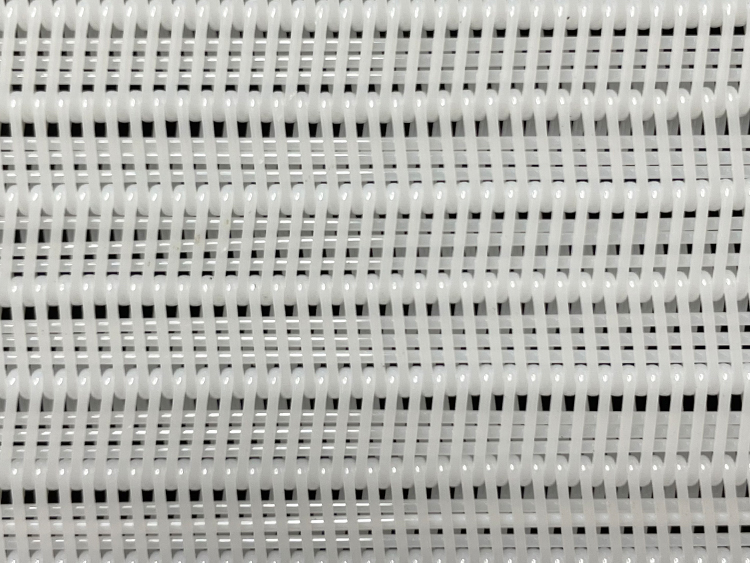
Polyester linear screen mesh conveyor belt — also called linear screen cloth or polyester plain weave filter belt. Made from 100% high-viscosity PET monofilament in 2-shed and 3-shed weave patterns. Aperture 0.4–5.0 mm, max width 5.6 m, working temperature -75°C to +150°C. US FDA & EU food contact (10/2011) compliant. Widely used in food processing, mineral washing, sludge dewatering, woodchip drying, and nonwoven production. All joint and edge types available. Inquire for a custom quote within 24 hours.
Description
2-Shed Plain Weave (Standard)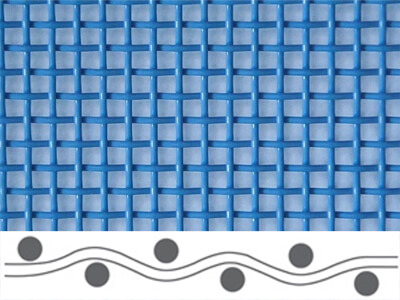 Best for: Food drying, fruit & vegetable washing, mineral screening, sludge dewatering — where filtration accuracy is the top priority. ● Precise square apertures for accurate particle classification and size separation ● High weave stability — consistent aperture accuracy across full belt width ● Smooth surface — easy cleaning, low product adherence ● Aperture: 400 µm to 5,000 µm (square or rectangular) | 3-Shed Twill Weave (Heavy-Duty)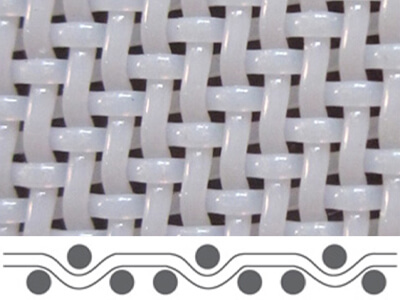 Best for: Woodchip drying, mineral processing, abrasive material conveying — where belt durability and dewatering speed matter most. ● Superior dewatering capacity vs. plain weave at equivalent aperture size ● Higher mechanical strength and wear resistance for abrasive conditions ● Longer service life under heavy load and continuous high-speed operation ● Anti-static yarn option available for static-sensitive processes |
Select the joint type that matches your equipment and operating conditions. All four methods are available for both 2-shed and 3-shed belts.
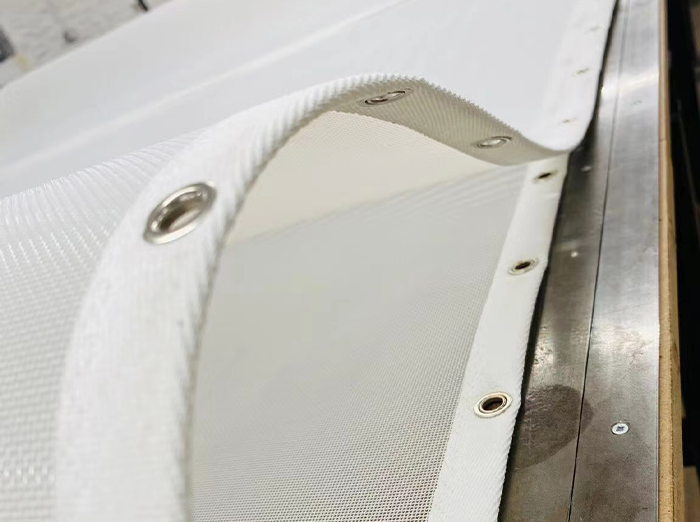
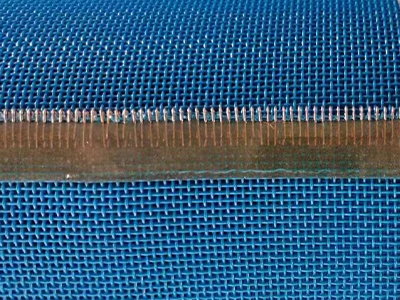 Metallic Clipper Quick installation; standard for most belt press and linear screen applications | 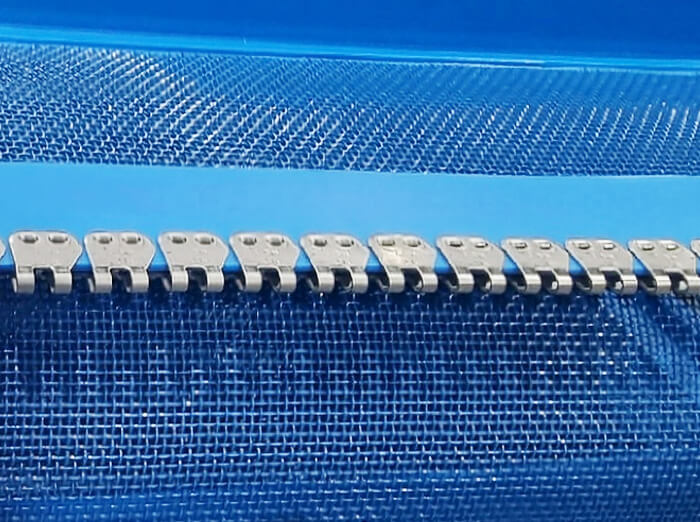 Staple Fastener Clipper Flat profile and enhanced grip for sensitive material conveying | 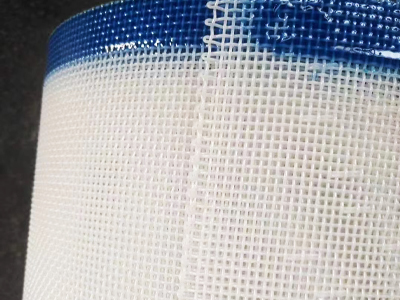 Integrated Spiral Ring Strong, hygienic joint for food-grade and high-tension applications | 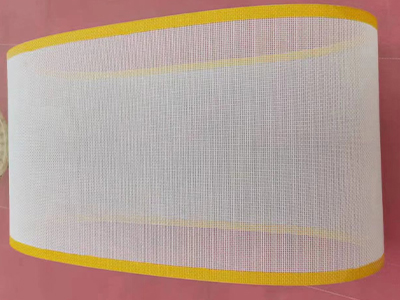 Seamless (Endless) No joint mark; ideal for critical filtration and surface-finish requirements |
All PFM Screen linear screen belts receive precision edge treatment to resist fraying and abrasion throughout their full service life.
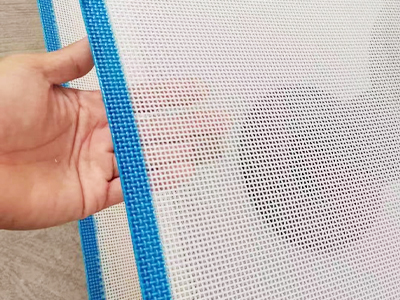 Glue Sealed Edge Resin-sealed for secure, anti-fray protection on standard applications | 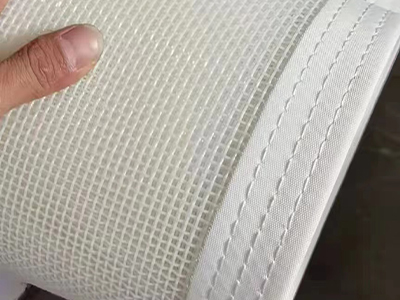 Sewn Edge High-durability stitched edge for heavy-duty industrial conveying | 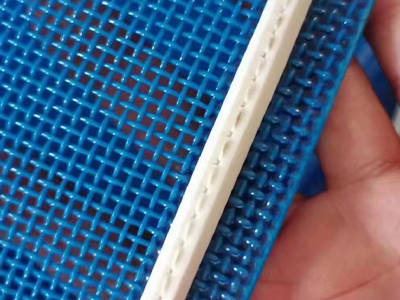 Tracking Guide Edge V-guide or tracking rope integrated to keep the belt centered under load | 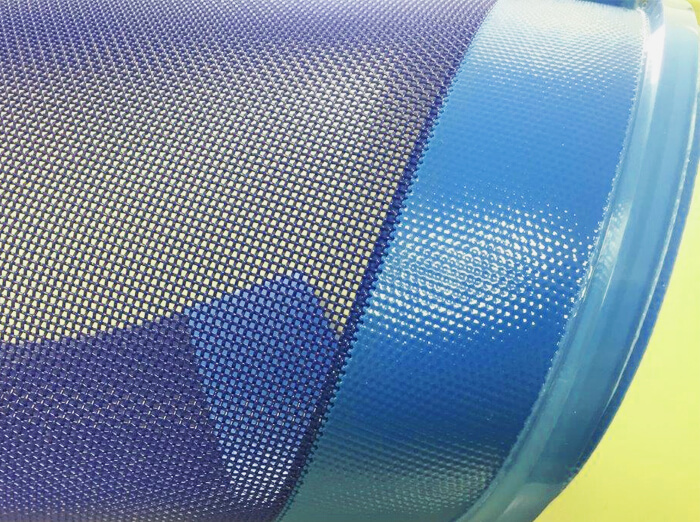 PVC / TPU Wrapping + V-Guide Maximum edge protection with integrated tracking for wide, high-speed belts |
| Material | Temp. Range | Recommended For |
| PET (Standard) | -75°C to +150°C | Food processing, mineral washing, sludge dewatering, wood industry — most standard applications |
| PA (Nylon) | Up to +120°C | High-alkalinity environments (pH > 11) — alkali-resistant belt press filter applications |
| PP (Polypropylene) | Up to +90°C | Very high pH (strong alkali), aggressive chemical filtration environments |
| PPS | Up to +250°C | High-temperature drying — woodchip, nonwoven, chemical industries |
| PET Hydrolysis-Resistant | Up to +160°C | High-temperature + high-humidity (steam, autoclave, hot-air bonding processes) |
Need a Custom Linear Screen Mesh Belt? Tell us your aperture size, belt width, belt length, working temperature, and machine type — our engineers will recommend the exact weave, material, and joint configuration within 24 hours. WhatsApp: +86 153 6967 9157Email: polyestermesh@pfmscreen.com |
Feature
PFM Screen has manufactured polyester mesh belts since 1987. Here is what 35+ years of product refinement delivers to your production line.
| ◈ Precision Uniform Aperture |
| Woven on heavy-duty rapier looms with tension-controlled warping, each belt maintains exact, repeatable mesh openings with minimal warp/weft tolerance variation — no loose wires in either direction. Consistent particle classification accuracy is guaranteed across the full belt width and throughout the belt's entire service life. |
| ◈ Thermal Setting for Dimensional Stability |
| Every belt is heat-set under controlled tension (140–200°C) to eliminate weaving stress, realign polymer chains, and lock in the belt's shape permanently. The result: minimal elongation in service, stable tracking on rollers, and consistent width throughout the belt's lifetime — even under high tension and continuous high-speed operation. |
| ◈ US FDA & EU Food Grade Certified |
| All belts are made from 100% first-quality, high-viscosity PET monofilament compliant with US FDA food contact regulations and EU Regulation No. 10/2011 & 1935/2004. SGS test certificates are available on request. The smooth surface and easy-clean properties make these belts the first choice for hygienic food processing environments. |
| ◈ Extended Service Life & Wear Resistance |
| Strong polyester fibers provide excellent stability and wear resistance for significantly extended media life vs. standard-quality competitors. The 3-shed twill weave option delivers even higher mechanical strength for abrasive conditions — reducing replacement frequency and lowering total cost of ownership on your production line. |
| ◈ All Joint & Edge Types Supported |
| Every joining method is available: metallic clipper, staple fastener, integrated spiral ring, pin ring, and seamless (endless). Edges can be resin-sealed, sewn, tracking-guided, or PVC/TPU-wrapped. All joint and edge types apply to both 2-shed and 3-shed belts — in roll fabric or fabricated endless belt form. |
| ◈ Wide Chemical & Temperature Resistance |
| Standard PET belts operate from -75°C to +150°C with excellent resistance to mineral acids and organic solvents. PPS yarn handles up to +250°C. PA (Nylon) for high-alkalinity environments. PP for very high-pH chemical filtration. Hydrolysis-resistant PET for high-temperature, high-humidity conditions up to +160°C. |
✓ US FDA Approved | ✓ EU 10/2011 Compliant | ✓ SGS Certificate Available | ✓ 35+ Years Manufacturing |
Application
PFM Screen linear screen belts serve six major industries worldwide. Each section shows recommended aperture sizes, compatible equipment, and why buyers choose PFM Screen.
01 — Food Processing, Drying & Washing | |
Applications: Fruit & vegetable washing and conveying, tunnel drying (pasta, snacks, seafood, soup powder), coffee roasting, tea drying, poultry processing, freezing conveyor, sugar/salt conveying, herb drying. Recommended Aperture: 500 µm, 1,000 µm, 2,000 µm, 3,000 µm (square mesh, blue color standard) PFM Screen Advantage: FDA & EU food contact certified (SGS report available). Smooth woven surface for easy cleaning and product release. Operating to 150°C. Precise aperture prevents product loss during drying or washing. | 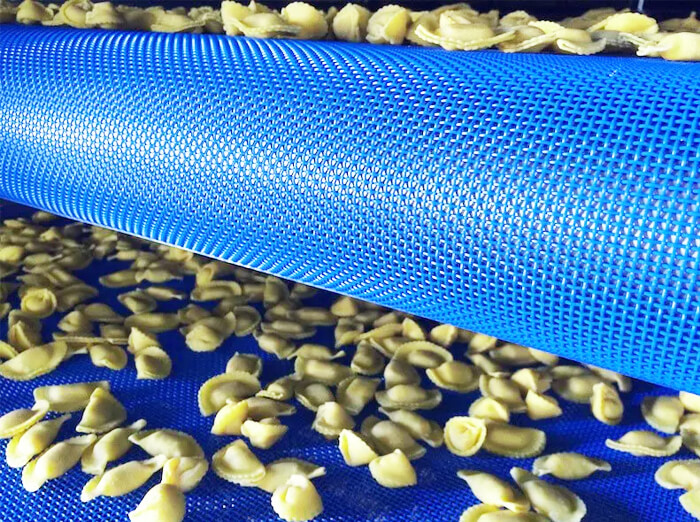 |
02 — Mineral Washing, Mining Slurry Screening & Separation | |
Applications: Coal washing, KCl/NaCl dewatering, gold CIP pre-filtering (removes 98%+ impurities from cyaniding slurry), mineral slurry screening, salt dewatering, gravel washing, kaolin filtering. Recommended Aperture: 400–2,000 µm (square: 400×400, 500×500, 600×600, 800×800, 1,000×1,000, 1,300×1,300, 2,000×2,000 µm; rectangular: 600×800, 500×1,400, 800×1,600 µm) PFM Screen Advantage: 3-shed twill for superior wear resistance against abrasive minerals. Chemical-resistant PET or PP yarn for acid/alkali slurries. 35+ years mining application knowledge. | 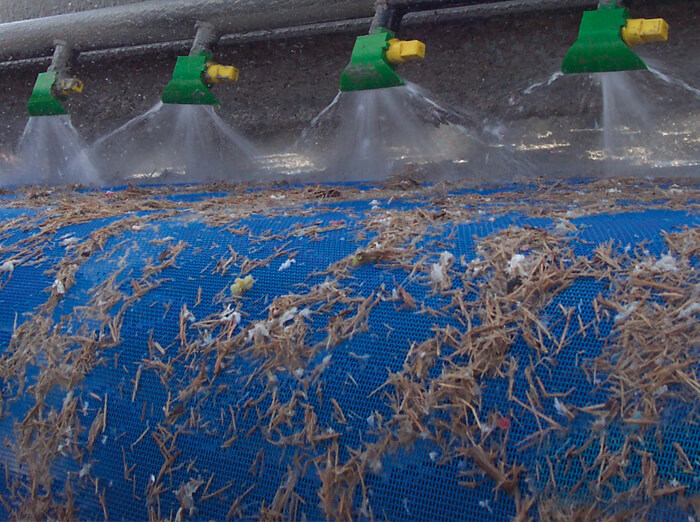 |
03 — Sludge Dewatering & Environmental Protection |
Applications: Belt press filters for municipal sludge dewatering, industrial wastewater treatment, paper mill sludge, FGD (flue gas desulfurization) slurry dewatering, chemical sludge treatment. Recommended Aperture: 400–1,600 µm — selected based on sludge type, solid content, and target cake dryness. PFM Screen Advantage: High throughput dewatering. Easy wash-down. Corrosion-resistant construction. Compatible with Andritz, Bellmer, HUBER, and other belt press brands. PA yarn option for high-alkalinity sludge (pH > 11). |
04 — Nonwoven Fabric Production | |
Applications: Hot-air through-bonding (TAB) forming belt, spunbond/meltblown laydown and forming belt, wetlaid process conveyor, airlaid forming belt, spunlace hydroentanglement conveyor. Recommended Aperture: 1,000–3,000 µm with high, uniform air permeability for consistent airflow through the fiber web. PFM Screen Advantage: Dimensionally stable under heat and tension. Anti-static yarn option for static-sensitive lines. Hydrolysis-resistant PET for high-humidity bonding. Compatible with Andritz, Reifenhäuser, Nordson, and other OEM equipment. | 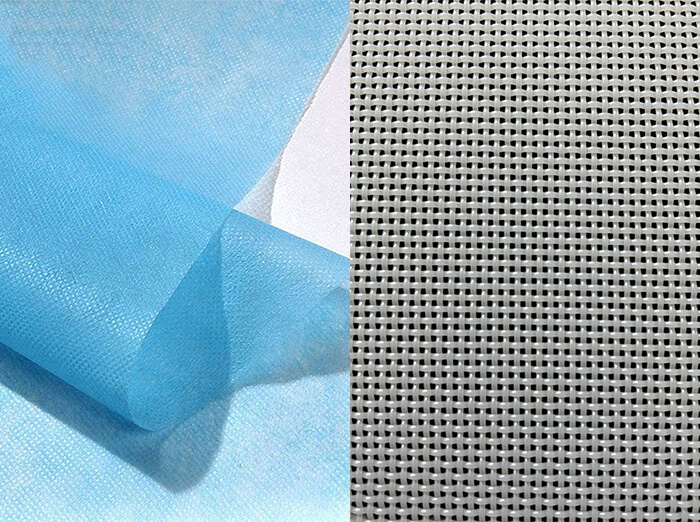 |
05 — Wood Industry — Particle Board, MDF/HDF, OSB Production |
Applications: Woodchip drying conveyor belt, particle board pre-press ventilation belt, MDF/HDF forming and drying belt, OSB mat forming belt, steam pre-heater spiral belt replacement. Recommended Aperture: 2,000–5,000 µm with high air permeability for efficient hot-air drying and uniform resin distribution. PFM Screen Advantage: 3-shed twill for maximum strength under press pressure. Anti-static yarn option available. Compatible with Siempelkamp, Dieffenbacher, Metso, and other continuous press OEM lines. |
06 — Pulp Board Making & Paper Industry Pre-Treatment |
Applications: Pulp board forming and dewatering conveyor, paper mill sludge dewatering, glass fiber mat production line, pulp washing mesh fabric. Recommended Aperture: 400–2,000 µm depending on fiber type and forming requirements. PFM Screen Advantage: 35+ years of paper machine clothing expertise from PFM Screen Group. Deep application engineering ensures correct belt specification for every pulp and paper application. |
Additional Applications: | ||
| ● Chemical industry conveying | ● Pharmaceutical drying | ● Material screening & classification |
| ● Glass fiber mat production | ● Aquaculture processing | ● Fruit & vegetable pre-cleaning |
Specifications
21 standard mesh configurations available in 2-shed plain weave and 3-shed twill weave. Standard warp tensile strength: 1,600 N/cm. Standard joint strength: 650 N/cm. Custom aperture, width, belt length, and special yarn material (PA, PP, PPS) available on request. Contact PFM Screen with your machine model and application details for a tailored specification.
| Model | Wire Dia. (mm) | Density (wire/cm) | Weight (kg/m²) | Thickness (mm) | Mesh Pitch Warp/Weft (threads/inch) | Aperture Warp/Weft (mm) | Permeability (m³/m²/h) | Open Area (%) | ||
|---|---|---|---|---|---|---|---|---|---|---|
| Warp | Weft | Warp | Weft | |||||||
| 021002 blue | 1.0 | 1.0 | 2.85 | 2.65 | 0.60 | 1.85 | 7.10 / 6.73 | 2.50 / 2.77 | 32,000 | 52.55% |
| 031002 blue/white | 1.0 | 1.0 | 3.2 | 3.25 | 0.80 | 1.86 | 8.10 / 8.20 | 2.12 / 2.07 | 25,600 | 45.90% |
| 03902 | 0.9 | 0.9 | 3.9 | 3.65 | 0.55 | 1.70 | 9.60 / 9.30 | 1.66 / 1.83 | 20,000 | 46.58% |
| 04902 | 0.9 | 0.9 | 4.65 | 4.70 | 0.95 | 1.66 | — | 1.25 / 1.22 | 17,600 | 33.55% |
| 04602 | 0.5 | 0.6 | 4.4 | 5.2 | 0.58 | 1.23 | 12.0 / 13.2 | 1.72 / 1.32 | 19,000 | 53.32% |
| 05602 | 0.6 | 0.6 | 5.9 | 5.6 | 0.62 | 1.10 | 14.98 / 14.2 | 1.09 / 1.18 | 18,000 | 42.89% |
| 05802 | 0.8 | 0.8 | 5.1 | 5.3 | 0.89 | 1.48 | 13.0 / 13.5 | 1.16 / 1.08 | 15,840 | 34.09% |
| 06652 | 0.65 | 0.65 | 7.4 | 6.8 | 0.65 | 1.19 | 18.8 / 17.3 | 0.70 / 0.82 | 14,400 | 28.96% |
| 06802 blue/white | 0.8 | 0.8 | 6.6 | 6.5 | 0.85 | 1.45 | 16.8 / 16.5 | 0.72 / 0.73 | 11,600 | 22.65% |
| 06702 blue/white | 0.7 | 0.7 | 7.0 | 7.0 | 0.77 | 1.30 | 17.8 / 17.8 | 0.72 / 0.72 | 11,000 | 26.01% |
| 07802 | 0.8 | 0.8 | 7.8 | 7.0 | 1.10 | 1.45 | 20.3 / 18.0 | 0.32 / 0.54 | 5,920 | 16.54% |
| 09502 | 0.5 | 0.5 | 9.7 | 10.3 | 0.50 | 0.90 | 25.0 / 26.2 | 0.53 / 0.47 | 10,100 | 24.97% |
| 012502 | 0.5 | 0.5 | 13.5 | 8.5 | 0.63 | 0.95 | 34.3 / 21.6 | 0.24 / 0.65 | 6,500 | 18.68% |
| 09452 | 0.45 | 0.45 | 10.0 | 8.6 | 0.45 | 0.88 | 25.4 / 21.8 | 0.55 / 0.71 | 15,570 | 33.71% |
| 08603 (3-shed) | 0.5 | 0.6 | 9.4 | 9.0 | 0.60 | 0.95 | 23.8 / 23.1 | 0.56 / 0.51 | 9,000 | 24.38% |
| 08502 | 0.5 | 0.5 | 9.5 | 8.6 | 0.89 | 0.47 | 24.13 / 21.8 | 0.50 / 0.65 | 10,140 | 29.93% |
| 06803 (3-shed) | 0.7 | 0.8 | 7.0 | 5.5 | 0.75 | 1.53 | 17.8 / 14.0 | 0.72 / 1.00 | 16,000 | 28.56% |
| PA061002 (Alkali) | 1.0 | 1.0 | 4.5 | 5.5 | 0.65 | 1.63 | 17.0 / 14.0 | 0.35 / 0.60 | 5,920 | 14.85% |
| 09603 (3-shed) | 0.5 | 0.6 | 10.5 | 9.2 | 0.65 | 1.05 | 26.67 / 23.4 | 0.45 / 0.48 | 8,300 | 44.87% |
| 07803 (3-shed) | 0.8 | 0.8 | 8.0 | 8.0 | 1.15 | 1.66 | 20.3 / 20.3 | 0.45 / 0.45 | 6,400 | 16.26% |
| 07903 (3-shed) | 0.8 | 0.9 | 7.6 | 6.5 | 1.25 | 1.76 | 19.3 / 16.5 | 0.51 / 0.63 | 9,184 | 12.96% |
* Models with suffix "03" are 3-shed twill weave; suffix "02" indicates 2-shed plain weave. PA061002 uses alkali-resistant nylon (PA) yarn. Mesh pitch data for model 04902 to be confirmed — contact PFM Screen for verified dimensions. All widths standard up to 5.6 m. All specifications subject to manufacturing tolerances.
Don't See the Model You Need? Send us your required aperture, belt width, belt length, and machine brand — we will match the right model or manufacture a custom belt to your exact specification. Quote turnaround: within 24 hours. WhatsApp: +86 153 6967 9157Email: polyestermesh@pfmscreen.com |
Q1: What is a polyester linear screen mesh belt? A polyester linear screen mesh belt — also called linear screen cloth, plain weave filter belt, or polyester monofilament conveyor belting — is a woven belt made from 100% PET monofilament yarn in a precise 1:1 plain weave. This produces uniform, defined mesh apertures for consistent particle separation, filtration, and conveying across demanding industrial environments. PFM Screen manufactures both 2-shed (plain weave) and 3-shed (twill weave) versions in aperture sizes from 0.4 mm to 5.0 mm. |
Q2: What is the difference between 2-shed and 3-shed polyester mesh belts? 2-shed plain weave produces uniform square apertures with high weave stability — best where filtration accuracy and precise particle classification are the top priority, such as food drying, fruit and vegetable washing, and mineral screening. 3-shed twill weave delivers superior dewatering capacity and significantly higher wear resistance, making it better suited to heavy-duty applications such as woodchip drying, MDF/HDF forming, and abrasive mineral processing. At equivalent aperture size, the 3-shed belt dewaters faster and lasts longer under mechanical stress. |
Q3: What aperture sizes are available, and which is right for my application? PFM Screen offers aperture sizes from 0.4 mm to 5.0 mm (400–5,000 µm), in square mesh, rectangular mesh, or custom configurations. General selection guide: ● Fruit & vegetable washing: 500–3,000 µm (square mesh, blue) ● Mineral washing / mining slurry: 400–2,000 µm ● Sludge dewatering (belt press): 400–1,600 µm ● Wood industry / MDF drying: 2,000–5,000 µm ● Nonwoven fabric production: 1,000–3,000 µm Not sure which aperture to select? Send PFM Screen your machine model and material type — we will specify the correct belt within 24 hours. |
Q4: Are PFM Screen linear screen mesh belts FDA-approved and food grade? Yes. PFM Screen's polyester linear screen mesh belts are manufactured from 100% first-quality, high-viscosity PET monofilament fully compliant with US FDA food contact regulations and EU Regulation No. 10/2011 & EC 1935/2004. SGS test certificates are available on request. The smooth woven surface is easy to clean and resistant to product adhesion — ideal for hygienic food processing, drying, and washing applications. |
Q5: What is the operating temperature range? Standard PET polyester linear screen belts operate from -75°C to +150°C. For higher temperature requirements: ● PPS yarn: up to +250°C — for high-temperature industrial drying processes ● Hydrolysis-resistant PET: up to +160°C — for high-temperature, high-humidity environments ● PA (Nylon): up to +120°C — for alkaline environments (pH > 11) ● PP (Polypropylene): up to +90°C — for very high pH or aggressive chemical environments |
Q6: What joint types and edge treatments are available? PFM Screen offers four belt joining options: metallic clipper seam (quick, widely compatible), staple fastener clipper (flat profile for sensitive conveying), integrated spiral ring seam (hygienic, high-tension food-grade), and seamless (endless) (no joint mark for critical filtration). Edge treatment options include: glue sealed edge (resin-sealed, standard), sewn edge (high-durability stitched), tracking guide edge (V-guide or tracking rope), and PVC/TPU wrapping + V-guide (maximum protection for wide, high-speed belts). All combinations are available for both 2-shed and 3-shed constructions. |
Q7: Can PFM Screen manufacture custom polyester mesh belts? Yes. We manufacture belts to any combination of: aperture size (0.4–5.0 mm, square or rectangular), belt width (up to 5.6 m), belt length (any circumference for endless belts), yarn material (PET, PA, PP, PPS, hydrolysis-resistant PET), weave pattern (2-shed or 3-shed), color (blue, white, or custom), and any joint and edge type. To request a custom quote, please provide your machine brand and model, belt dimensions, required aperture size, operating temperature, and preferred joint type. Quote response: within 24 hours. Production lead time: typically 1–3 weeks. |
Q8: Do you supply roll fabric or fabricated endless belts — and what is the lead time? PFM Screen supplies both: roll fabric (hot-melt sealed edges, no joint) for buyers who fabricate belts locally, and fully fabricated endless belts (with selected joint type, edge treatment, and tracking guides installed) ready to mount on your machine. Standard models in stock ship in 3–7 days. Fabricated endless belts with standard dimensions: 2–4 weeks. Fully custom specifications: 3–6 weeks depending on complexity. Worldwide shipping by express courier, air freight, or sea freight. |
Still Have Questions? Contact PFM Screen Directly. Our technical team responds within 24 hours with a recommendation tailored to your machine model, process conditions, and required specifications. No commitment required. WhatsApp: +86 153 6967 9157Email: polyestermesh@pfmscreen.com |