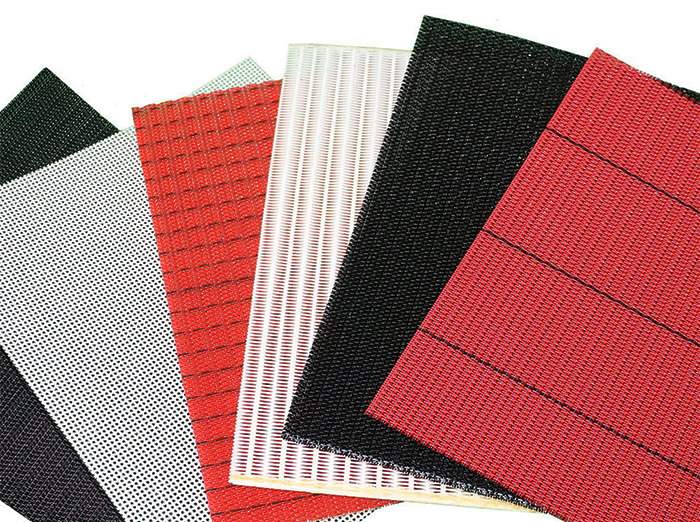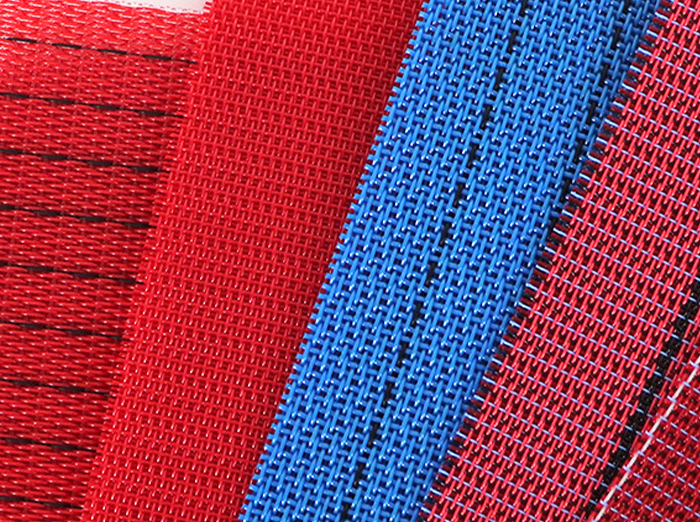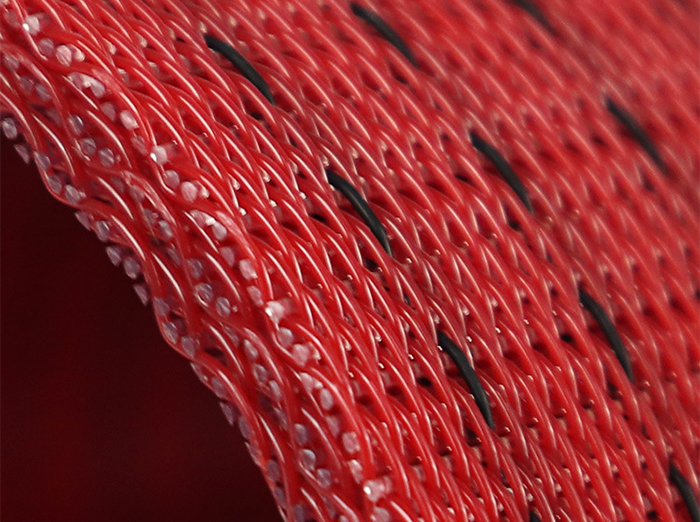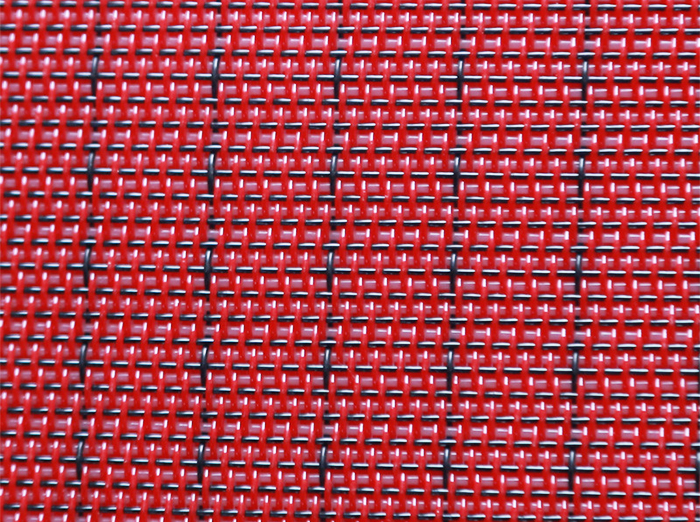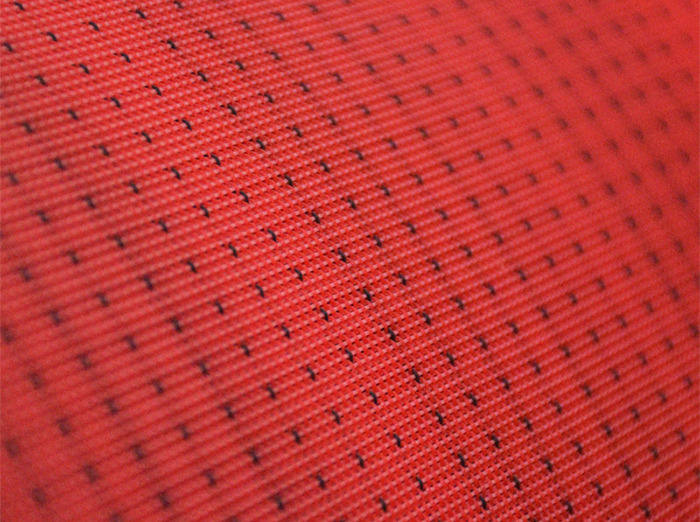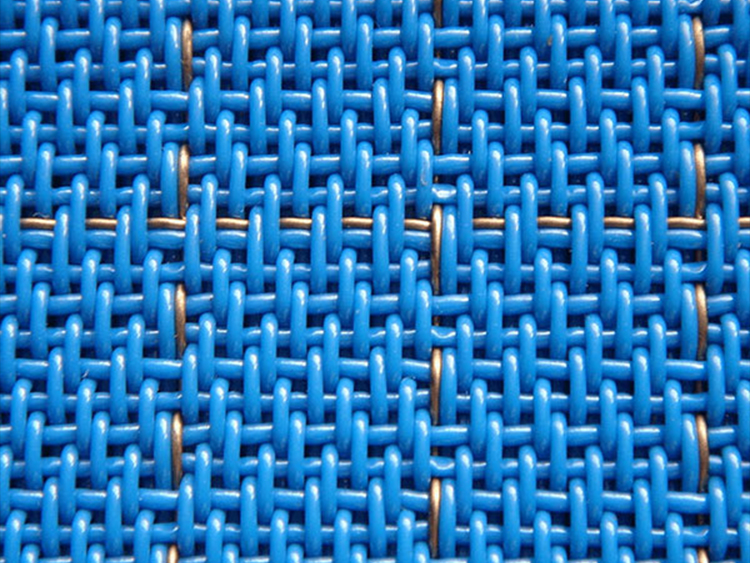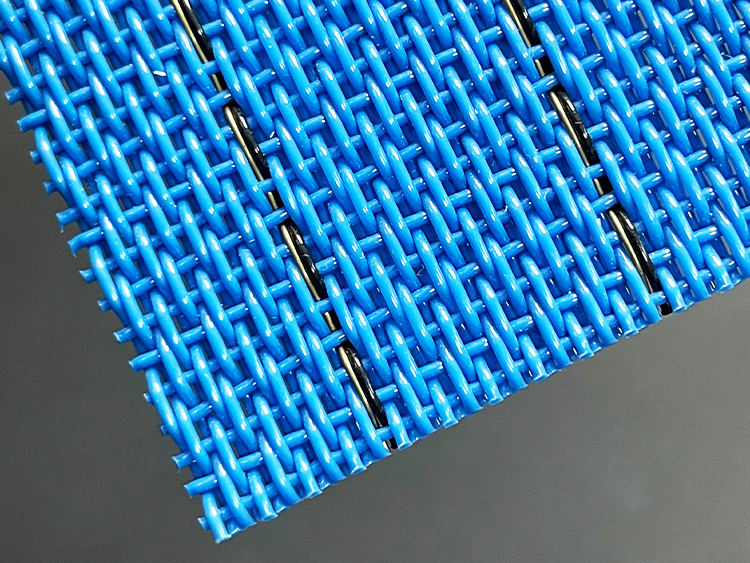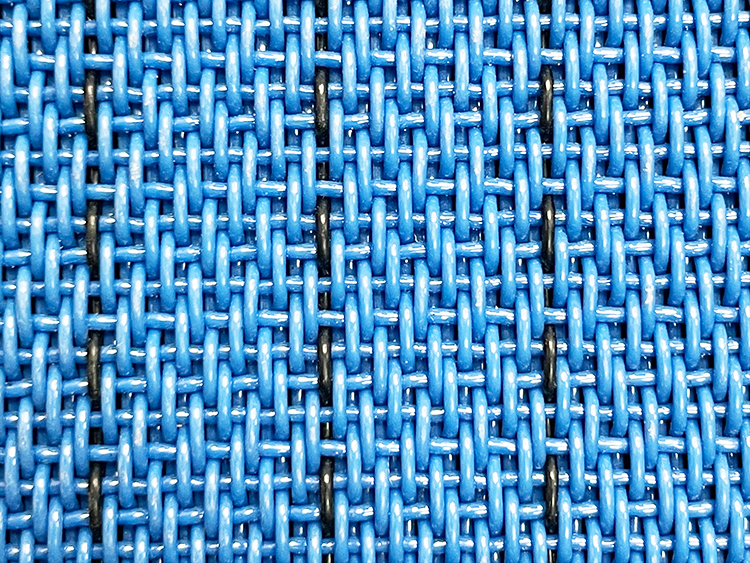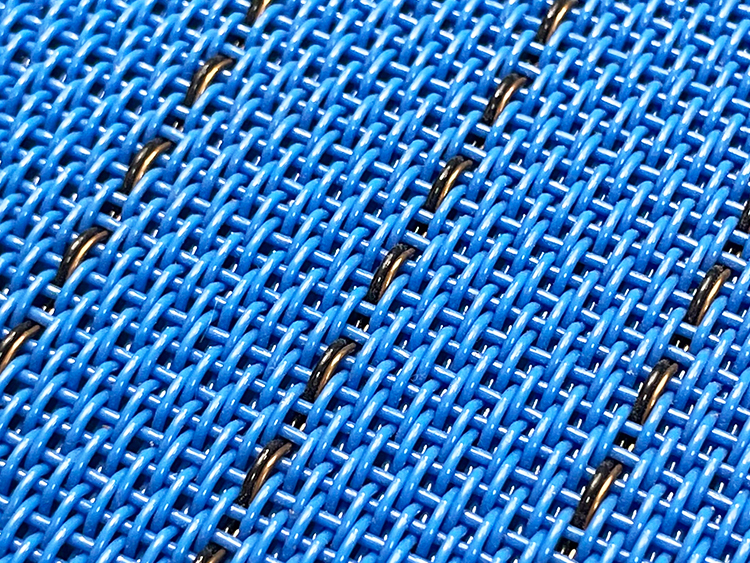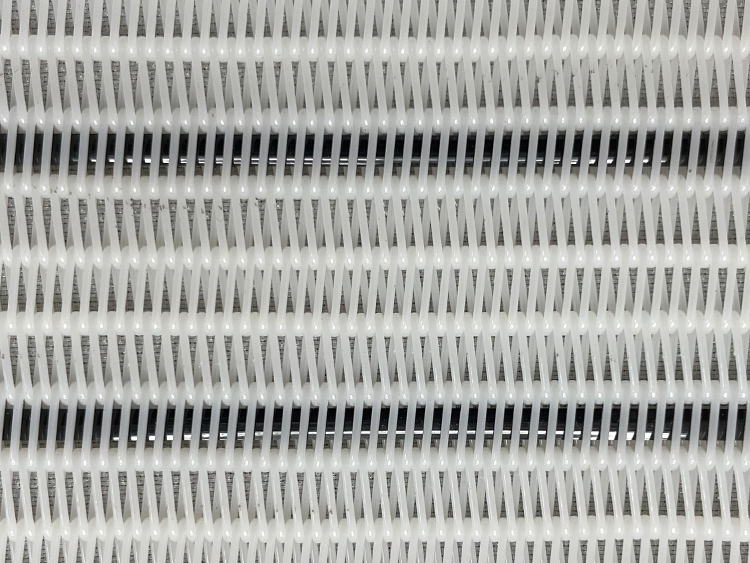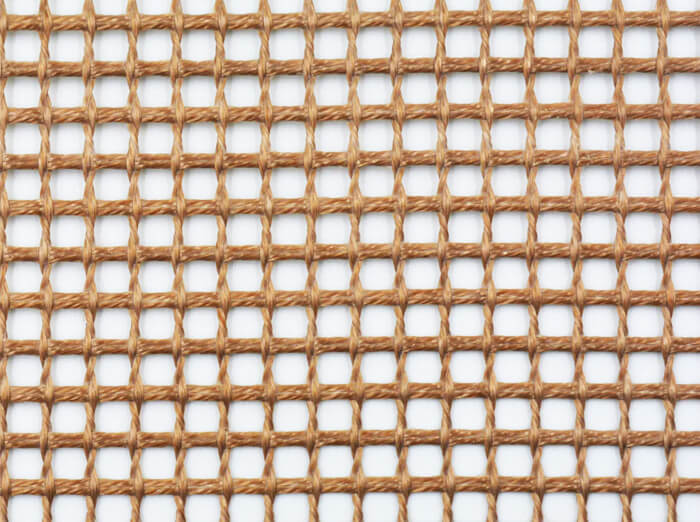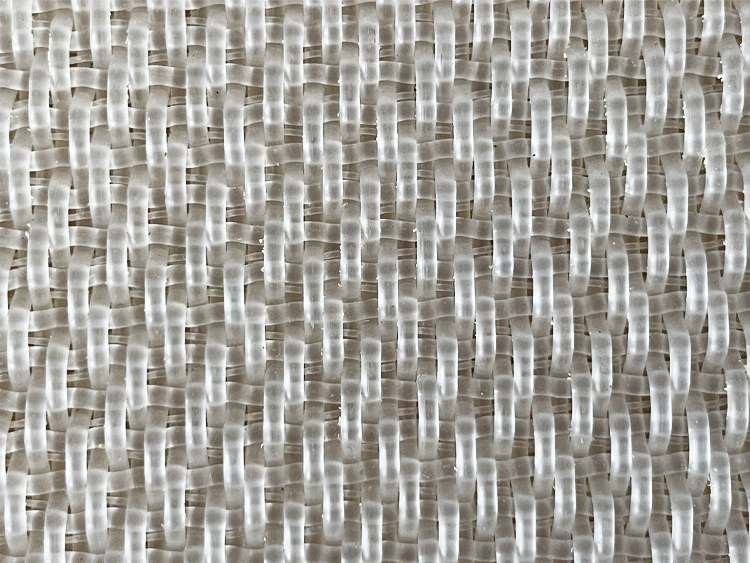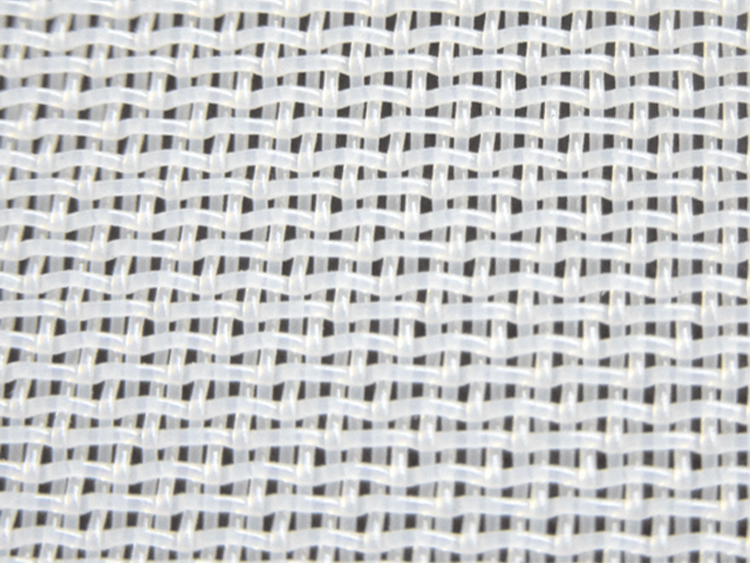
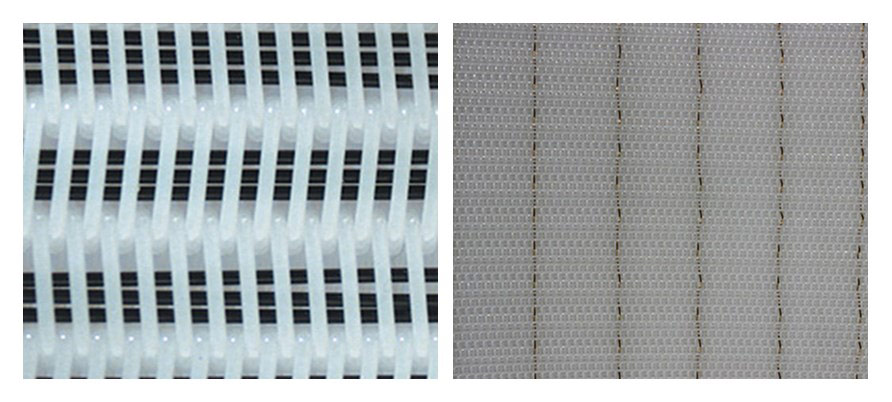
PFM Screen's Anti-Static Conveyor Mesh Belts are precision-woven from PET (polyester) monofilament interlaced with conductive carbon wire, bronze wire, or copper/stainless steel wire. Designed for high-speed, electrostatic-sensitive production lines — including MDF/HDF/particleboard mat forming and pre-pressing, airlaid, spunlaid, wetlaid and drylaid nonwoven forming, chemical fiber processing, and dust-free paper manufacture.
Description
PFM Screen's Anti-Static Conveyor Mesh Belts are precision-woven from high-quality PET (polyester) monofilament interlaced with conductive carbon wire, bronze wire, or copper/stainless steel wire. Engineered for high-speed electrostatic-sensitive production lines — including MDF/HDF fiberboard mat forming and pressing, airlaid, spunlaid, wetlaid and drylaid nonwoven forming, chemical fiber processing, and dust-free paper manufacture — these belts reliably intercept, dissipate, and discharge surface static electricity at the source. All standard models comply with ATEX Group II, Category 3G and 3D requirements for use in explosive dust and gas atmospheres.
When polyester mesh belts run at high speed against slider beds, processed fibrous materials, or dry ionized air, friction generates continuous electrostatic charges. Although the quiescent current is typically low in intensity, the consequences can be severe:
01 Fire & Explosion Risk Spark discharge in dusty MDF mat forming or dry fiber environments can ignite airborne combustibles — a deflagration hazard requiring ATEX-rated equipment | 02 Product Quality Loss Lightweight fibers, polymer particles, and fine dust adhere to a charged belt surface — reducing product uniformity, consistency, and yield across the entire run | 03 Operator & Equipment Risk Personnel touching the belt or conveyed materials risk electrical shock. Static discharge to electronic control systems can cause sensor faults and equipment damage |
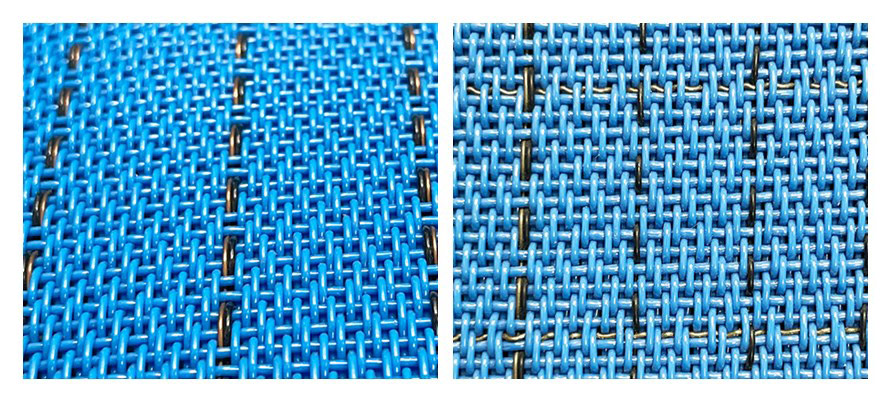
PFM Screen's antistatic mesh belts embed conductive wire threads directly into the woven polyester fabric structure, uniformly distributed throughout belt width and length. When static charges accumulate on the belt surface during high-speed operation, the conductive network provides a continuous low-resistance discharge path — draining static electricity to grounded machine frames before localized charge buildup can reach dangerous levels.
Surface conductivity of ≥5,000 Ω·cm ensures reliable static dissipation across all operating conditions — including low-humidity environments where conventional polymer belts lose their surface conductivity entirely.
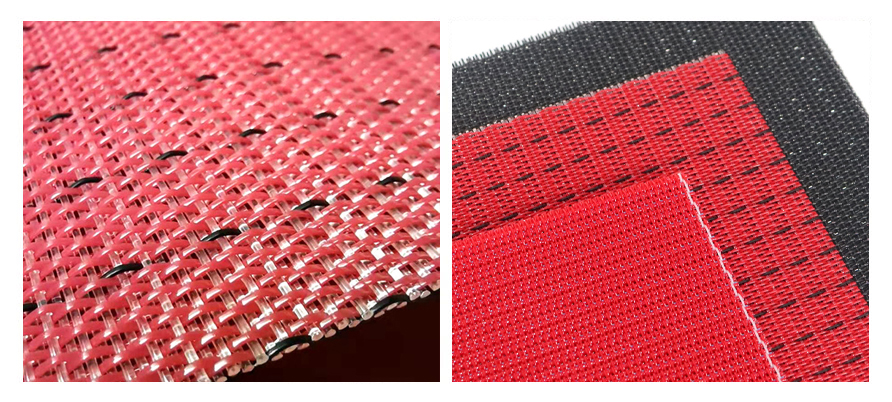
PFM Screen offers three conductive wire options. Selection depends on process temperature, chemical environment, and required conductivity level:
Carbon Wire ● Most widely used, cost-effective ● Excellent static dissipation in standard and low-humidity conditions ● Good resistance to acids and organic solvents ● Suitable for MDF mat forming, spunbond and meltblown lines ● Operating temperature: up to 150°C continuous | Bronze Wire ● Higher conductivity in humid process environments ● Excellent tensile strength in the conductive thread ● Preferred for wetlaid nonwoven and high-humidity drying lines ● Good resistance to organic solvents ● Operating temperature: up to 150°C continuous | Copper / Stainless Steel Wire ● Highest conductivity available ● Recommended for severe ATEX environments (Cat 3G/3D) ● Excellent corrosion resistance (stainless steel option) ● Used in chemical fiber, rubber, and industrial applications ● Contact PFM Screen to confirm material and specification |
ATEX Group II Applies to surface industry equipment (non-mining). Covers processes where combustible gases, vapors, mists, or dusts may be present — including wood fiber mat forming, nonwoven production, chemical fiber processing, and rubber manufacturing. | Category 3G & 3D Category 3G: Explosive gas or vapor atmosphere. Category 3D: Explosive dust atmosphere. Both represent zones where an explosive atmosphere is unlikely to occur in normal operation but may occur in abnormal conditions. PFM Screen antistatic belts satisfy both categories — essential for MDF mat forming (wood dust) and spunbond/airlaid lines (airborne polymer fibers). |
Specify Your Antistatic Belt — Get a 24-Hour Quote Tell us your belt width, application (MDF/nonwoven/other), conductor type preference, required air permeability, and operating temperature. PFM Screen will recommend the right model and return a full specification and price within one business day. WhatsApp: +86 153 6967 9157Email: polyestermesh@pfmscreen.com |
Feature
⚡ ATEX Certified Meets ATEX Group II, Category 3G (explosive gas) and 3D (explosive dust) — mandatory for wood fiber and nonwoven process environments | ▶ ≥5,000 Ω·cm Conductivity Permanent static dissipation at all humidity levels — unlike surface-treatment antistatic belts that lose conductivity in dry conditions | ⇆ 2,976 — 20,000 m³/m²h Widest air permeability range across 9 models — tunable to your exact ventilation, mat forming, and dewatering requirements | ≅ Dimensional Stability Heat-set post-treatment delivers low thermal shrinkage and elongation — straight belt tracking, minimum deviation at high operating speeds |
Antistatic & Electrical Performance ● Surface conductivity: ≥5,000 Ω·cm (area, all models) ● Conductive threads woven uniformly throughout width and length ● Permanent antistatic effect — independent of ambient humidity ● ATEX Group II, Category 3G (gas) and 3D (dust) compliant ● Eliminates localized charge buildup and spark discharge risk | Ventilation & Air Flow ● Air permeability range: 2,976 to 20,000 m³/m²h across 9 standard models ● Uniform open area prevents clogging and uneven flow channeling ● Tight warp/weft connection maintains stable mesh geometry under load ● Smooth surface: good product release at belt end, easy cleaning ● Slip-resistant weave pattern on process contact surface |
Mechanical & Structural Strength ● Tensile strength: ≥1,600 to ≥2,200 N/cm (warp direction, by model) ● Excellent wear resistance for long service life at continuous high-speed operation ● Thicker weft yarn option for enhanced transverse bending resistance and anti-fold ● Heat-set structure: low shrinkage and elongation at operating temperature ● Straight tracking with minimum lateral deviation under high-speed continuous runs | Chemical & Environmental Resistance ● Good resistance to acids and organic solvents ● Good moisture resistance for humid drying environments ● Operating temperature: up to 150°C continuous ● Stable in dry, dusty, and moderate-humidity process environments ● UV-stable polyester fiber for high-light-exposure installations |
PFM Screen antistatic mesh belts are available with three joining configurations. Joining method affects product mark risk, installation convenience, and belt tension capability:
| Joining Method | How It Works | Best Application | Product Mark Risk |
| Pin Seam (Spiral) | Woven spiral loops joined by removable pin — enables installation/removal on closed-frame machines without disassembly | Standard fiberboard and nonwoven forming lines; easy field replacement | Minimal with correct alignment |
| Double Pin Seam | Dual-row pin joint for higher-tension applications; invisible when properly aligned and closed | Wide belts or high-speed lines with elevated warp tension | Very low |
| Endless Woven | Belt woven as a single continuous loop — no joint hardware, no seam mark, seamless product contact surface | High-quality nonwoven, dust-free paper, no-mark required applications | None |
Request Samples or Technical Datasheet PFM Screen can provide belt samples, conductor type confirmation, and ATEX compliance documentation on request. Contact our technical team with your application details for immediate assistance. WhatsApp: +86 153 6967 9157Email: polyestermesh@pfmscreen.com |
Application
PFM Screen antistatic conveyor mesh belts serve as the mat forming belt, pre-press conveying belt, and deaeration belt in two major industrial groups: wood-based panel manufacturing (MDF/HDF/Particleboard/OSB) and nonwoven fabric production (airlaid, spunlaid, wetlaid, drylaid, spunbond/meltblown). In both applications, the belt runs in direct contact with loose, highly mobile fiber or particle masses at high conveying speeds — exactly where friction-induced static charge presents the greatest hazard.
Wood Fiber Prep Refiner / Blowline | → | Mat Forming Antistatic forming belt | → | Pre-press / Deaeration Antistatic conveying belt | → | Continuous Hot Press ContiRoll / CPS / CPS+ | → | Panel Output |
■ Orange stages: primary antistatic belt application zones. ContiRoll is a trademark of Siempelkamp GmbH; CPS/CPS+ are trademarks of Dieffenbacher GmbH.
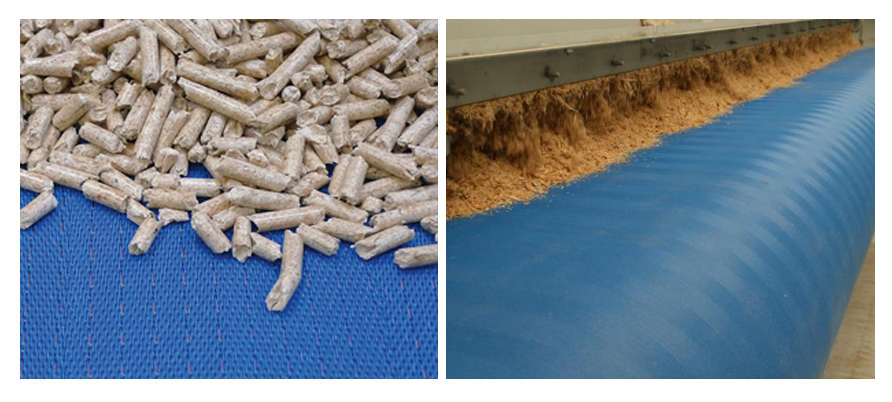
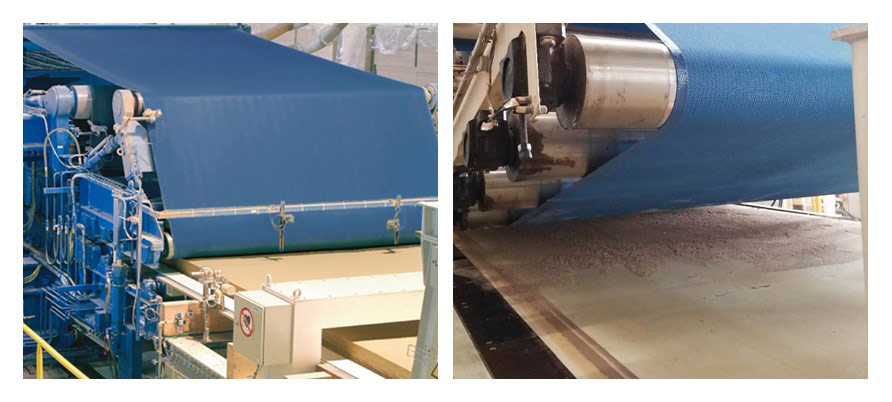 | Panel Types Covered: ● MDF (Medium-Density Fibreboard) — fine wood fiber mat forming, highest static risk in panel production ● HDF (High-Density Fibreboard) — elevated fiber density increases static accumulation risk ● Particleboard / Chipboard — wood chip mat forming and deaeration before continuous press ● OSB (Oriented Strand Board) — larger strand mat forming with antistatic deaeration belt ● Wood Biomass & Sawdust Drying — dryer conveyor belt for wood shavings, sawdust, and biomass ● Dust-Free Paper — continuous mat conveying in dry papermaking (airlaid pulp lines) |
The following continuous press and line systems are used in wood-based panel production and are routinely equipped with antistatic forming or pre-press conveying belts. This table is provided as a compatibility reference based on machine design characteristics, not as a certified OEM partnership.
| Press Manufacturer | Key System / Series | Panel Type | Belt Application Zone | Typical Model |
| Siempelkamp | ContiRoll Gen. 8 / Gen. 9 | MDF, HDF, Particleboard, OSB | Mat forming belt, deaeration / pre-press belt | 14804 / 14708 / anti-static |
| Dieffenbacher | CPS / CPS+ Continuous Press | MDF, Particleboard, OSB | Mat forming belt, infeed conveying belt | 14804-1 / 31505 / anti-static |
| SWPM | Shandong Wantai Continuous Press | MDF, HDF, Particleboard | Mat forming and pre-press conveying | 14804 / 14708 / anti-static |
| Stela Laxhuber | Band Dryer / Conveyor Dryer Systems | Wood chip, sawdust, biomass | Dryer conveyor belt (antistatic) | 4080 / 4106 / anti-static |
| Grenzebach | MDF / OSB Forming Line | MDF, OSB | Mat forming and conveying | 14804 / 31505 / anti-static |
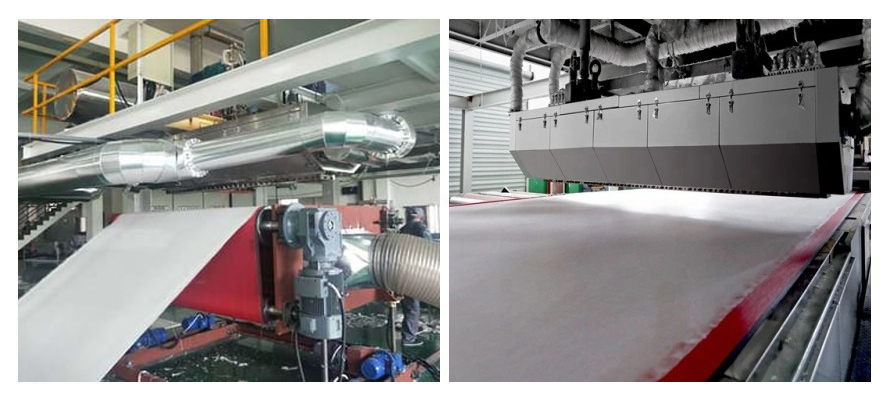 | Nonwoven Process Coverage: ● Airlaid — fiber deposition forming belt; high static from air-fiber friction during web formation ● Spunlaid / Spunbond — filament web forming belt; polymer fiber highly susceptible to static buildup ● Meltblown — fine fiber capture belt; electrostatic charge directly affects web basis weight uniformity ● Wetlaid — wet web forming and dewatering conveying under continuous tension ● Drylaid / Carded — carded fiber web conveying, highest static generation risk among nonwoven processes ● Chemical Fiber — continuous pre-pressing and forming in fiber production and drying lines |
Antistatic forming and conveying belts have been used across a wide range of nonwoven production systems. The following covers common equipment configurations by process type. Contact PFM Screen to confirm belt specification for your specific line.
| Equipment Supplier | Process Type | Belt Function | Key Belt Requirement |
| Andritz (Asselin-Thibeau, Diatec) | Airlaid, Spunlace, Wetlaid | Web forming belt, suction conveyor belt | High air permeability + reliable antistatic |
| Reifenhäuser (Reicofil) | Spunbond, Meltblown, SMS / SMMS | Filament web forming and collection belt | Antistatic + even fiber deposition surface |
| Trützschler Nonwovens | Airlaid, Drylaid, Carded | Card web conveying belt | Antistatic + high dimensional stability |
| Oerlikon Neumag | Spunbond, Meltblown | Web formation and conveying belt | Antistatic + low thermal elongation |
| Laroche | Airlaid, Drylaid | Fiber mat forming belt | Antistatic + adjustable air permeability |
Chemical Fiber Production Used as pre-pressing and conveying belt in chemical fiber drying and processing. Antistatic properties prevent fiber accumulation on belt surfaces and reduce product contamination risk. | Rubber & Chemical Industry Applied in processing environments with flammable or explosive materials. ATEX Group II, Cat 3G/3D compliance ensures safe operation where conventional belts are a regulatory risk. | Environmental & Industrial Filtration Used in industrial filter mat production, dust collection line conveying, and environmental filtration where static charge must be controlled during fiber mat formation or material handling. |
Confirm Belt Compatibility for Your Production Line Share your press or line manufacturer, belt width, process type, and operating temperature. PFM Screen will confirm the right antistatic belt model and provide a formal quotation within 24 hours. WhatsApp: +86 153 6967 9157Email: polyestermesh@pfmscreen.com |
Specifications
All models incorporate conductive carbon or bronze wire woven uniformly throughout the PET monofilament fabric. Surface conductivity ≥5,000 Ω·cm (area). ATEX Group II, Category 3G and 3D compliant. Contact PFM Screen to confirm warp/weft density data marked with * where final confirmation is required.
| Model | Warp Dia (mm) | Weft Dia (mm) | Warp Density (w/cm) | Weft Density (w/cm) | Strength (N/cm) | Permeability (m³/m²h) | Conductivity (Ω·cm) |
| 12708 / anti-static | 0.46x0.68 (Flat) | 0.70 | 14.1 | 7.3 | ≥2,000 | 8,000 | ≥5,000 |
| 14708 / anti-static | 0.64 | 0.70 | 15.0 | 8.0 | ≥2,000 | 11,200 | ≥5,000 |
| 14804 / anti-static | 0.65 | 0.80 | 14.8 | 7.2 | ≥2,000 | 6,800 | ≥5,000 |
| 14804-1 / anti-static | 0.65 | 0.80 | 14.8 | 7.2 | ≥2,000 | 6,800 | ≥5,000 |
| 31505 / anti-static | 0.40 | 0.50 | 33.0 | 9.0 | ≥1,600 | 2,976 | ≥5,000 |
| 4106 / anti-static | 0.50 | 0.50 | 23.0 | 12.0 | ≥2,000 | 6,800 | ≥5,000 |
| 4106-3 / anti-static | 0.50 | 0.30 / 0.70 | 22.8 | —* | ≥2,200 | 8,000 | ≥5,000 |
| 4080 / anti-static | 0.90 | 1.10 | —* | —* | ≥2,000 | 20,000 | ≥5,000 |
| L201005T / anti-static | 0.65 / 0.35 | 1.00 | 20.6 | 5.1 | ≥2,000 | 7,678 | ≥5,000 |
* Contact PFM Screen to confirm density data for models 4106-3 and 4080. All specifications subject to manufacturing tolerances. Custom mesh specifications and widths available on request. Maximum standard width: 4,600 mm.
Q1: What is an antistatic conveyor mesh belt, and how does it dissipate static electricity? An antistatic conveyor mesh belt is a woven synthetic fabric belt in which conductive wire threads — typically carbon, bronze, or copper/stainless steel — are interlaced directly into the polyester (PET) monofilament weave structure. When the belt runs at high speed in contact with fibrous materials, slider beds, or dry ionized air, friction generates electrostatic charges on the belt surface. The embedded conductive threads provide a continuous low-resistance discharge path that drains these charges to grounded machine frames before they accumulate to hazardous levels. Unlike surface-coated antistatic treatments that degrade over time or lose conductivity in dry conditions, woven-in conductive threads deliver permanent, humidity-independent antistatic performance throughout the belt's service life. |
Q2: What does ATEX Group II, Category 3G and 3D mean for a conveyor belt, and why does it matter? ATEX is the European directive governing equipment for use in potentially explosive atmospheres. Group II covers surface industry equipment (excluding mines). Category 3G means the equipment is suitable for zones where an explosive gas or vapor atmosphere is unlikely to occur in normal operation but may occur in abnormal conditions (Zone 2). Category 3D covers zones where explosive dust atmospheres may occasionally be present (Zone 22). For wood-based panel production and nonwoven manufacturing, airborne wood fiber dust, polymer particles, and dry fine fibers create precisely these conditions. Using a non-ATEX-rated belt in such environments creates both a regulatory compliance gap and a real safety hazard. PFM Screen's antistatic mesh belts comply with both ATEX Group II Category 3G and 3D, making them the correct specification for MDF mat forming, airlaid, spunbond, and similar dusty or fiber-rich process zones. |
Q3: What is the difference between carbon wire, bronze wire, and copper/stainless steel wire in antistatic belts? All three conductor types achieve ATEX-compliant static dissipation, but performance profiles differ by environment. Carbon wire is the most widely used option — cost-effective, chemically resistant to acids and organic solvents, and excellent for standard dry process environments including MDF mat forming and spunbond lines. Bronze wire offers higher conductivity in humid or wet-process environments and has superior tensile strength in the conductive thread, making it the preferred choice for wetlaid nonwoven lines or high-humidity drying systems. Copper and stainless steel wire deliver the highest possible conductivity and are selected for severe ATEX environments, chemical process lines, or applications where maximum electrical discharge speed is required. PFM Screen offers all three options and can advise on the right choice based on your operating environment and conductivity requirements. |
Q4: What surface conductivity specification is required for antistatic process belts in nonwoven and fiberboard production? For process belts used in ATEX-rated zones (Group II, Category 3G/3D), surface conductivity below 10^9 ohms per square (or equivalent area conductivity) is the general threshold for reliable static dissipation that prevents spark generation. PFM Screen's antistatic mesh belts achieve a surface conductivity of ≥5,000 Ω·cm (area measurement), which places them firmly in the static-dissipative range at all standard operating humidity levels. This conductivity is achieved by the physical presence of conductive wire threads woven into the fabric — not by humidity-dependent surface treatments or antistatic coatings — ensuring consistent performance even in very dry environments where conventional antistatic finishes fail. |
Q5: Which nonwoven production processes require an antistatic forming belt, and why? All major nonwoven formation processes generate significant friction-induced static because they involve high-speed movement of lightweight synthetic or natural fibers. Spunbond and meltblown processes generate the highest static levels because extruded polymer filaments carry a natural electrostatic charge that concentrates on the forming belt. Airlaid processes create intense air-fiber friction as fibers are air-deposited onto the forming belt at high velocity. Drylaid/carded processes generate static through mechanical fiber-to-fiber and fiber-to-belt contact at high conveying speeds. Wetlaid processes generally carry lower static risk but still benefit from antistatic belts in the dry end of the line. In all these processes, a standard polyester belt without conductive threads allows charge to build until product defects appear (uneven fiber distribution, fiber clumping, surface contamination) or spark discharge creates a fire risk. An antistatic forming belt intercepts and dissipates these charges continuously during operation. |
Q6: Are PFM Screen's antistatic mesh belts compatible with Siempelkamp ContiRoll and Dieffenbacher CPS press lines? PFM Screen antistatic forming and pre-press belts are designed to the specifications used in continuous press lines from leading manufacturers including Siempelkamp (ContiRoll Gen. 8/9) and Dieffenbacher (CPS/CPS+ series). The mat forming and deaeration belt position in these systems requires specific air permeability, tensile strength, and dimensional stability — all of which PFM Screen's belt models are engineered to deliver. Model 14804/anti-static and 14708/anti-static are frequently specified for Siempelkamp-based MDF/HDF lines; model 14804-1/anti-static and 31505/anti-static are common for Dieffenbacher configurations. PFM Screen's technical team will confirm the exact model, width, and joining method for your specific press system after reviewing your drawings or belt specification sheet. Contact PFM Screen with your press type, working width, and panel product for confirmation. |
Q7: Which joining method — pin seam, double pin seam, or endless woven — is recommended for an antistatic process belt? The best joining method depends on your machine geometry, production priorities, and whether product mark-free performance is critical. Pin seam joining uses a woven spiral loop and removable pin wire — it allows installation and removal on closed-frame machines without disassembly, and is the most common choice for standard MDF forming lines and nonwoven processes where periodic belt replacement is expected. Double pin seam uses a dual-row joint for higher tension applications and provides very low mark risk when correctly aligned. Endless woven (seamless) construction eliminates all joint hardware and delivers zero mark risk — it is the premium specification for high-quality nonwoven lines, dust-free paper production, and any application where even a minimal seam mark on the product is unacceptable. PFM Screen manufactures all three joining types and can advise on which is appropriate for your conveyor geometry and process requirements. |
Q8: What information do I need to provide when ordering a custom antistatic mesh belt from PFM Screen? To receive an accurate quotation and model recommendation, please provide the following: (1) Belt working width (mm) and required endless circumference or open length; (2) Application — process type (MDF mat forming, spunbond, airlaid, etc.) and the position of the belt in your production line; (3) Operating temperature and process humidity conditions; (4) Required air permeability (m³/m²h) if known, or the press/line manufacturer and model number so PFM Screen can reference standard specifications; (5) Preferred conductor wire type (carbon/bronze/copper/stainless steel) or leave to PFM Screen's recommendation; (6) Preferred joining method (pin seam/double pin seam/endless); (7) Quantity required and target delivery date. There is no fixed minimum order quantity. PFM Screen accepts orders from a single replacement belt to full-volume production runs. Standard lead time is 2 to 4 weeks after specification confirmation. Contact PFM Screen via WhatsApp (+86 153 6967 9157) or email (polyestermesh@pfmscreen.com) — a formal quotation is returned within 24 hours. |
Ready to Order? Get Your Custom Antistatic Belt Quote in 24 Hours Send us your belt width, application, conductor wire preference, and process details. PFM Screen will respond with a full model recommendation, specification, and pricing within one business day. WhatsApp: +86 153 6967 9157Email: polyestermesh@pfmscreen.com |