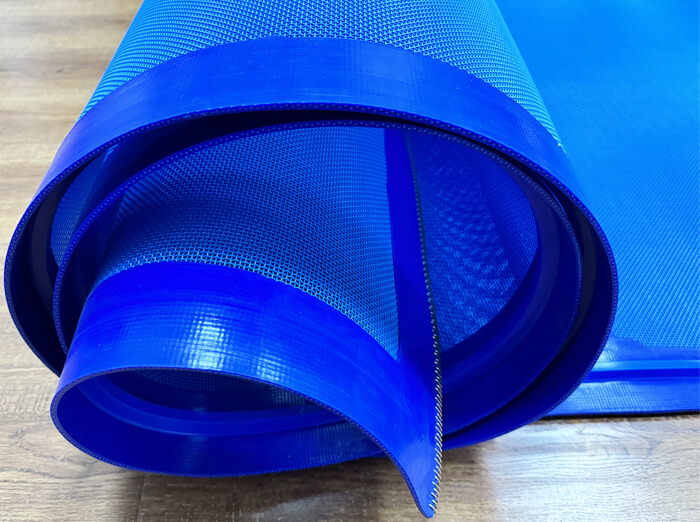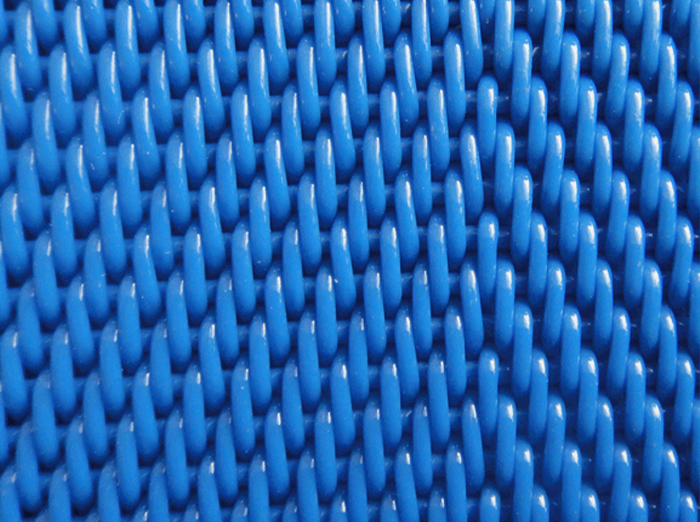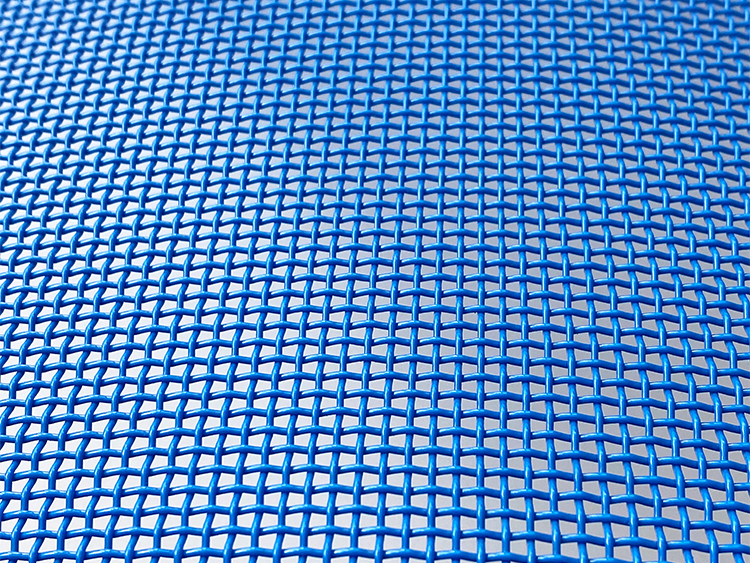
PFM Screen's Reinforced Polyester Dewatering Mesh Conveyor Belts are precision-woven from stable monofilament polyester fibers with TPU or PVC heat-sealed edge reinforcement. Delivering superior filtration, dewatering, and drainage performance, these FDA and EC compliant belts are trusted by food processors worldwide for fruit and vegetable washing, pasta drying, seafood processing, and dairy filtration. Available in 21 standard mesh configurations — with custom widths, cleats, V-guides, and joining methods tailored to your production line. Request your custom specification within 24 hours.
Description
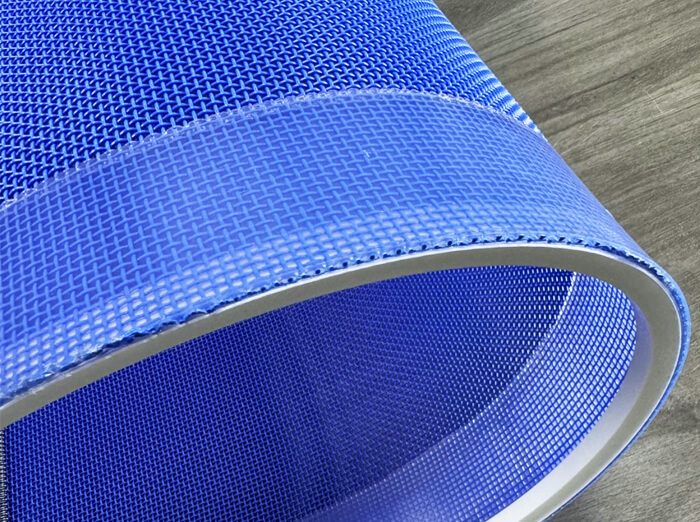
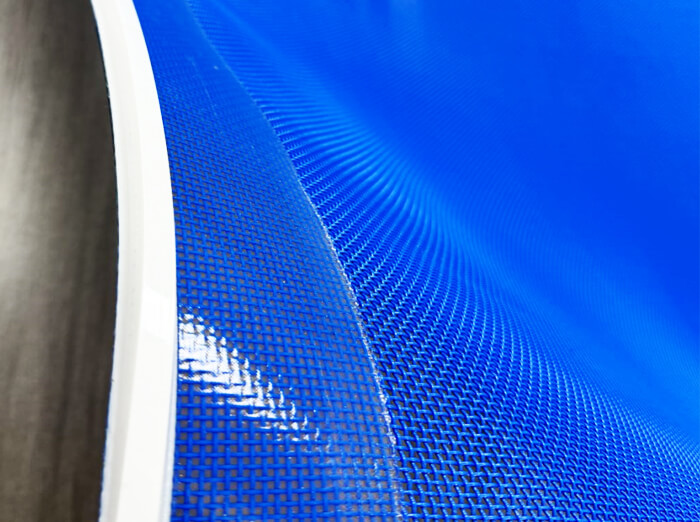
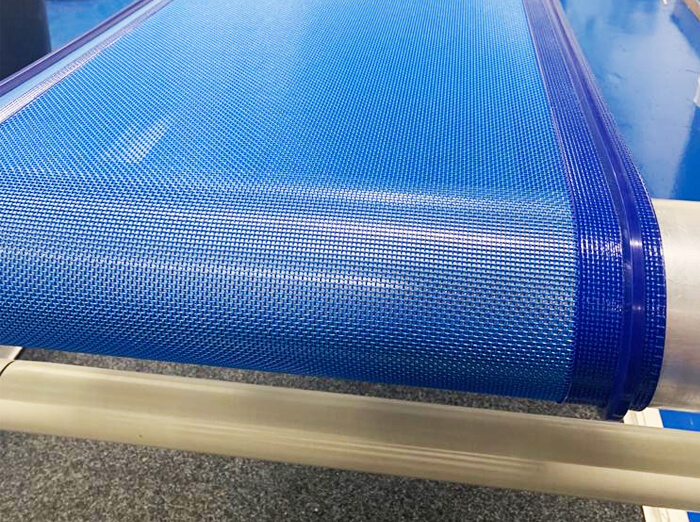
PFM Screen's Reinforced Polyester Dewatering Mesh Conveyor Belts are precision-woven from stable monofilament polyester fibers in an open-mesh structure engineered for superior filtration, dewatering, drainage, and conveying across demanding food processing and industrial environments. Lateral and end reinforcements in TPU (thermoplastic polyurethane) or PVC (polyvinyl chloride) provide a heat-sealed edge that prevents fiber fraying, blocks contamination, and meets FDA 21 CFR and EU EC 1935/2004 food-contact regulations.
By adjusting monofilament diameter and weave density, PFM Screen engineers mesh size, aperture, open area percentage, and liquid/air permeability to match your exact process requirements — from coarse vegetable-washing meshes to fine dairy-filtration fabrics. Belts are delivered endless or with mechanical joints, and can be equipped with cleats, V-guides, and weft reinforcement threads.
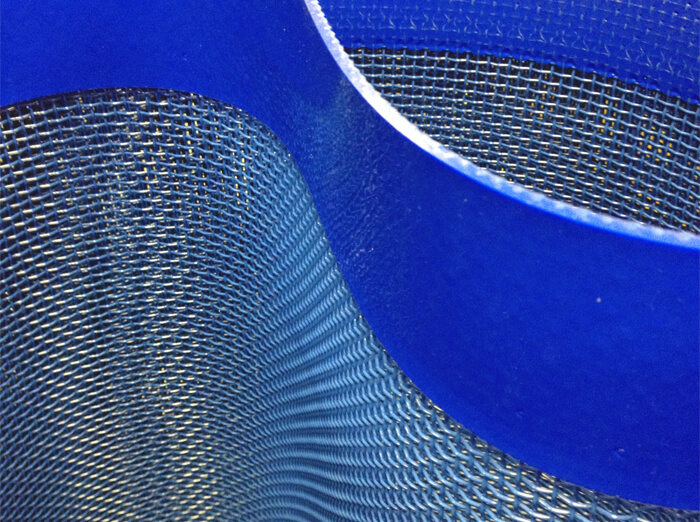 PVC Sealed Edge ● Cost-effective rigid edge protection ● Excellent resistance to oils and greases ● Suitable for standard dewatering and industrial conveying ● Available in solid or transparent finish | 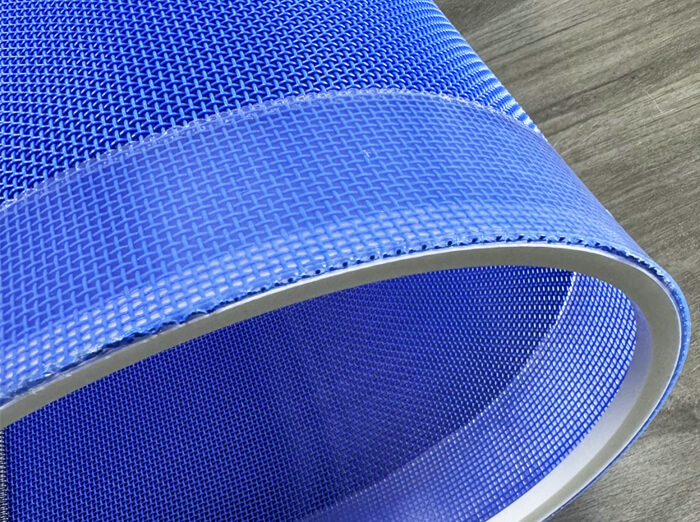 TPU Sealed Edge — Recommended for Food Processing ● FDA 21 CFR and EU EC 1935/2004 certified for direct food contact ● Superior flexibility — reliable performance through CIP wash cycles ● Resistant to hydrolysis and microbial growth ● Preferred for fruit, vegetable, dairy, seafood, and pasta lines |
PFM Screen's proprietary heat-sealing process encases belt edges in urethane or PVC, forming an airtight hygienic barrier that delivers four critical performance advantages:
01 Blocks Contamination Seals out bacteria, moisture, oil, and foreign particles from the belt edge structure | 02 Stops Fiber Fraying Encapsulates all edge yarns — eliminates fiber contamination risk in food products | 03 Enhances Drainage Sealed edge profile improves fluid flow and enables direct-on-belt product rinsing | 04 Maintains Flexibility Sealed edges flex with belt movement — no cracking or delamination under continuous operation |
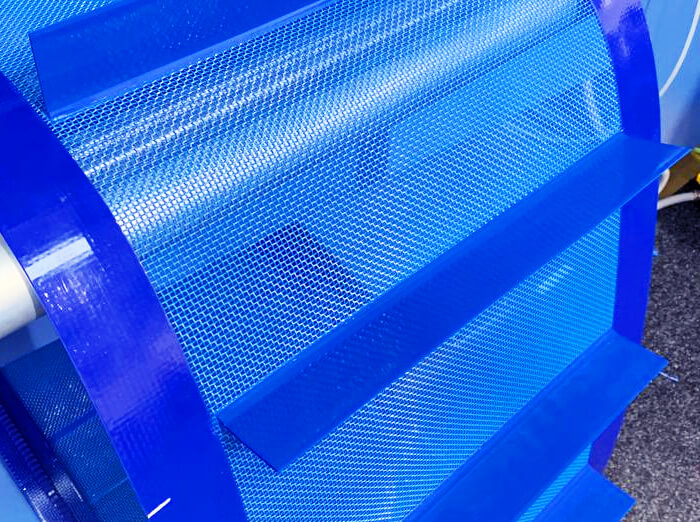
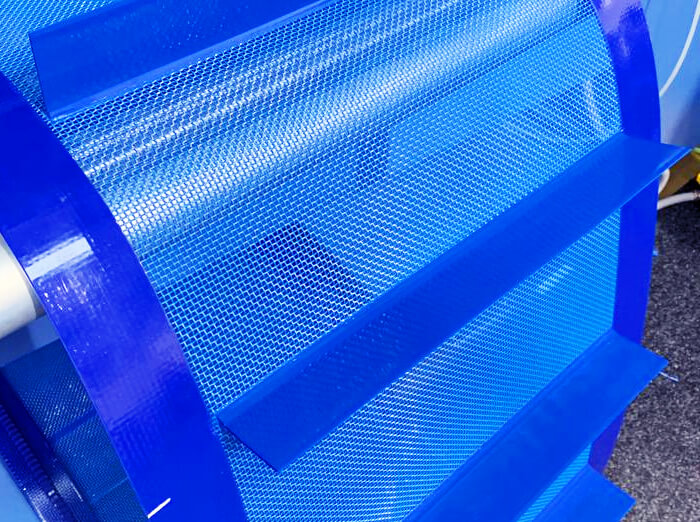 Belt with Cleats / Baffles Prevents product rollback on inclined conveyor sections |  Belt with V-Guides Longitudinal tracking guides ensure precise belt alignment and eliminate lateral drift |
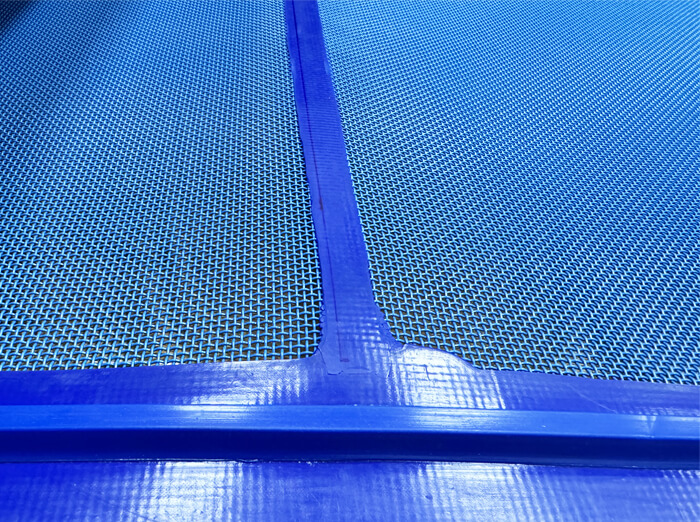 Weft Reinforcement Cross-direction reinforcement threads add tear resistance and dimensional stability under high tension | Custom to Your Conveyor Line ● Belt width: 300 mm to 12,000 mm+ ● 21 standard mesh specs + custom mesh dimensions ● Endless or mechanical joint configuration ● Optional cleats, V-guides, weft reinforcement threads ● Alkali-resistant PA nylon fiber variant available ● TPU (food-grade) or PVC edge seal to your specification |
Get a Custom Belt Specification Within 24 Hours Share your required belt width, mesh size, application, and edge type — PFM Screen will engineer the right belt for your line. WhatsApp: +86 153 6967 9157Email: polyestermesh@pfmscreen.com |
Feature
Edge & Transverse Reinforcement TPU or PVC heat-sealed lateral edges prevent fraying and contamination. Optional transverse (weft) reinforcement threads provide added cross-direction stability and tear resistance for high-tension conveying applications. | Custom Mesh Dimensions Available in 21 standard specifications with wire diameters from 0.45 mm to 1.0 mm. Open area percentage, aperture size, and permeability are engineered to match your exact filtration or dewatering process requirements. |
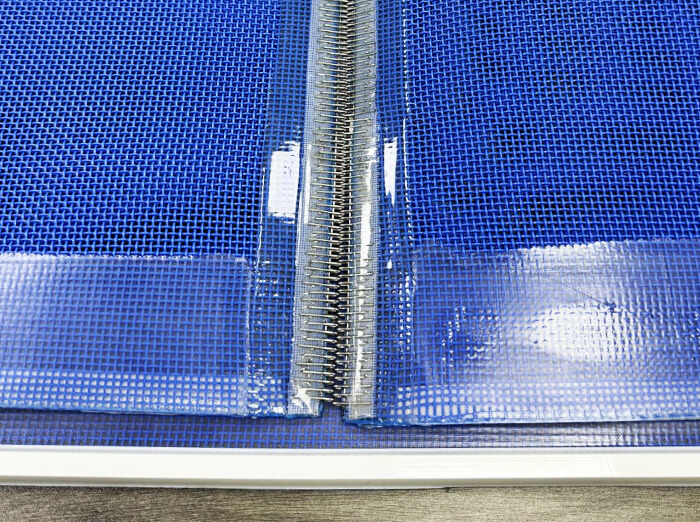
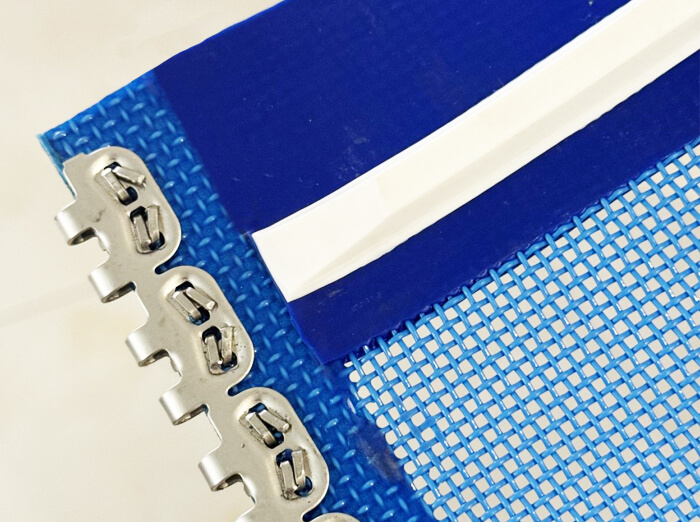
Tracking Guides & Cleats V-guides, guide rails, and entraining elements are bonded to the belt for accurate tracking on conveyor systems. Cleats (baffles) are available for inclined conveying to prevent product rollback on gradient lines. | Endless or Mechanical Joint Belts are available in fully endless (welded/spliced) configurations or with mechanical fastener joints. Supported types include stainless steel clips, flat and round hooks, plastic spirals, and hinge-type connectors for easy on-site installation. |
| Joint Type | Description | Best Application |
|---|---|---|
| Endless / Finger Splice | Woven-together seamless joint — no hardware | Maximum hygiene — food processing, dairy, pharmaceutical |
| Single-Finger Joining | Single-direction interlocking belt ends | Quick field installation, lower-tension conveying lines |
| Stainless Steel Fasteners | Flat, round, or hinge-type metal clips | High-tension industrial and chemical applications |
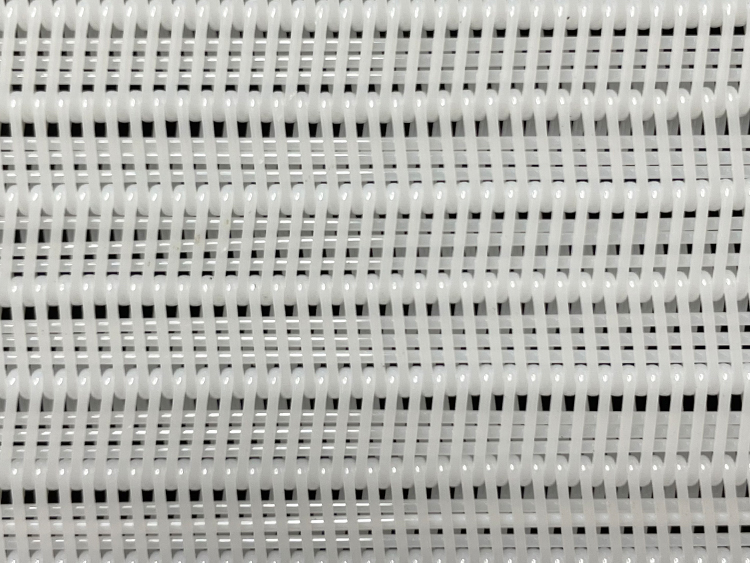
| Plastic Spiral / Clipper | Plastic thread or clip fastener system | Corrosive or hygroscopic environments |
FDA Food Safety Certified TPU-edge belts comply with FDA 21 CFR (USA) and EU EC 1935/2004 food contact regulations for direct food product contact | 1600 N/cm Warp Strength High tensile strength across all 21 mesh specifications ensures reliable splice performance under sustained belt tension | 32000 m³/m²/h Peak Permeability Open-mesh design achieves outstanding air and liquid permeability for efficient dewatering and through-drying |
Dimensional Stability High elongation modulus maintains belt dimensions under sustained tension — prevents stretch-induced tracking problems and misalignment | Chemical Resistance Good resistance to oils, greases, and a broad range of cleaning chemicals — suitable for CIP (clean-in-place) wash systems | Easy Maintenance Smooth monofilament surface releases product cleanly. Flush, scrub, or CIP-clean with standard food-grade detergents without belt removal |
Application
PFM Screen's Reinforced Polyester Dewatering Mesh Conveyor Belts are deployed across a wide range of food processing, environmental, and industrial applications where continuous filtration, dewatering, washing, drying, or drainage performance is mission-critical. The open-mesh structure, combined with a food-safe sealed edge, makes these belts the trusted choice for facilities requiring both high throughput and uncompromising hygiene.
| Fruit & Vegetable Processing● Washing and rinsing of whole and cut vegetables● Draining after water bath or blanching● Air-drying of washed produce before packaging● Grading and conveying of fresh produce on inclined lines | Pasta, Bakery & Ready-to-Eat Foods● Drying and pasteurization of pasta and noodle products● Cooling of baked goods — bread, biscuits, crackers● Proofing and baking on ventilated conveyor● Spiral cooler and freezer conveyor applications |
| Fish & Seafood Processing● Transport through washing and brine immersion lines● Draining after ice water immersion● Conveying through smoking and hot-air drying chambers● Thawing and cooling of frozen seafood on production lines | Dairy & Food Processing● Whey and curd drainage in cheese production● Filtration of dairy by-products and whey streams● CIP-compatible conveying in ultra-hygienic processing zones● Butter, cream, and yogurt processing conveyors |
| Environmental & Wastewater Treatment● Sludge dewatering and industrial mud filtration● Contaminated water treatment and drainage● Industrial effluent and leachate filtration● Mining and mineral washing drainage | General Industrial Applications● Industrial drying, cooling, and heat treatment conveyors● Particle, granule, and powder sieving● Chemical component washing and rinsing● Gravel, aggregate, and mineral washing drainage |
 Fruit & vegetable washing and draining conveyor application | 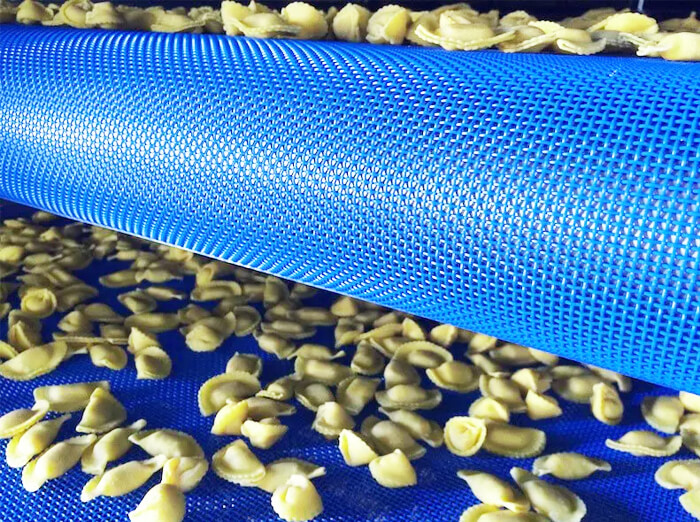 Pasta drying and pasteurization line application |
Industries Served by PFM Screen Reinforced Dewatering Mesh Belts Fruit & Vegetable ProcessingPasta & BakerySeafood ProcessingDairy IndustryWastewater TreatmentIndustrial FiltrationMining & Minerals |
Specifications
21 standard mesh configurations available. All models supplied with TPU or PVC sealed edge reinforcement as specified. Standard warp tensile strength: 1,600 N/cm. Standard weft tensile strength: 650 N/cm. Custom mesh specifications and alkali-resistant (PA nylon) variants available on request.
| Model | Wire Dia. (mm) | Density (wire/cm) | Weight (kg/m²) | Thickness (mm) | Mesh Pitch Warp/Weft (mm) | Aperture Warp/Weft (mm) | Permeability (m³/m²/h) | Open Area (%) | ||
|---|---|---|---|---|---|---|---|---|---|---|
| Warp | Weft | Warp | Weft | |||||||
| 021002 blue | 1.0 | 1.0 | 2.85 | 2.65 | 0.6 | 1.85 | 7.10 / 6.73 | 2.50 / 2.77 | 32,000 | 52.55% |
| 031002 blue/white | 1.0 | 1.0 | 3.2 | 3.25 | 0.8 | 1.86 | 8.10 / 8.20 | 2.12 / 2.07 | 25,600 | 45.9% |
| 03902 | 0.9 | 0.9 | 3.9 | 3.65 | 0.55 | 1.70 | 9.60 / 9.30 | 1.66 / 1.83 | 20,000 | 46.58% |
| 04902 | 0.9 | 0.9 | 4.65 | 4.70 | 0.95 | 1.66 | — | 1.25 / 1.22 | 17,600 | 33.55% |
| 04602 | 0.5 | 0.6 | 4.4 | 5.2 | 0.58 | 1.23 | 12.0 / 13.2 | 1.72 / 1.32 | 19,000 | 53.32% |
| 05602 | 0.6 | 0.6 | 5.9 | 5.6 | 0.62 | 1.10 | 14.98 / 14.2 | 1.09 / 1.18 | 18,000 | 42.89% |
| 05802 | 0.8 | 0.8 | 5.1 | 5.3 | 0.89 | 1.48 | 13.0 / 13.5 | 1.16 / 1.08 | 15,840 | 34.09% |
| 06652 | 0.65 | 0.65 | 7.4 | 6.8 | 0.65 | 1.19 | 18.8 / 17.3 | 0.70 / 0.82 | 14,400 | 28.96% |
| 06802 blue/white | 0.8 | 0.8 | 6.6 | 6.5 | 0.85 | 1.45 | 16.8 / 16.5 | 0.72 / 0.73 | 11,600 | 22.65% |
| 06702 blue/white | 0.7 | 0.7 | 7.0 | 7.0 | 0.77 | 1.30 | 17.8 / 17.8 | 0.72 / 0.72 | 11,000 | 26.01% |
| 07802 | 0.8 | 0.8 | 7.8 | 7.0 | 1.10 | 1.45 | 20.3 / 18.0 | 0.32 / 0.54 | 5,920 | 16.54% |
| 09502 | 0.5 | 0.5 | 9.7 | 10.3 | 0.50 | 0.90 | 25.0 / 26.2 | 0.53 / 0.47 | 10,100 | 24.97% |
| 012502 | 0.5 | 0.5 | 13.5 | 8.5 | 0.63 | 0.95 | 34.3 / 21.6 | 0.24 / 0.65 | 6,500 | 18.68% |
| 09452 | 0.45 | 0.45 | 10.0 | 8.6 | 0.45 | 0.88 | 25.4 / 21.8 | 0.55 / 0.71 | 15,570 | 33.71% |
| 08603 | 0.5 | 0.6 | 9.4 | 9.0 | 0.60 | 0.95 | 23.8 / 23.1 | 0.56 / 0.51 | 9,000 | 24.38% |
| 08502 | 0.5 | 0.5 | 9.5 | 8.6 | 0.89 | 0.47 | 24.13 / 21.8 | 0.50 / 0.65 | 10,140 | 29.93% |
| 06803 | 0.7 | 0.8 | 7.0 | 5.5 | 0.75 | 1.53 | 17.8 / 14.0 | 0.72 / 1.00 | 16,000 | 28.56% |
| PA061002 (Alkali) | 1.0 | 1.0 | 4.5 | 5.5 | 0.65 | 1.63 | 17.0 / 14.0 | 0.35 / 0.60 | 5,920 | 14.85% |
| 09603 | 0.5 | 0.6 | 10.5 | 9.2 | 0.65 | 1.05 | 26.67 / 23.4 | 0.45 / 0.48 | 8,300 | 44.87% |
| 07803 | 0.8 | 0.8 | 8.0 | 8.0 | 1.15 | 1.66 | 20.3 / 20.3 | 0.45 / 0.45 | 6,400 | 16.26% |
| 07903 | 0.8 | 0.9 | 7.6 | 6.5 | 1.25 | 1.76 | 19.3 / 16.5 | 0.51 / 0.63 | 9,184 | 12.96% |
* Custom mesh specifications, widths, and lengths available. PA model uses alkali-resistant nylon fiber. Mesh pitch data for model 04902 to be confirmed — contact PFM Screen for verified dimensions. All specifications subject to manufacturing tolerances.
Q1: What is the difference between TPU and PVC edge reinforcement on polyester dewatering mesh belts? TPU (thermoplastic polyurethane) edges are more flexible, hydrolysis-resistant, and comply with FDA 21 CFR and EU EC 1935/2004 for direct food contact, making them the standard choice for food processing environments. PVC edges are more rigid and cost-effective, suited for standard industrial dewatering, environmental, and non-direct-food-contact applications. Both types are heat-sealed to prevent fiber fraying and edge contamination. |
Q2: Are PFM Screen's reinforced polyester dewatering mesh belts certified for food contact? Yes. PFM Screen's reinforced polyester dewatering mesh belts with TPU edge reinforcement comply with FDA 21 CFR (USA) and EU EC 1935/2004 (Europe) food contact material regulations. These belts are safe for direct contact with food products including fruits, vegetables, seafood, pasta, and dairy products, and are suitable for CIP (clean-in-place) sanitization environments. |
Q3: Can I order a custom belt width, length, and mesh size? Absolutely. PFM Screen manufactures belts to exact buyer specifications — any width from 300 mm to over 12,000 mm, any length (endless or with mechanical joints), and custom mesh configurations beyond the 21 standard models. Custom options include adding cleats, V-guides, weft reinforcement threads, and choosing between TPU or PVC edge sealing. Share your drawings or process requirements and PFM Screen will engineer the right belt for your line. |
Q4: What joining methods are available and which is recommended for food processing? PFM Screen offers four joining types: (1) Endless/finger splice — seamless, no hardware, highest hygiene rating — recommended for food, dairy, and pharmaceutical applications; (2) Single-finger joining — quick field installation for lower-tension lines; (3) Stainless steel flat, round, or hinge-type fasteners — for high-tension industrial or chemical applications; (4) Plastic spiral or clipper fasteners — for corrosive or hygroscopic environments. The best method depends on your conveyor geometry, belt tension, and sanitary classification. |
Q5: Which mesh model is best for fruit and vegetable washing? For fruit and vegetable washing applications, belts with a high open area percentage and larger aperture are recommended to allow water and fine debris to drain freely while supporting the product. Models 021002 blue (52.55% open area, aperture 2.50/2.77 mm) and 04602 (53.32% open area) are commonly used. The exact selection depends on the size and type of produce, conveyor width, and belt tension requirements. Contact PFM Screen with your product and line specifications for a tailored recommendation. |
Q6: How do I clean and maintain reinforced polyester dewatering mesh belts? The smooth monofilament surface releases product cleanly after each cycle. Routine cleaning options include high-pressure water spray, brush scrubbing with food-grade detergents, or full CIP (clean-in-place) systems. The heat-sealed TPU or PVC edges prevent moisture from infiltrating the belt body where bacteria could harbor. Avoid solvents incompatible with polyester. Regular inspection of edge seals, splice points, and V-guide adhesion is recommended to ensure long service life. |
Q7: What is the minimum order quantity (MOQ) and lead time? PFM Screen accepts orders from a single custom belt to full production volumes — there is no fixed minimum order quantity. Standard lead time for custom-engineered belts is typically 2 to 4 weeks after drawing confirmation, depending on belt size, configuration complexity, and production scheduling. Rush orders can be accommodated in certain cases. Contact our team via WhatsApp (+86 153 6967 9157) or email (polyestermesh@pfmscreen.com) with your specifications for a formal quotation within 24 hours. |
Q8: Can PFM Screen supply an alkali-resistant version of the polyester dewatering mesh belt? Yes. For applications involving exposure to alkaline cleaning agents, industrial chemicals, or high-pH process fluids, PFM Screen offers the PA061002 variant woven from PA (polyamide/nylon) monofilament fiber instead of standard polyester. This alkali-resistant belt delivers comparable dewatering performance with significantly improved resistance to caustic wash chemicals. Contact PFM Screen to discuss your chemical exposure conditions and suitability requirements. |
Ready to Order? Get Your Custom Quote Within 24 Hours Send us your belt width, mesh model, edge type, quantity, and application — PFM Screen will respond with a full specification and pricing within one business day. WhatsApp: +86 153 6967 9157Email: polyestermesh@pfmscreen.com |