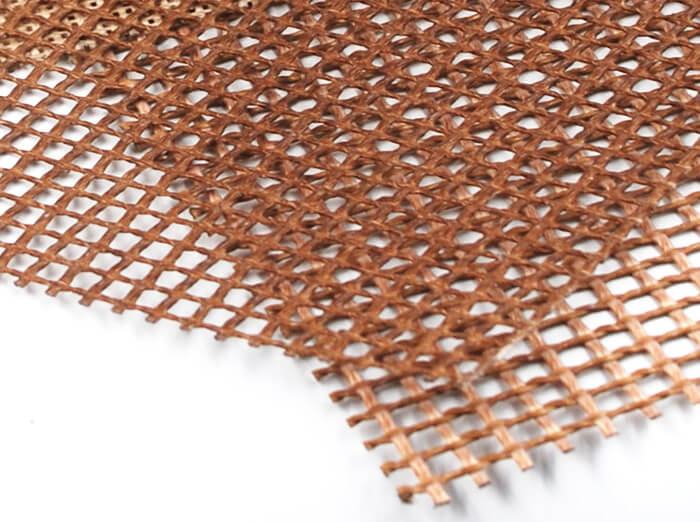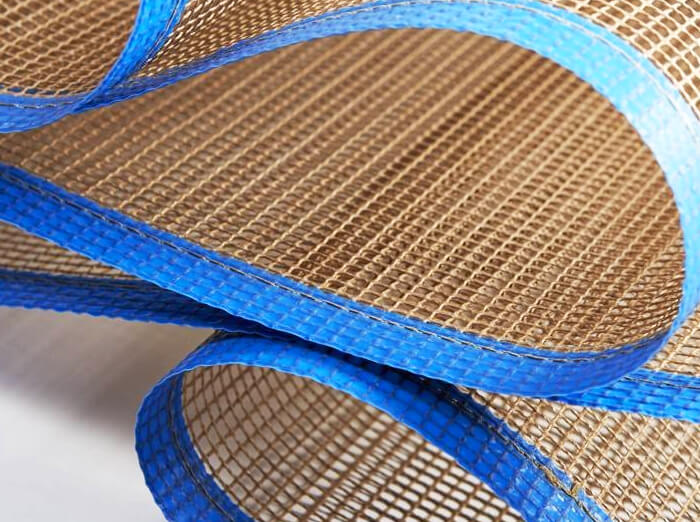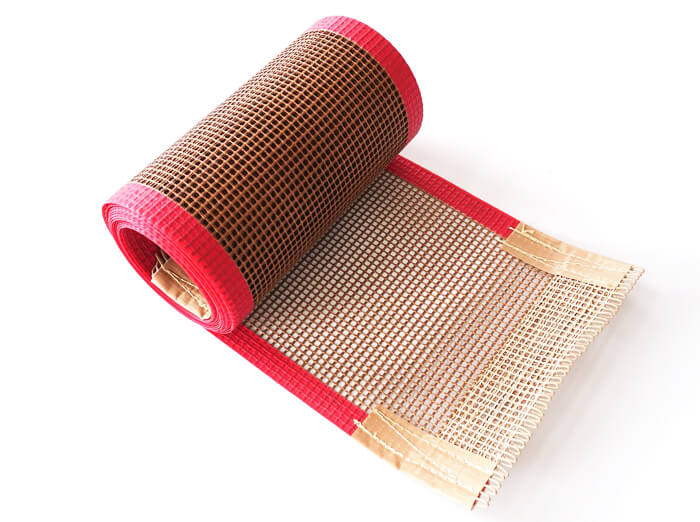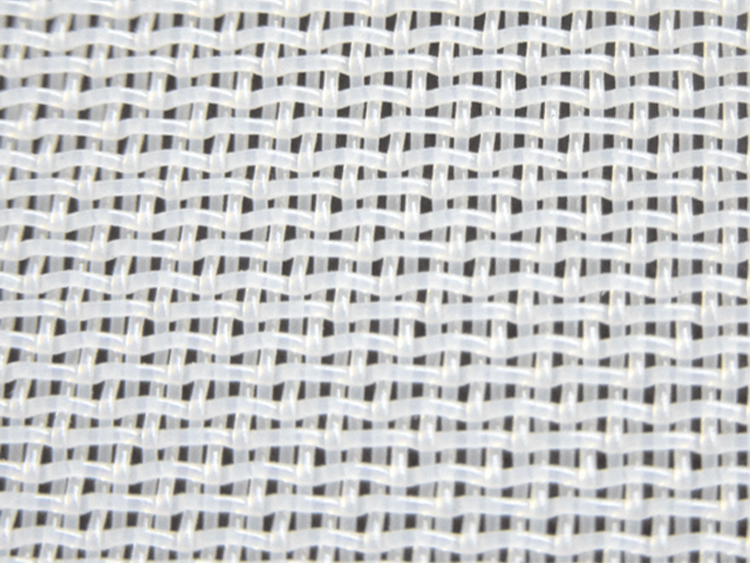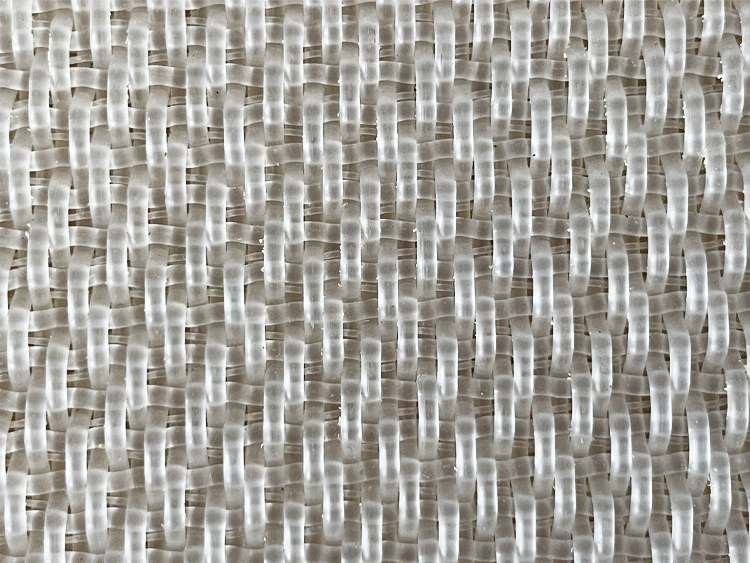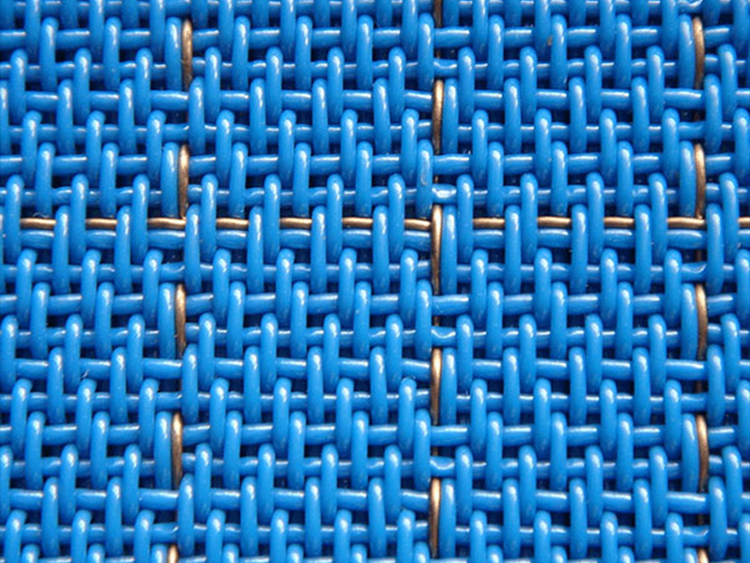
PFM SCREEN's PTFE mesh belts — widely known as Teflon mesh belts or PTFE open mesh conveyor belts — are manufactured by impregnating precision-woven fiberglass (E-glass) or Kevlar aramid open-mesh fabric with multiple layers of high-purity PTFE dispersion resin. Rated for continuous service from -70°C to +260°C, with mesh apertures from 1×1 mm to 10×10 mm and standard widths from 100 mm to 4,000 mm.
Description
PFM SCREEN's PTFE mesh belts — also widely known as Teflon mesh belts, PTFE open mesh conveyor belts, or PTFE fiberglass conveyor belts — are manufactured by impregnating precision-woven fiberglass (E-glass) or aramid (Kevlar) open-mesh fabric with multiple layers of high-purity polytetrafluoroethylene (PTFE) dispersion resin. The result is a dimensionally stable, chemically inert, non-stick open-mesh belt surface rated for continuous service from -70°C to +260°C (-94°F to +500°F), with mesh apertures from 1×1 mm to 10×10 mm and standard widths from 100 mm to 4,000 mm.
Unlike solid PTFE-coated belts, the open-mesh construction allows hot air, steam, infrared (IR) radiation, ultraviolet (UV) light, and microwave energy to pass freely through the belt plane — maximizing heat transfer efficiency and drying rate in tunnel ovens, dryers, curing lines, and heat-sealing systems where PTFE mesh consistently outperforms silicone, rubber, or standard polyester alternatives.
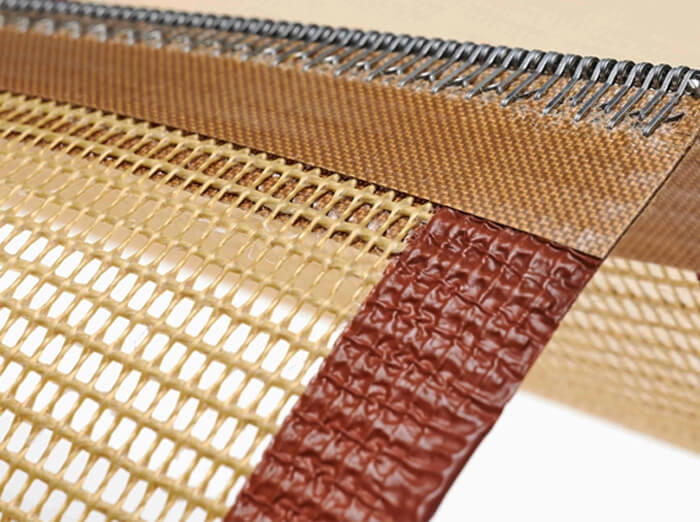
Fiberglass (E-Glass) Substrate — Standard Grade ● Most cost-effective grade for drying and conveying applications ● Excellent dimensional stability; elongation ≤1% under normal load ● Available in single-weft (standard), double-weft (heavy-duty), and triple-weft (extra-heavy) grades ● Standard widths to 4,000 mm; select grades to 6,000 mm on request ● Ideal for: food baking ovens, screen-printing dryers, shrink tunnels, textile stenters | Kevlar (Aramid) Substrate — High-Strength Grade ● Superior tensile strength: fill strength up to 900 N/cm vs. 580 N/cm for fiberglass ● Excellent anti-bending fatigue — handles tight-radius pulley configurations ● Lighter than equivalent-strength fiberglass grade ● Available with bullnose joint for narrow-width applications (120–300 mm) ● Ideal for: high-speed screen printing, narrow-conveyor lines, high-tension applications |
01 Maximum Heat Transfer Hot air, IR, UV, microwave, and steam pass freely through the open weave — drying efficiency far exceeds solid-surface belts | 02 Zero-Stick Release PTFE has a static CoF ≈0.04 — the lowest of any solid material. Products release cleanly with no release agents required | 03 260°C Continuous Service Rated -70°C to +260°C continuous; peak to 290°C — well above silicone (230°C) and polyester mesh (150°C) limits | 04 Full Chemical Inertness Virtually inert to all common acids, alkalis, organic solvents, oils, and steam — no degradation from aggressive cleaning agents |
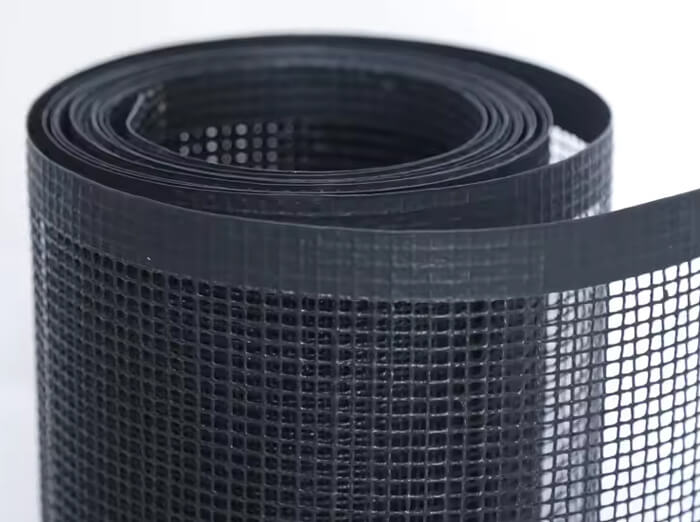
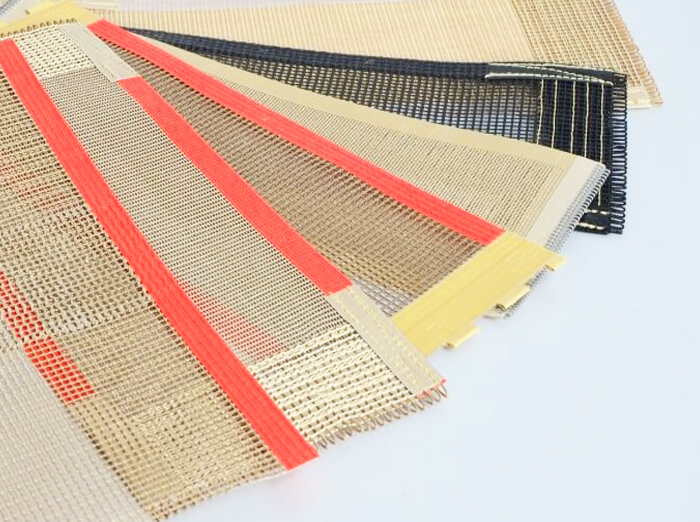
Standard Brown — Natural PTFE Grade ● Standard grade for food processing, drying, and general industrial conveying ● Excellent non-stick release and chemical resistance ● Food-grade versions comply with FDA 21 CFR (consult datasheet for specific model) ● Best for: food tunnel ovens, textile dryers, shrink tunnels, general drying and conveying | Antistatic Black — Carbon-Loaded PTFE Grade ● Surface resistivity: 105–107 Ω — eliminates static charge accumulation on belt surface ● Prevents ink mist adhesion on screen-printing dryers; prevents ESD damage in electronics lines ● Also blocks UV light — preferred in UV-curing dryer systems ● Best for: screen printing conveyor dryers, PCB reflow ovens, powder-coating lines |
| Parameter | Standard Range | Notes |
| Belt Width | 100 mm – 4,000 mm | Up to 6,000 mm for select grades; custom widths on request |
| Mesh Aperture | 1×1 mm to 10×10 mm | 8 standard aperture sizes; custom mesh dimensions on request |
| Operating Temperature | -70°C to +260°C | Short-term peak to 290°C; cryogenic service down to -70°C |
| Substrate Material | Fiberglass (E-glass) or Kevlar aramid | Nomex substrate available for extreme-temperature environments on request |
| Color / Grade | Brown (standard) / Black (antistatic) / White | White grade: PFM6011 — double-weft, food/clean-room environments |
| Elongation under Load | ≤1% | Fiberglass and Kevlar substrates; ensures consistent product positioning |
| Joining / Splice Types | 6 standard types | Bullnose, PEEK spiral, overlap, clipper, alligator, castellated |
| Edge Reinforcement | 4 edge types | PTFE film hem, Kevlar fabric binding, PTFE fiberglass fabric binding |
Request a Custom PTFE Mesh Belt Quote — 24-Hour Response Send us your belt width, mesh aperture, substrate type, color grade, splice type, and application — PFM SCREEN will respond with a full specification and price within one business day. WhatsApp: +86 153 6967 9157Email: polyestermesh@pfmscreen.com |
Feature
PFM SCREEN's PTFE mesh belts deliver performance that no alternative conveyor material matches for high-temperature, non-stick, open-mesh conveying. The table below compares PTFE mesh against the most common alternative belt materials across the key criteria industrial buyers evaluate.
| Property | PTFE Mesh Belt | Silicone Belt | Polyester Mesh Belt | Steel Wire Mesh |
| Max. Continuous Temperature | 260°C (500°F) | 230°C (446°F) | 150°C (302°F) | 300°C+ |
| Non-Stick Performance | Excellent (CoF ≈0.04) | Good | Poor | None |
| Air / Heat Permeability | Excellent (open mesh) | None (solid surface) | Excellent | Excellent |
| Chemical Resistance | Excellent (virtually universal) | Good | Moderate | Good (SS316) |
| Elongation under Load | ≤1% | 2–5% | ≤1% | <0.1% |
| FDA Food-Grade Compliance | Yes (FDA 21 CFR, select grades) | Yes | Yes (limited) | Varies |
| Antistatic Option Available | Yes (black carbon-loaded grade) | No | Yes (carbon blend) | Conductive by nature |
| Typical Service Life | 3–8 years | 1–3 years | 1–3 years | 5–10 years |
| Belt Weight (g/m2) | 460–1,180 (light) | Light | Light | Heavy |
1. Lowest-Friction Non-Stick Surface PTFE has a static coefficient of friction of approximately 0.04 — the lowest of any solid material. Adhesives, resins, food doughs, inks, and hot-melt materials release cleanly without release agents, reducing contamination risk and cleaning downtime. | 2. Continuous Operation to 260°C PFM SCREEN PTFE mesh belts operate continuously at up to 260°C (500°F) and withstand intermittent peak exposures up to 290°C (554°F) — well above the working limits of silicone belts (230°C) and standard polyester mesh belts (150°C). |
3. Superior Air and Heat Permeability The open-weave structure delivers uniform, controlled airflow through the belt plane — maximizing evaporation rate and heat transfer in drying, curing, and baking applications. This directly reduces drying time, energy consumption, and final product moisture content. | 4. Exceptional Dimensional Stability High-modulus fiberglass or Kevlar reinforcement limits belt elongation to ≤1% under normal load, even at maximum operating temperatures. This ensures accurate product positioning, consistent conveyor tracking, and minimal re-tensioning over the belt's full service life. |
5. Broad Chemical Resistance PTFE is virtually inert to all common acids, alkalis, and organic solvents. PTFE mesh belts withstand steam, water, oils, adhesives, cleaning agents, and most industrial process chemicals — suitable for demanding pharmaceutical, chemical, and food-processing environments. | 6. Antistatic Carbon-Loaded Grade Standard brown PTFE belts are electrically non-conductive. Black antistatic-grade belts incorporate carbon to achieve a surface resistivity of 105–107 Ω, preventing static charge accumulation. Essential in screen printing, PCB assembly, powder-coating, and ESD-sensitive environments. |
7. Long Service Life, Low Maintenance The combination of chemical resistance, dimensional stability, and non-stick properties delivers a 3–8 year working life in typical applications — significantly longer than silicone or polyester equivalents. Reduced product adhesion lowers cleaning frequency and cleaning agent consumption, reducing total operating costs. | 8. Wide Width and Full Customization Standard widths from 100 mm to 4,000 mm (to 6,000 mm for select grades), accommodating virtually any machine configuration. Belts supplied as cut-to-order rolls or factory-made endless loops. Edge reinforcement types, guide bars, and all splice types available to order. |
Need a Technical Comparison for Your Application? PFM SCREEN's engineering team will advise on the optimal substrate grade, mesh aperture, color grade, and splice type for your specific machine and process conditions. WhatsApp: +86 153 6967 9157Email: polyestermesh@pfmscreen.com |
Application
PTFE mesh belts from PFM SCREEN are the standard belt choice wherever industrial conveying requires open-mesh air permeability, non-stick surface performance, and continuous operating temperatures above 150°C. The combination of fiberglass or Kevlar structural strength with PTFE's unique surface properties makes this belting irreplaceable across food processing, screen printing, packaging, textile drying, electronics manufacturing, and nonwoven production.
Product | → | Pre-treatment | → | ★ PTFE Mesh Belt Heat Treatment / Drying / Curing Oven | → | Cooling | → | Packaging |
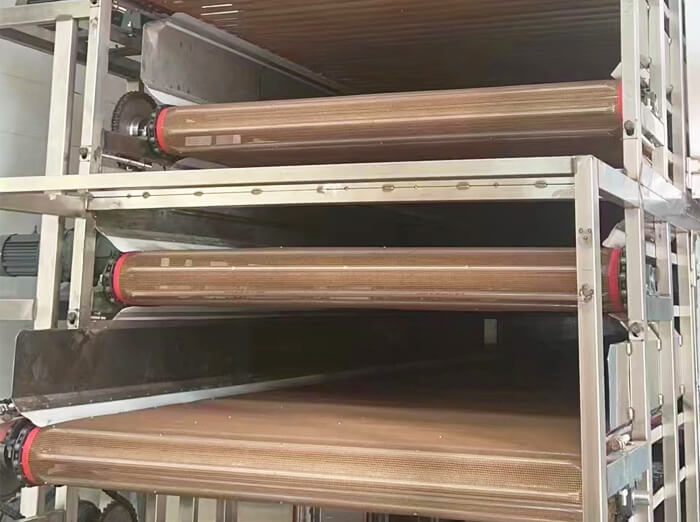 Food Processing & Baking ● Tunnel oven conveyor belts for bread, biscuits, crackers, and snacks ● Food drying lines for fruits, vegetables, herbs, pasta, and pet food ● Microwave and IR dryer belts ● Freezer and cooling conveyor support screens | 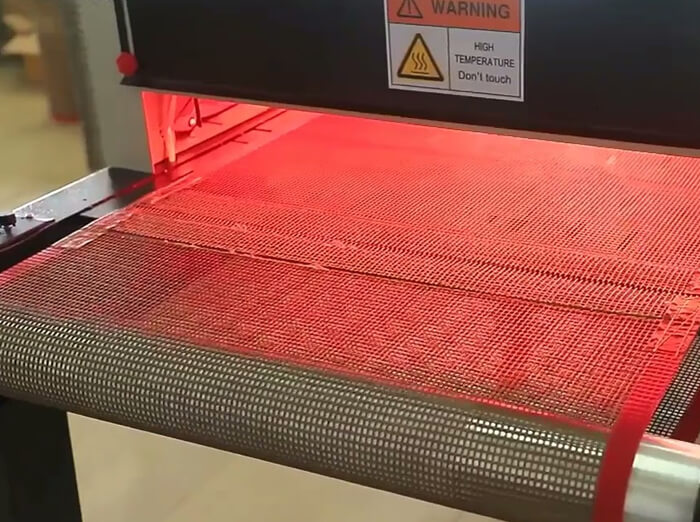 Screen Printing & Graphics ● Ink-curing conveyor belts for flatbed and rotary screen-printing dryers ● UV and infrared dryer exit belts — antistatic black grade prevents ink mist adhesion ● Digital textile printing conveyors ● Flash-cure unit conveyor belts |
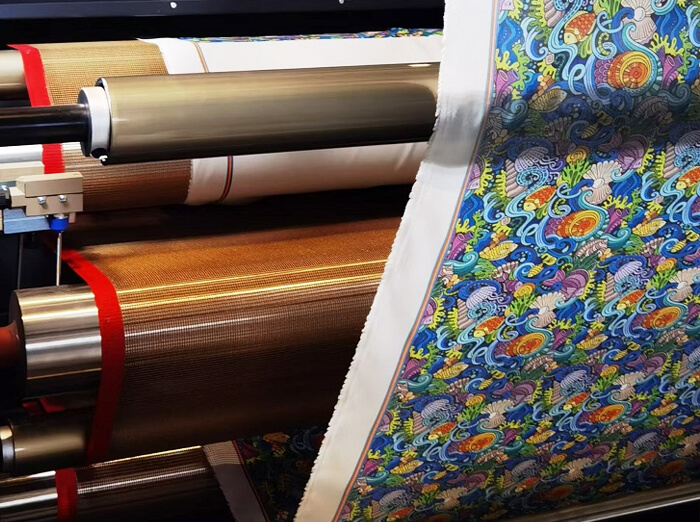 Textile & Garment Industry ● Stenter and heat-setting conveyor belts ● Fusing and laminating machine belts ● Nonwoven fabric thermal bonding and curing lines ● Carpet and flooring backing cure conveyors | 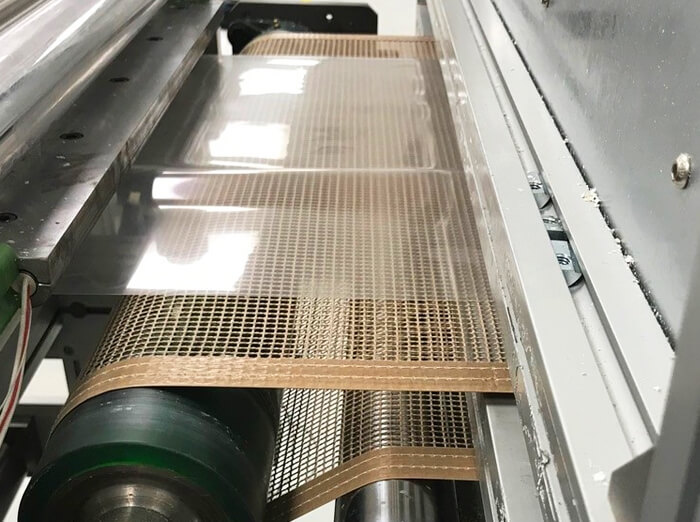 Packaging Industry ● Shrink-tunnel conveyor belts (film activation and product bundling) ● Heat-sealing machine belts for bag sealers and flow wrappers ● Continuous band sealer conveyor belts ● Label and film lamination conveyor belts |
PFM SCREEN PTFE mesh belts are routinely supplied as OEM-specification or replacement belts for the equipment categories below. Share your machine make, model, and current belt dimensions for a confirmed replacement specification and quote.
| Industry / Application | Equipment / Machine Type | Representative Machine Brands | Recommended Grade |
| Screen Printing | Conveyor flash-cure and gas / electric dryers | M&R Radicure / Gauntlet, Vastex D-100 / D-1000, Anatol VOLT / PULSE, Riley Hopkins, Workhorse Mach III, Lawson Screen & Digital | PFM6003, PFM6012 (black antistatic) |
| Food Baking | Tunnel ovens, spiral ovens, baking lines | Rademaker, Kaak Group, Baker Perkins, AMF Bakery Systems, Reading Bakery Systems, Fritsch, GEA, MIWE | PFM6004, PFM6008 (brown) |
| Packaging | Shrink tunnels, band sealers, flow wrappers | Shanklin T-series / CF-series, Eastey ST-series / TF-series, Arpac, Fuji, Ulma, Kallfass, Audion, Minipack Torre | PFM6001, PFM6004 (brown) |
| Textile & Nonwoven | Stenters, dryers, fusing & laminating machines | Brückner Trockentechnik, Monforts, Trident, Hashima, Corino Macchine, Mathis AG | PFM6008, PFM6030 (heavy-duty) |
| Electronics / PCB | SMT reflow ovens, wave soldering, cure lines | Heller 1800 series, ERSA HOTFLOW / VERSAFLOW, Vitronics Soltec XPM, BTU Pyramax, Electrovert OmniES | PFM6002, PFM6012 (black antistatic) |
| Nonwoven Production | Through-air dryers, thermal bonding, calenders | Andritz, Dilo, Trützschler, Oerlikon Neumag, Reifenhäuser | PFM6030, PFM6031 (triple weft) |
Request a Replacement Belt for Your Machine Share your machine make, model, belt width, length, and mesh specification — PFM SCREEN will supply an exact-fit PTFE mesh belt with a confirmed specification and quote within 24 hours. WhatsApp: +86 153 6967 9157Email: polyestermesh@pfmscreen.com |
Specifications
| Property | Value / Description |
| Base Fabric Substrate | Woven fiberglass (E-glass) or aramid (Kevlar) |
| Coating Material | High-purity PTFE (polytetrafluoroethylene) dispersion resin, multi-layer impregnation |
| Operating Temperature (continuous) | -70°C to +260°C (-94°F to +500°F) |
| Short-term Peak Temperature | Up to 290°C (554°F) |
| Elongation at Load | ≤1% (fiberglass and Kevlar substrates, under normal operational load) |
| Static Coefficient of Friction | ≈0.04 (PTFE surface — the lowest of any solid material) |
| Standard Colors | Brown (natural PTFE), Black (antistatic carbon-loaded), White (PFM6011, food/clean-room) |
| Available Mesh Apertures | 1×1 mm, 2×2 mm, 2×2.5 mm, 2×4 mm, 4×4 mm, 5×5 mm, 8×8 mm, 10×10 mm |
| Max. Standard Belt Width | 4,000 mm standard; up to 6,000 mm for select grades on request |
| Antistatic Surface Resistivity (black grade) | 105 – 107 Ω |
| Chemical Resistance | Resistant to virtually all acids, alkalis, organic solvents, oils, and process chemicals |
| FDA / Food Contact | Food-grade versions available (FDA 21 CFR); consult product datasheet for model-specific compliance |
| Style | Standard Widths (mm) | Mesh (mm) | Weight (g/m2) | Weft | Color | Tensile Warp/Fill (N/cm) |
| PFM6001 | 1000, 1500, 2050, 2600, 2800, 3200, 3650, 4000 | 1×1 | — | — | Brown | 446 / 330 |
| PFM6002 | 1000, 1500, 2050, 2600, 2800, 3200, 3650, 4000 | 1×1 | — | — | Black | 446 / 330 |
| PFM6003 | 1000, 1500, 2050, 2500, 2750, 3200, 3350, 3600, 4000 | 4×4 | 460 | Single | Black | 320 / 434 |
| PFM6004 | 1000, 1500, 2050, 2500, 2750, 3200, 3350, 3600, 4000 | 4×4 | 460 | Single | Brown | 320 / 434 |
| PFM6008 | 1000, 1500, 1700, 2050, 2500, 2700, 3200, 3400, 3600, 3800, 4000 | 4×4 | 580 | Double | Brown | 360 / 500 |
| PFM6011 | 1000, 1500, 2500, 2700, 3200, 3800, 4000 | 4×4 | 580 | Double | White | 330 / 470 |
| PFM6012 | 1000, 1500, 1700, 2050, 2500, 2700, 3200, 3400, 3600, 3800, 4000 | 4×4 | 580 | Double | Black | 360 / 500 |
| PFM6013 | 1000, 1500, 2000, 3000 | 10×10 | — | — | Brown | 220 / 360 |
| PFM6014 | 1000, 1500, 1800, 2000, 3000, 3600 | 2×2.5 | — | — | Black | 290 / 400 |
| PFM6015 | 1000, 1500, 1800, 2000, 3000, 3600 | 2×2.5 | — | — | Brown | 290 / 400 |
| PFM6016 | 1000, 1400, 2000, 2800 | 2×4 | — | — | Brown | 330 / 470 |
| PFM6017 | 1000, 1500, 2000, 3600, 4000 | 5×5 | — | — | Black | 320 / 434 |
| PFM6018 | 1000, 1400, 2000, 2800 | 8×8 | — | — | Brown | 350 / 480 |
| Style | Standard Widths (mm) | Mesh (mm) | Weight (g/m2) | Weft | Color | Tensile Warp/Fill (N/cm) |
| PFM6001S | 1000, 1500, 2000, 3000 | 1×1 | — | — | Brown | 536 / 410 |
| PFM6008S | 1000, 1400, 2500, 2600, 2700, 3300, 3400, 3700, 3800, 4000 | 4×4 | 720 | Double | Brown | 390 / 580 |
| PFM6008S-S | 1000, 1350, 2700 | 4×4 | 1180 | Double | Brown | 480 / 940 |
| PFM6016S | 1000, 1700, 1800, 1900, 2400, 2600, 2800, 3400, 3600, 3800 | 2×4 | — | — | Brown | 410 / 590 |
| PFM6030 | 1000, 1500, 1700, 2050, 2700, 3200, 3400, 3600, 3800, 4000 | 2×2 | 660 | Triple | Brown | 680 / 620 |
| PFM6031 | 1000, 1500, 2050, 2700, 3200, 3600, 3800, 4000 | 2×2 | 660 | Triple | Black | 680 / 620 |
| PFM6032 | 1000, 1500, 2050, 2700, 3200, 4000 | 2×2 | 660 | Triple | Red | 680 / 620 |
| Style | Standard Widths (mm) | Mesh (mm) | Warp / Weft | Color | Tensile Warp/Fill (N/cm) |
| PFM6007 Kevlar | 1000, 1700, 2000, 2700, 3400, 4000 | 4×4 | Kevlar / Glass | Brown | 380 / 900 |
| PFM6200 (Bullnose) | 120, 150, 170, 190, 210, 250, 300 | 4×4 | Kevlar / Glass | Brown | Consult PFM |
| PFM6201 (Bullnose) | 120, 150, 170, 190, 210, 250, 300 | 4×4 | Kevlar / Glass | Black | Consult PFM |
* Additional widths available on request for all series. Contact PFM SCREEN with your exact machine dimensions for a custom-width confirmation and lead time.
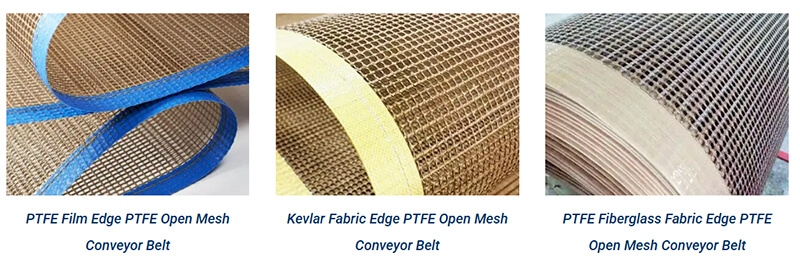
● PTFE Film Hem — lightweight folded-edge seal; standard food-industry and general drying applications
● Kevlar Fabric Binding — high-tensile edge for demanding and wide-belt applications
● PTFE Fiberglass Fabric Binding — general industrial reinforced edge; temperature-stable
● Custom edge profiles available on request for non-standard conveyor guide configurations
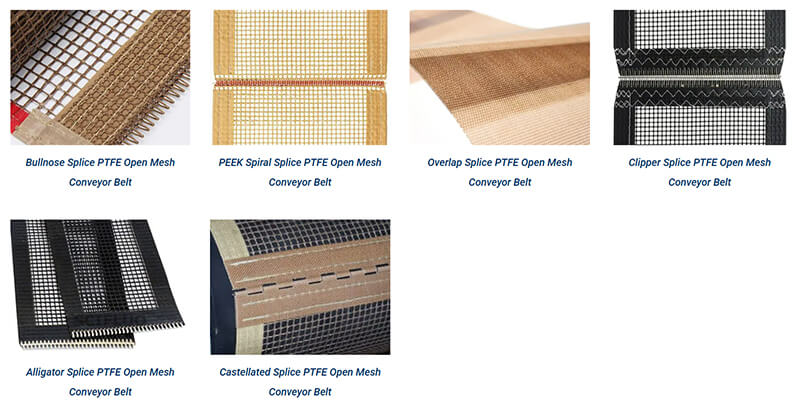
● Bullnose Splice — exclusive to narrow Kevlar belts (120–300 mm); tight-radius, high-speed screen-printing conveyors
● PEEK Spiral Splice — high-temperature, food-safe joining; no metal contact; preferred for food processing lines
● Overlap Splice — strong, low-profile factory splice for endless belt configuration
● Clipper Splice — metallic fastener; simplest field removal and replacement — standard for screen printing and industrial drying
● Alligator Splice — for standard industrial conveying lines with moderate belt tension
● Castellated Splice — for high-tension, wide-belt applications requiring a robust mechanical joint
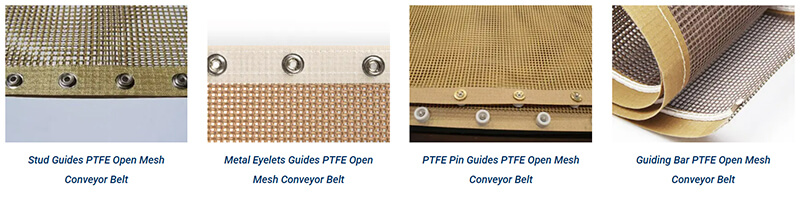
● Stud Guides — bolt-on stainless steel tracking studs welded to belt edge for roller-guide systems
● Metal Eyelet Guides — precision-punched stainless steel eyelets for pin-roller lateral tracking
● PTFE Pin Guides — non-metallic guide pins for food-safe, hygienic, and hygroscopic environments
● Guiding Bar — continuous stainless steel or PTFE-coated bar bonded to belt edge; provides stable lateral tracking on long conveyor runs
Q1: What is a PTFE mesh belt and how is it different from a solid PTFE-coated belt? A PTFE mesh belt — also called a Teflon mesh belt or PTFE open mesh conveyor belt — is manufactured by impregnating an open-weave fiberglass or Kevlar fabric with polytetrafluoroethylene (PTFE) dispersion resin. The open-mesh structure allows air, heat, UV, IR, steam, and microwave energy to pass freely through the belt plane, making it the preferred choice for drying, curing, and baking applications where heat transfer through the belt is required. A solid PTFE-coated belt (no mesh) is used where a smooth, non-porous non-stick surface is needed but air permeability is not required — for example, on heat-sealing platens or non-stick liners. The open mesh version is significantly lighter and more energy-efficient in thermal processing than any solid-surface alternative. |
Q2: What is the maximum operating temperature of a PTFE mesh belt? PFM SCREEN's PTFE mesh belts are rated for continuous operation from -70°C to +260°C (-94°F to +500°F), with short-term peak exposure tolerance up to 290°C (554°F). This far exceeds the working limits of silicone belts (approximately 230°C maximum continuous) and standard polyester mesh belts (approximately 150°C maximum), making PTFE mesh the correct choice for direct-heat tunnel ovens, infrared dryers, and PCB reflow oven lines where sustained high temperatures are required. The Kevlar substrate further improves performance at elevated temperatures compared to standard fiberglass. |
Q3: What is the difference between fiberglass substrate and Kevlar substrate PTFE mesh belts? The substrate (base fabric) determines the belt's tensile strength, flexibility, and weight. Fiberglass (E-glass) substrate is the standard, cost-effective choice for most food processing, screen printing, packaging, and textile drying applications. Kevlar (aramid) substrate delivers significantly higher fill-direction tensile strength — up to 900 N/cm for PFM6007 Kevlar vs. 500–580 N/cm for double-weft fiberglass grades — making it the preferred choice for high-tension applications, tight-radius pulleys, and narrow-width screen-printing conveyors (120–300 mm bullnose joint series PFM6200/6201). Kevlar belts also offer better anti-bending fatigue resistance and are lighter per unit area than equivalent fiberglass grades. For wide food or industrial drying applications, the standard or stronger fiberglass series is sufficient and more economical. |
Q4: Are PTFE mesh belts food-safe and suitable for direct food contact? Yes. PTFE (polytetrafluoroethylene) is non-toxic, odorless, tasteless, and biologically inert. PFM SCREEN's food-grade PTFE mesh belt models comply with FDA 21 CFR regulations (USA) for food contact applications. They are suitable for direct contact with baked goods, fruits, vegetables, pasta, meat, seafood, and other food products, and can withstand CIP (clean-in-place) wash cycles with hot water and food-grade cleaning agents without degradation. The food-grade compliance status depends on the specific belt model and substrate — please request the product datasheet or contact PFM SCREEN to confirm compliance for your application and region. |
Q5: What is the difference between standard brown and antistatic black PTFE mesh belt grades? Standard brown PTFE mesh belts are manufactured from natural PTFE without conductive additives. They are electrically non-conductive (surface resistivity >1012 Ω) and are the correct choice for food processing, general drying, and industrial conveying. Antistatic black PTFE mesh belts incorporate carbon additives to achieve a controlled surface resistivity of 105–107 Ω, which safely dissipates static charge build-up during belt movement. Black antistatic belts are required for: screen printing conveyor dryers (to prevent ink mist adhesion and static-related print defects), PCB reflow ovens and SMT assembly lines (to prevent ESD damage to sensitive electronic components), UV-curing dryer conveyors where the black grade also blocks UV light, and powder-coating systems where electrostatic discharge poses a fire or quality risk. |
Q6: How do I select the correct mesh aperture size for my application? Mesh aperture selection balances three factors: (1) product support — smaller products require finer mesh (1×1 mm or 2×2.5 mm) to prevent marking or falling through; (2) airflow rate — coarser apertures (4×4 mm, 8×8 mm, 10×10 mm) allow greater airflow, accelerating drying and heat transfer; (3) energy source — UV-curing systems typically use 1×1 mm or 4×4 mm black antistatic grade for maximum UV transparency. As a general guide: 1×1 mm for light, delicate products and maximum contact area; 2×2 mm to 2×4 mm for medium-weight products with moderate airflow needs; 4×4 mm for most standard industrial drying, screen-printing dryers, and shrink tunnels; 8×8 mm to 10×10 mm for maximum airflow and large or heavy product conveying. Contact PFM SCREEN's technical team with your product dimensions, conveyor speed, and oven specifications for a specific model recommendation. |
Q7: Which splice type should I choose for my PTFE mesh belt replacement? Splice selection depends on conveyor geometry, belt tension, hygiene requirements, and replacement frequency. PEEK spiral splices are the cleanest option for food processing and pharmaceutical applications — high-temperature rated, food-safe, and no exposed metallic parts. Clipper (metallic fastener) splices are the easiest to install and remove in the field, minimizing downtime during belt replacement — they are the standard choice for most screen printing dryers and industrial drying lines. Bullnose splices are exclusive to narrow-width Kevlar belts (120–300 mm, PFM6200/6201 series) and provide a tight, strong joint for high-speed screen-printing conveyors. Overlap splices give the flattest, strongest joint for endless configuration in wide industrial belts. Alligator and castellated splices suit high-tension or wide conveyor configurations. If replacing an existing belt, share the current splice type with PFM SCREEN for a confirmed like-for-like replacement specification. |
Q8: What is the minimum order quantity and lead time for custom PTFE mesh belts? PFM SCREEN accepts orders from a single custom PTFE mesh belt to full production volumes — there is no fixed minimum order quantity. Standard lead time for custom-engineered belts is typically 2 to 4 weeks after drawing confirmation, depending on belt width, series, splice configuration, and current production scheduling. For standard-width stock models, shorter lead times may be available. Rush orders can be accommodated on a case-by-case basis. Contact PFM SCREEN via WhatsApp (+86 153 6967 9157) or email (polyestermesh@pfmscreen.com) with your belt specifications for a formal quotation and confirmed lead time within 24 hours. |
Ready to Order? Get Your Custom PTFE Belt Quote Within 24 Hours Send us your belt width, length, mesh aperture, substrate type, color grade, splice type, and application details — PFM SCREEN will respond with a full specification and pricing within one business day. WhatsApp: +86 153 6967 9157Email: polyestermesh@pfmscreen.com |