
The Complete Guide to Polyester Dewatering Mesh Belts
A polyester dewatering mesh belt is a woven monofilament conveyor belt with square holes in it. Water drains through the holes, air passes through the holes, and the product stays on top. That simple idea runs vegetable washing lines, air-knife dewatering machines, pasta dryers, and seafood plants all over the world. If you are buying or replacing one of these belts, five numbers decide whether it works: wire diameter, aperture, open area, air permeability, and tensile strength. This guide explains what each number means and how we help customers choose between the 21 standard specifications.
About the author of this guide: PFM SCREEN is a polyester mesh belt manufacturer founded in 1987, operating a 40,000 m² production base and exporting dewatering mesh belts to more than 50 countries. Its reinforced polyester dewatering mesh conveyor belts are supplied in 21 standard specifications with FDA 21 CFR and EU EC 1935/2004 compliant sealed edges.
What Is a Polyester Dewatering Mesh Belt?
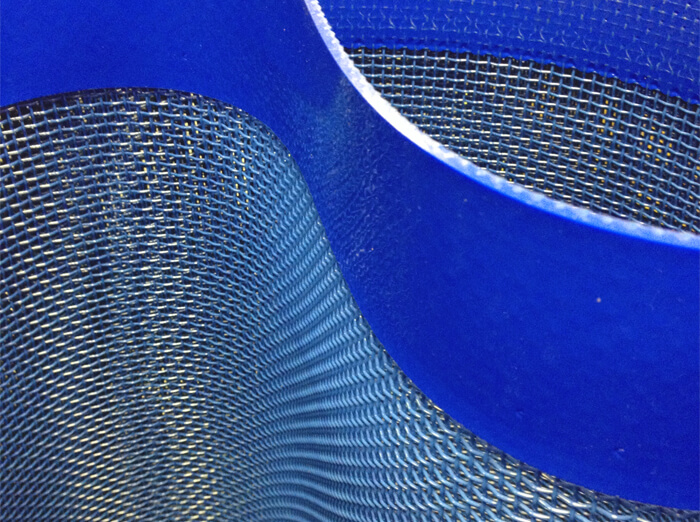
A polyester dewatering mesh belt is an open conveyor belt woven from polyester (PET) monofilament yarns in a square-hole pattern. The holes are sized so that water and air get through while the product, anything from leafy salad to tomato halves to prawns, stays on the belt. The open area is part of the weave itself, so the belt carries product and drains water at the same time. A solid rubber or PVC belt cannot do that, which is why washing lines are built around mesh.
Most of these belts spend their working life removing surface water in food plants. They carry washed vegetables out of the wash tank and through a draining section or an air-knife machine. They drain seafood after brine or ice-water immersion. They let air reach the underside of pasta on a drying line and the underside of bread on a cooling line. Machine builders call the same product a dewatering belt, a draining belt, or a linear screen belt. We use one name in this guide: polyester dewatering mesh belt.
Not to be confused: square-aperture dewatering mesh belts are made for food and light-industrial draining. They are not the belts used on belt filter presses for sludge dewatering. Sludge work needs a much finer, press-rated filter fabric, and a square-hole food belt would let sludge pass straight through. If your application is municipal or industrial sludge, see our woven press filter belts (sludge dewatering belts) instead.
How a Dewatering Mesh Belt Is Constructed
Monofilament square mesh, the working surface
The belt body is woven from single-filament polyester yarns, usually between 0.45 mm and 1.0 mm thick. Why monofilament and not multifilament? Mostly because the surface is smooth. Product releases cleanly, food particles do not get trapped between filaments, and there is no yarn bundle for residue to hide in during CIP cleaning. Change the yarn diameter or the weave density and you change the aperture, the open area, and the permeability. Two belts can look identical on the roll and run completely differently on the same line.
Sealed edges, the reinforcement
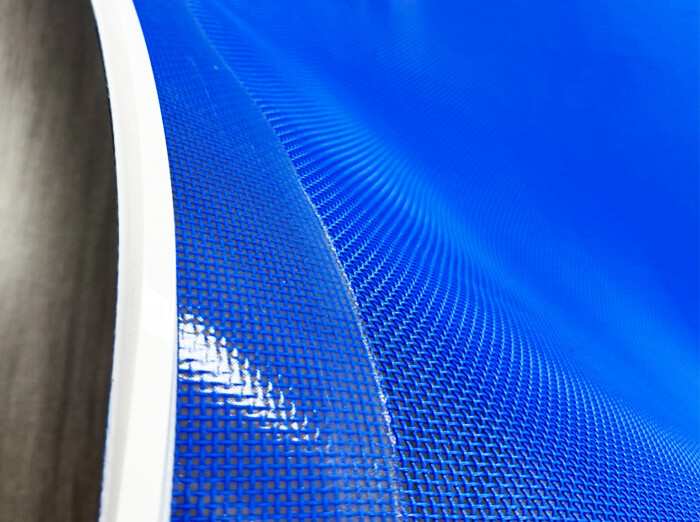
A cut woven edge frays. Filaments snap, loose ends can fall into the product, and the damage works its way inward until the belt is scrap. Reinforced belts get around this with lateral edges heat-sealed in TPU (thermoplastic polyurethane) or PVC (polyvinyl chloride). The sealed edge locks the cut yarns in place and gives the belt a clean, closed border, which is also what food-contact rules under FDA 21 CFR and EU EC 1935/2004 expect to see. Wide belts and high-tension lines can also get transverse (weft) reinforcement threads woven in for extra tear resistance.
Tracking and conveying accessories
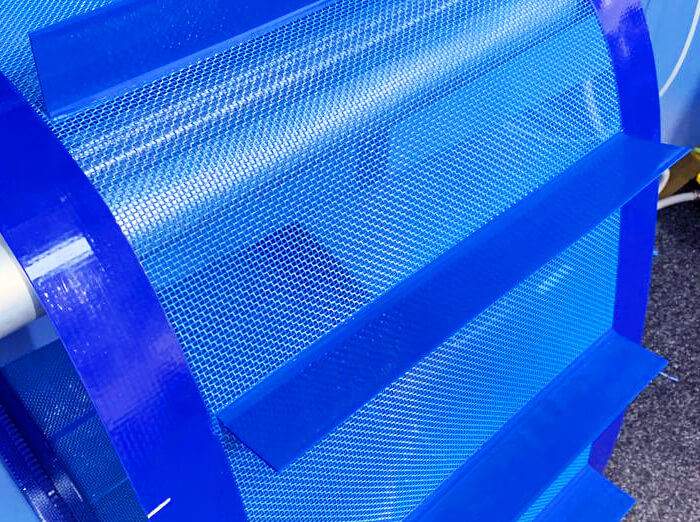
Two add-ons solve most conveyor headaches. V-guides welded to the underside of the belt keep it centered on long lines. Cleats (flights) across the belt surface stop product rolling back when the belt climbs out of a wash tank toward a dewatering or packaging station. Both go on during fabrication, so decide when you order. Retrofitting rarely holds.
The Five Specifications That Define a Polyester Dewatering Mesh Belt
Every dewatering belt datasheet comes down to five numbers. Learn them and you can compare belts from any supplier on the numbers rather than on the sales pitch.
1. Wire diameter (mm). How thick the monofilament is, typically 0.45 to 1.0 mm. Thicker wire gives you strength and wear life. Thinner wire gives a smoother, gentler surface for delicate produce. Wire diameter also sets the smallest pulley the belt can wrap around without fatigue.
2. Aperture (mm). The clear square opening between yarns, measured in warp and weft. Anything larger than the aperture stays on the belt; anything smaller can drop through. Coarse draining belts run apertures around the 2 mm class for fast water removal. Fine versions go down to the 0.24 to 0.5 mm class for small or fragile products.
3. Open area (%). How much of the belt surface is hole rather than yarn. Across the 21 standard specifications this runs from 13% to 53%. More open area means faster draining and drying; less open area means better support for small pieces. Do not confuse it with aperture: a thick-wire belt can have large holes and still only moderate open area.
4. Air permeability (m³/m²/h or CFM). The volume of air that passes through a square meter of belt in an hour at a set pressure difference. Standard dewatering belts sit between roughly 6,000 and 32,000 m³/m²/h. This number tells you how freely wash water drains and how hard an air knife can work through the mesh. High-permeability belts suit air-knife dewatering and through-air drying. Denser belts give better product support.
5. Tensile strength (N/cm). The load the belt carries in warp (running) and weft (cross) direction. A well-made dewatering belt reaches about 1,600 N/cm in warp and 650 N/cm in weft. The warp figure has to cover working tension plus startup peaks, with something left over for the splice. The joint is always the weakest point of any belt.
How the Belt Works in a Dewatering Machine
It helps to look at an air-knife dewatering machine, the kind used for leafy vegetables, tomatoes, cucumbers, bell peppers, and bean sprouts. Washed product rides the mesh belt under a row of adjustable air knives. The airflow blows surface water off the product and down through the holes, and a drainage channel or cassette under the belt collects it. Some machines add belt beaters or extraction units underneath to shake off or pull away the droplets that remain.
These machines are popular because they are compact and use far less energy than a drying tunnel. But they only work if the belt lets the air through. A belt that is too dense throttles the airflow. A belt that is too open lets small products fall or blow through. This is why machine builders specify the mesh class, and why "same width, same length" is not enough when you order a replacement.
TPU vs PVC Sealed Edges: A Quick Decision
Both edge materials are heat-sealed to the mesh, and both stop fraying. TPU stays flexible at low temperature and handles hydrolysis well, so it is the default for food plants where the belt is wet all day and goes through wash-down or CIP every shift. PVC is stiffer and cheaper, and it does the job in industrial draining and conveying where food-contact certification is not needed. If the belt touches food, specify TPU and ask for the migration test reports behind the FDA 21 CFR and EC 1935/2004 claims. Any serious supplier has them on file.
Endless or Mechanical Joint?
Belts leave the factory either endless (welded into a loop) or fitted with a mechanical joint such as stainless steel clips, flat or round hooks, plastic spirals, or hinge connectors. Endless belts have no weak point and no metal near the product, so hygienic food lines usually go endless. Mechanical joints cost a little strength but install fast without stripping rollers, which matters on wide conveyors where threading an endless belt can take hours. When you set the machine tension, work to the joint's rating rather than the belt's.
How to Choose: A Seven-Step Selection Method
These seven steps work for replacements and new lines alike. In our experience, nearly every wrong belt we have been asked to replace traces back to a skipped step.
Step 1, define the product. Piece size and weight, how fragile it is, whether the surface is sticky, and whether you run it whole, cut, or leafy. Diced peppers and bean sprouts need much finer apertures than tomato halves or whole cucumbers.
Step 2, set the retention target. The smallest piece that must not fall through fixes your maximum aperture. If you run a mixed line, size the belt for the smallest product on the schedule, not the average one.
Step 3, match permeability to the process. Gravity draining after a wash bath gets by with moderate permeability. Air-knife dewatering and through-air drying need high permeability, toward the top of the 6,000 to 32,000 m³/m²/h range, so the airflow can strip moisture through the mesh.
Step 4, check the mechanics. Width and length, working tension, minimum pulley diameter against wire diameter, and splice type. Make sure the machine can actually tension the joint you want.
Step 5, specify the edge and accessories. TPU edge for food contact. V-guides if the line is long. Cleats if the belt climbs out of a wash tank or feeds an elevated dewatering machine.
Step 6, confirm compliance and chemistry. Food contact means FDA 21 CFR / EC 1935/2004 conformity with migration test reports. Check that your CIP detergents are compatible with polyester. And be honest about temperature: polyester in continuously hot, wet, or steamy service above roughly 70 °C hydrolyzes over time. Tell your supplier the real numbers.
Step 7, trial and record. In the first weeks, measure residual surface moisture and product loss and write the numbers down. Six months later those baselines tell you whether the belt is wearing out or the machine has developed a problem.
Where Polyester Dewatering Mesh Belts Are Used
One belt platform covers a lot of ground because the job is always the same: carry the product, let water and air through. The specifications change from plant to plant.
Fresh-cut vegetables and salads. Draining and air-knife dewatering of leafy greens, tomatoes, cucumbers, bell peppers, and bean sprouts after washing. This is the classic duty for this belt: high open area and permeability, TPU sealed edges, FDA/EC compliance.
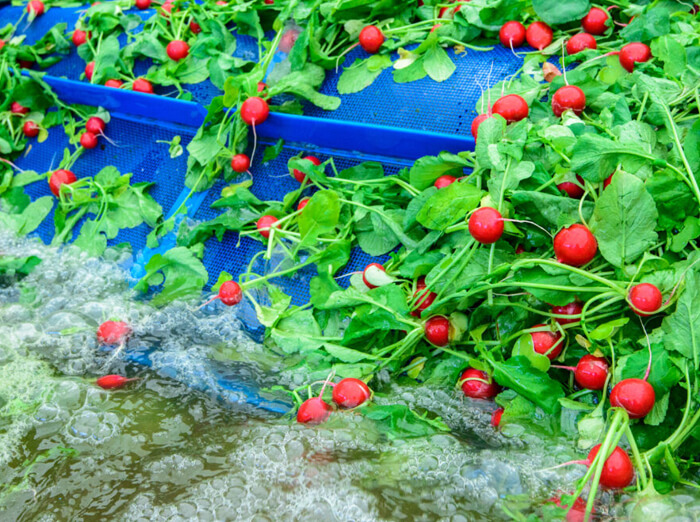
Fruit and vegetable washing lines. Carrying produce through the wash and rinse tanks, lifting it out on cleated inclines, and draining it before grading or packaging.
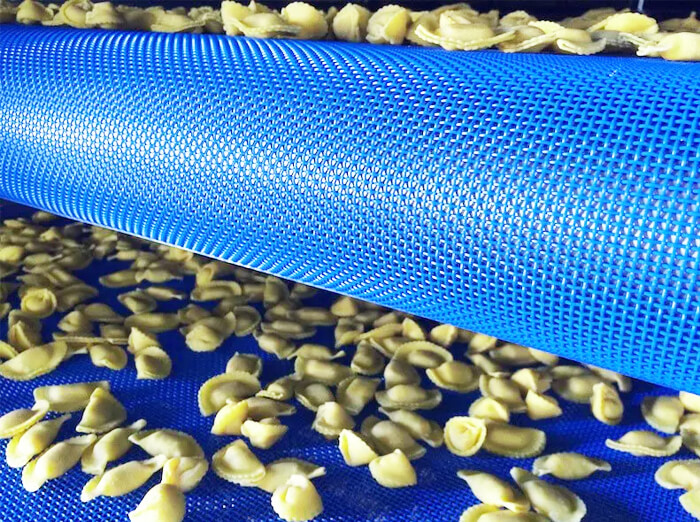
Pasta, bakery and ready-to-eat foods. Pasta drying and pasteurization, bread and biscuit cooling, spiral cooler conveyors. The smooth monofilament surface releases dough and pasta without sticking. For dedicated high-temperature dryer service, see our spiral dryer fabrics.
Fish and seafood. Washing and brine immersion, draining after ice water, smoking and hot-air drying, thawing. Belts here live wet, so hydrolysis-resistant TPU edges and daily wash-down compatibility matter more than anywhere else.
Dairy filtration. Whey and curd drainage in cheese production, using the fine-aperture specifications in the 0.24 to 0.5 mm class with CIP-compatible materials.
General industry. Component washing, particle and granule sieving, cooling and heat-treatment conveyors, drainage after aggregate or mineral washing. Anywhere an open, cleanable carrying surface works better than a solid belt.
Maintenance, Cleaning and Service Life
A dewatering belt is a wear part, but how fast it wears is mostly up to you. Keep the holes clean. Flush or spray-wash before product residue dries into the mesh, because dried residue is several times harder to shift. Stay within the chemical resistance of polyester when you pick detergents. Run the lowest tension that still drives and tracks the belt; over-tensioning stretches the fabric and fatigues the splice for no benefit. And respect the wet-temperature limit: polyester copes with dry heat, but above roughly 70 °C in continuously wet or steamy service it starts to hydrolyze. If your line runs hot and wet, say so when ordering.
The belt usually tells you before it fails. Product arrives wetter at the discharge end. Tracking starts to wander. The edge seal frays. If any of these persist after cleaning and a tension check, start planning the replacement. Vegetable and salad lines with good cleaning habits often get years out of a belt. Lines running sharp-edged or abrasive product wear belts faster. Either way, the baseline numbers from step 7 are what turn a gut feeling into a decision.
Frequently Asked Questions
What is the difference between a dewatering mesh belt and a regular conveyor belt?
A regular conveyor belt is a closed surface that only carries product. A dewatering mesh belt has an open square-aperture weave, 13% to 53% open area, so it drains wash water and passes air while it conveys. Conveying, draining, and through-air drying happen on one belt instead of three machines.
Can I use this belt for sludge dewatering on a belt filter press?
No, that is a different product. Belt filter presses need woven press filter fabrics with much finer, press-rated apertures that can build a solids cake. A square-hole food belt would let sludge pass straight through. For municipal and industrial sludge, specify purpose-built woven press filter belts (sludge dewatering belts) instead.
Is a higher air permeability always better?
No. Air-knife dewatering and through-air drying want high permeability because the airflow does the work. But an overly open belt lets small product pieces fall or blow through, and gives delicate items less support. Sort out retention first: fix the aperture for your smallest product, then take the highest permeability available in that aperture class.
TPU or PVC edge, which should I choose?
Choose TPU for food contact and permanently wet service. It is flexible, hydrolysis-resistant, and available with FDA 21 CFR and EC 1935/2004 conformity. Choose PVC for industrial draining and conveying where food certification is unnecessary, since it costs less. Both are heat-sealed and both stop fraying, so this is a chemistry and compliance question, not a quality one.
Will this belt fit my existing washing line or dewatering machine?
Usually yes, after three checks. Width and length must match the frame. Machine tension must stay within the joint's rating. And the smallest pulley must suit the wire diameter, because thick monofilament needs larger pulleys. Machine builders normally specify the mesh class, so match it when replacing. If you send the conveyor drawing or a photo of the old belt's data tag, the manufacturer can verify fit before production.
How should a polyester mesh belt be cleaned, and what temperature can it take?
Flush or spray-wash before residues dry into the mesh. Most food lines simply include the belt in their CIP cycle with standard food-grade detergents. In dry conditions polyester tolerates high temperatures well. In continuously wet or steamy service, keep it below roughly 70 °C to avoid hydrolysis. Angle high-pressure sprays across the mesh rather than firing straight at the edge seal from close range.
How long does a dewatering mesh belt last?
It depends on the duty and the housekeeping. Vegetable and salad lines with good cleaning practice often run a belt for years. Heavily loaded lines, or sharp and abrasive products, shorten that. The four things you control are tension, clean apertures, intact edge seals, and wet-service temperature. Track residual moisture and product loss from day one; a change in those numbers is the earliest reliable sign of wear.
What information should I send when requesting a quote?
Six things get you an accurate quotation within 24 hours: belt width and length (or the machine model and builder), the product you run and its smallest piece size, working temperature and whether the belt runs wet or dry, the joint type you prefer, the edge material (TPU or PVC), and any accessories such as V-guides or cleats. A photo of the old belt's data tag helps us match or improve the specification.
Need Help Specifying Your Dewatering Belt?
Send us your product details and machine dimensions. Our engineers reply with a matched specification and quotation within 24 hours.
View Reinforced Dewatering Mesh BeltsRequest a Free Quote
