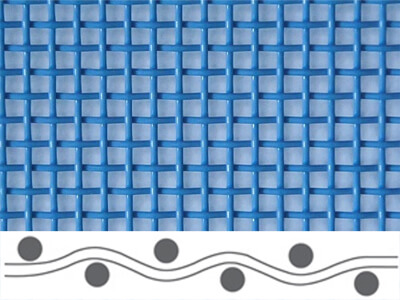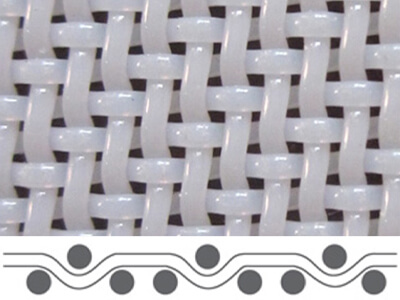
If two linear screen belts are quoted as “0.72 mm,” ask for the second opening dimension before choosing a weave. PFM SCREEN lists a 2-shed plain weave and a 3-shed twill that both have a 0.72 mm warp-direction opening. Across the belt, one measures 0.72 mm and the other 1.00 mm. That difference matters when the feed contains narrow flakes or long slivers.
Follow one yarn across a clean patch of mesh. In a 2-shed plain weave, it goes over one crossing yarn and under the next. The adjacent yarn starts the opposite way. In a typical 3-shed twill with a 2-over, 1-under repeat, a yarn passes over two crossing yarns before dipping under one. The exposed length over those two yarns is called a float. The repeat shifts on the next yarn, producing a diagonal pattern.
2-Shed Plain Weave
| 3-Shed Twill Weave
|
The sketches beneath the photos show the yarn paths. Colour varies with the yarn supplied. When matching an old belt, photograph both faces of a clean, unworn sample with a ruler in the same plane. Mark which way the belt travels.
Warp yarns run along the length of the woven cloth. Weft yarns run across it. The following nominal values come from two models in the PFM SCREEN linear screen mesh belt specifications. Dimensions in each cell follow the catalogue order, warp / weft.
| What to compare | 06702 2-shed plain | 06803 3-shed twill |
|---|---|---|
| Clear opening (mm) | 0.72 / 0.72 | 0.72 / 1.00 |
| Yarn diameter (mm) | 0.70 / 0.70 | 0.70 / 0.80 |
| Belt cloth thickness (mm) | 1.30 | 1.53 |
Suppose your screen must retain thin flakes. A flake that lies flat may stay on either sample. The same flake can present a narrower profile when it turns on edge. Include those shapes in a trial and inspect the material that passes through. Here the opening, yarn diameter and thickness all change together, so a difference in the trial cannot be attributed to the weave alone.
Will usable material pass through? Split a representative feed sample into comparable portions. Use the same exposed mesh area, orientation and feed conditions. Collect the passing material separately and examine or weigh the fraction you wanted to retain.
Will the loaded belt drain quickly enough? Ask for open area, the percentage of mesh surface occupied by openings. Then measure the volume that passes through each sample in a fixed time at the same liquid head, solids concentration and exposed area. Repeat after solids accumulate. Record any openings that stay blocked after the usual rinse.
Will a change help with wear? Identify where the old belt wears first. Damage at a single edge calls for a tracking and clearance check. For wear across the working face, compare yarn size and material, then assess candidate belts under comparable load, speed and cleaning conditions. A short drainage test cannot establish service life.
For a replacement, use the existing belt as the starting point if it already meets your separation target. Record its finished width, endless circumference, edge treatment, guide position and joint type. If a candidate cloth is thicker, ask for the finished joint thickness, the minimum roller diameter and the allowable working tension. A seam that catches a scraper can rule out an otherwise suitable mesh.
For a new machine, tell the supplier what should stay on the belt, what should pass through and how the belt will be cleaned. Ask for the proposed opening and tolerance in both directions, yarn material and diameter, open area, thickness and seam drawing. Agree on a pass/fail target for product loss or drainage before comparing the samples. The screening and separation selection guide covers how to define that target.
An enquiry can be as simple as “We need to keep these flakes and drain this liquid. Here are photos of the feed, both faces of the old mesh and its joint. Please compare two options and show the opening dimensions in each direction.”
Still Have Questions? Contact PFM SCREEN Directly. Send a close-up of your screen cloth, the material you want to retain and the problem you want to solve. We can help you compare suitable belt specifications. First response within 1 business day (Beijing time). WhatsApp: +86 153 6967 9157 Email: polyestermesh@pfmscreen.com |