To choose a linear screen mesh belt, first decide what must stay on the mesh and what should pass through it. Then match the opening in both directions, the woven construction and the finished belt to the feed material and machine. A useful specification describes the separation task as well as the belt dimensions.
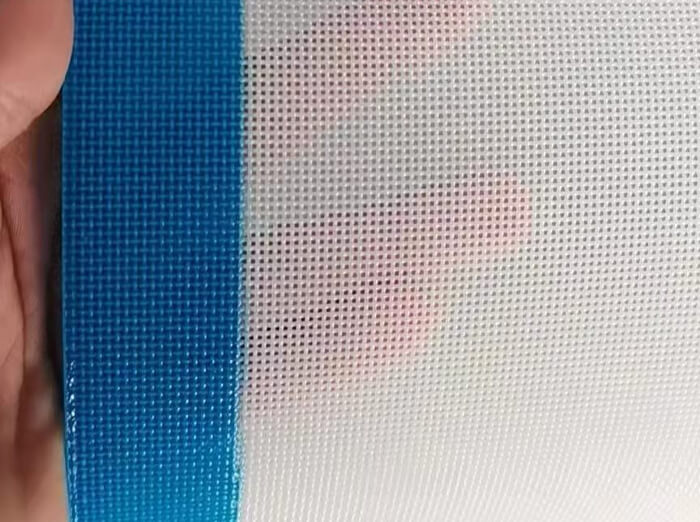
A linear screen mesh belt, also called linear screen cloth, is a woven monofilament belt with defined openings. It can carry retained material while allowing smaller particles or liquid to pass through. This guide explains how to turn that process requirement into a practical enquiry.
The mesh and the finished edges are separate parts of the belt specification. |
Start with two descriptions: the material you want to retain on the belt, and the material you want to pass through. The retained material may be the product, or it may be unwanted debris. For example, a slurry screen may retain coarse trash while useful fine material passes with the liquid.
Also identify how the machine creates separation. A moving open mesh, a belt filter press and a vacuum filter place different demands on the fabric and its installation.
| Your process task | Where to start |
|---|---|
| Remove coarse debris from a slurry | Describe the unwanted debris and the useful material that should pass. Assess a linear screen belt for the required separation and machine. |
| Carry material while free liquid drains | Confirm product support, drainage time and the amount of liquid carried to the next process. For washing conveyors with fabricated edges and attachments, also review reinforced polyester dewatering mesh belts. |
| Squeeze sludge or a product layer in a belt press | Use the machine and feed details to assess woven press filter belts. Pressure, cake release and the belt path require a separate selection. |
| Filter over a vacuum system | Start with the vacuum machine layout and its support and sealing arrangements. Review vacuum filter belts for that duty. |
For a replacement, describe what the current belt does well and what needs to improve: unwanted material passing through, useful material being retained, slow drainage, repeated cleaning or edge damage. This gives the supplier a clearer target than a request for a “better mesh.”
Aperture is the clear opening between adjacent yarns. Check it in both warp and weft directions: warp follows the woven fabric length, and weft runs across it. A rectangular opening needs two dimensions.
Mesh count describes the number of threads per unit length under the stated counting convention. It is a different measurement from aperture. PFM SCREEN lists the warp/weft count and the opening separately; compare the units before matching one specification to another.
Use representative feed material, including the size variation normally seen in production. Long fibres, flat flakes and flexible pieces can meet the mesh in different orientations. Record what must be retained and what is acceptable in the passing stream, then check candidate meshes with that material.
A smaller opening may retain more material, including fines that you intended to pass. A larger opening may pass unwanted pieces. The appropriate choice depends on the required separation and the way the feed behaves on the screen.
Open area is the proportion of the fabric surface occupied by openings. It helps compare mesh geometry. In service, the feed layer, blocked openings, belt supports and liquid loading also affect the available passage. Evaluate retention and flow together.
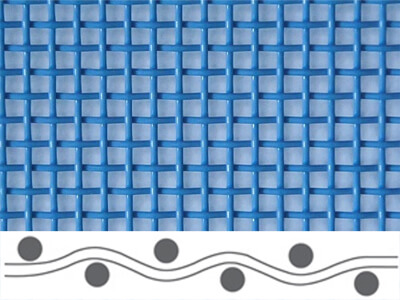
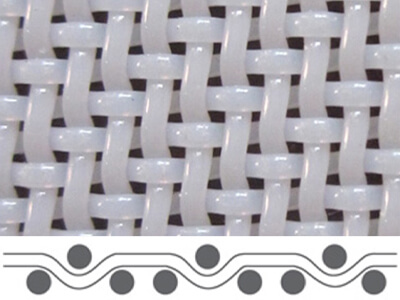
PFM SCREEN offers 2-shed plain weave and 3-shed twill weave linear screen belts. Plain weave uses a regular over-and-under interlacing pattern; twill uses a different repeat with longer yarn floats.
2-Shed Plain Weave
| 3-Shed Twill Weave
|
Compare aperture, yarn diameter, thickness, open area and the finished seam before choosing between them. Where permeability data are used, ask for the test conditions so the figures can be compared on the same basis.
Weave type alone does not establish which belt will drain faster, carry more load or last longer. A replacement should be assessed against the same material, speed, support arrangement, cleaning and operating tension. Use the current Linear Screen Mesh Belts product specifications to identify candidates, then confirm the required construction.
Two belts made from similar mesh can fit and run differently because of their seam, edges or guides. Include these details in the selection, especially when a replacement must use the existing rollers and installation space.
| Check | Information to confirm |
|---|---|
| Finished dimensions | Belt width, usable carrying width and the required closed-loop circumference. If you measured an open belt, state the endpoints and how the joint is included. |
| Joint and installation | Whether the belt can be installed as a closed loop or must be joined on the machine. Check seam profile, smallest roller, transfer points and cleaning access. |
| Edges and guides | Edge finish, clearance, guide shape and position, and matching roller grooves. Guides need a correctly aligned machine and suitable tension. |
| Load and support | Material loading, belt speed, support layout and the allowable operating tension of the selected belt and joint. A breaking-strength figure is not a working-tension setting. |
| Production and cleaning | Actual belt-contact temperature, exposure time, wet or dry conditions, and cleaning chemicals with their concentration and contact time. |
The product range includes metallic clipper, staple fastener and integrated spiral ring joint options, as well as belts supplied in endless form. Endless describes a closed loop; confirm the seam construction. Edge choices include resin sealing, sewing, tracking guides and PVC/TPU wrapping with a guide.
Standard polyester construction uses PET yarn; other listed yarn options include PA, PP, PPS and hydrolysis-resistant PET. Assess the mesh, joint and edge materials together for the actual exposure. If the belt contacts food, request documents applicable to the supplied construction and intended contact conditions.
Shut down and isolate the machine before hands-on measurement or inspection. Existing drawings and safely taken close-up photographs can help establish the required configuration.
Before committing to a new mesh, agree what the comparison needs to show. A sample test can help assess material retention and passage. A machine trial is needed to check installation and running behaviour. Use conditions representative of the intended feed, liquid flow, loading and belt speed.
Separation: examine both the retained and passing streams against the agreed target.
Flow and blockage: observe whether material builds up and how performance changes during the test.
Machine fit: check the seam, edges, guides and product transfers when assessing the finished belt.
Cleaning: confirm access to the mesh and joint and compatibility with the intended cleaning method.
Send PFM SCREEN four pieces of information:
The material being processed, what should stay on the belt and what should pass through.
Photos of the machine, mesh, joint and both belt edges.
Any known belt dimensions, machine details or an existing specification.
The main problem you want to solve, plus any heated contact or chemical cleaning conditions.
If some details are unknown, say so. Photos, a sample and available measurements provide a useful starting point. The final quotation should identify the agreed mesh, finished dimensions, joint, edge treatment and operating conditions, so the replacement can be checked against a clear specification.
Still Have Questions? Contact PFM SCREEN Directly. Share your material, separation target, photos and available belt dimensions so we can assess a suitable configuration. First response within 1 business day (Beijing time). WhatsApp: +86 153 6967 9157 Email: polyestermesh@pfmscreen.com |