
PFM Screen's Polyester Forming Belt for Glass Fiber Mat is a precision-woven wetlaid forming belt engineered for the forming and dewatering section of wet-laid glass fiber mat production lines. Used as a glass fiber mat forming belt, fiberglass mat forming wire and wetlaid nonwoven forming wire, it receives the glass fiber-water slurry from the headbox or inclined former, supports uniform fiber deposition across the full working width, and rapidly drains process water through gravity and vacuum suction.
Every polyester forming belt for glass fiber mat is made to order according to your fiber type, fiber length, slurry concentration, belt width, belt length, mesh count, aperture opening, air permeability and seam requirement. By balancing fiber retention, drainage capacity, surface smoothness and dimensional stability, PFM Screen helps glass mat producers improve mat uniformity, reduce fiber loss, stabilize basis weight and achieve clean wet web release before binder impregnation and drying.
In wet-laid fiberglass mat production, chopped glass fibers are dispersed in a large volume of process water to form a low-consistency slurry. The slurry is delivered onto a moving forming belt, where glass fibers are retained and arranged into a continuous wet web while water drains through the mesh. The forming belt must provide the right balance between open area, fiber support, vacuum dewatering and surface release.
A properly engineered wet-laid fiberglass mat belt directly influences mat formation, CD/MD basis weight profile, web dryness, binder pick-up consistency and final surface quality. If the mesh is too open, glass fiber loss and uneven formation may occur. If the mesh is too tight, drainage slows down, vacuum load increases and production speed may be limited.
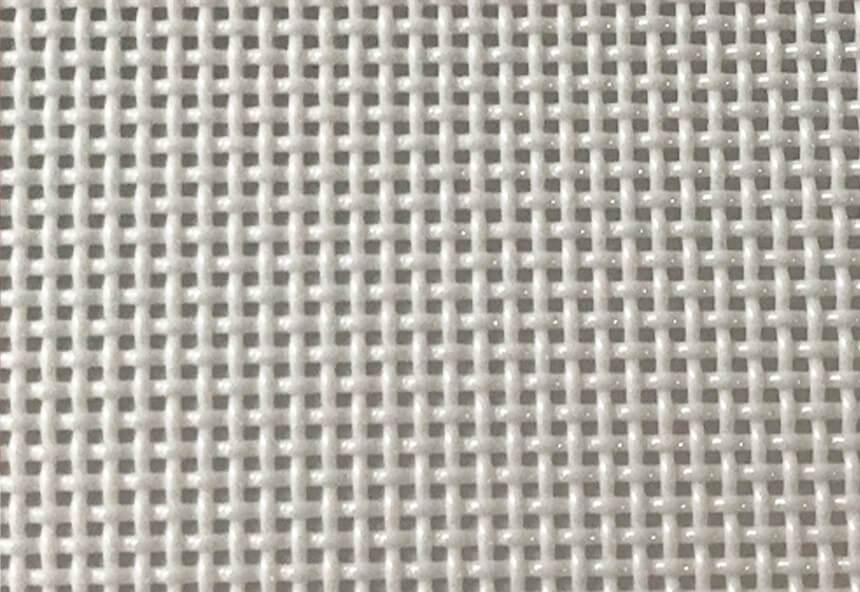
Precision PET Monofilament Construction Woven from high-strength polyester monofilament yarns for stable aperture geometry, wet dimensional stability, smooth web contact and reliable operation under continuous vacuum dewatering conditions. | Custom Aperture, Permeability & Seam Mesh count, wire diameter, aperture opening, open area, air permeability and seam type are engineered to match your glass fiber length, mat weight, machine speed and vacuum layout. |
01 Uniform Formation Supports even glass fiber laydown and helps reduce streaks, cloudy areas, thin spots and basis weight variation. | 02 Controlled Drainage Optimized open area allows fast water removal while maintaining stable web support under vacuum boxes. | 03 Fiber Retention Calibrated aperture openings retain chopped glass fibers and reduce fiber loss into the white water loop. | 04 Mark-Free Release Smooth PET monofilament surface helps wet mat transfer cleanly before binder impregnation and drying. |
PFM Screen forming belts are used in the wet end of fiberglass mat production, where fiber distribution, dewatering and web support are critical. Depending on the machine design, the belt may work as a forming wire, transfer belt, pre-dewatering belt or drainage belt for fiberglass mat production.
| Process Stage | Belt Function | Technical Requirement |
|---|---|---|
| Slurry Delivery | Receives glass fiber-water slurry from the headbox or inclined former. | Stable tracking, flat surface and uniform cross-machine support. |
| Fiber Formation | Retains glass fibers and forms a continuous wet mat on the belt surface. | Correct aperture size, high fiber support and low marking structure. |
| Vacuum Dewatering | Removes process water through the mesh by gravity and vacuum suction. | High drainage capacity, clean apertures and low hydraulic resistance. |
| Wet Web Transfer | Transfers the wet mat to binder application, suction and drying sections. | Smooth release surface, stable seam and minimal transfer disturbance. |
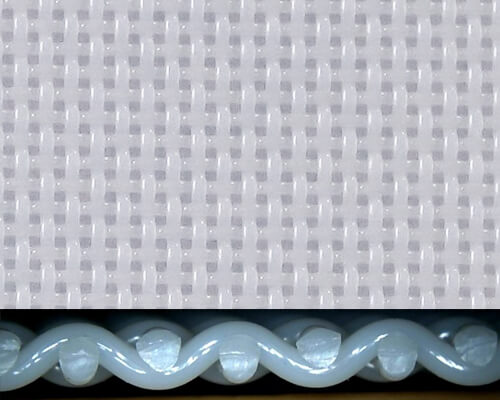 High-Drainage Glass Fiber Mat Forming Belt • Designed for longer glass fibers and higher white water flow • Suitable for roofing mat, gypsum board facer and construction substrates • Used as a wet-laid fiberglass mat belt where drainage capacity is the priority | 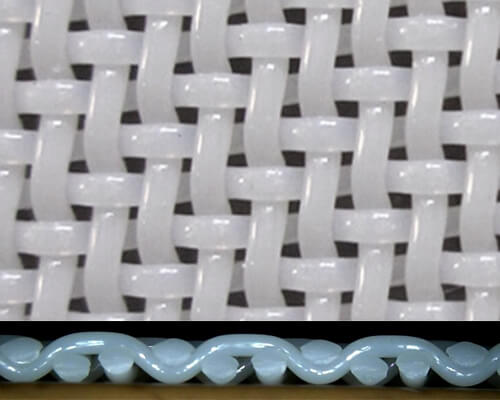 Fine-Aperture Fiberglass Mat Forming Wire • Improved fiber retention for finer glass fibers and lightweight mats • Suitable as glass fiber tissue forming fabric and fiberglass veil forming belt • Helps produce smoother surfaces with reduced mesh marks |
| Parameter | Options / Range |
|---|---|
| Product name | Glass fiber mat forming belt / fiberglass mat forming wire / wetlaid forming belt |
| Material | Polyester (PET) monofilament |
| Wire diameter | 0.5-0.6 mm typical, custom designs available |
| Mesh density | 9.5 x 9.0 wire/cm, 10.5 x 9.2 wire/cm or custom mesh count |
| Aperture opening | Selected according to glass fiber length, fiber diameter and retention target |
| Air permeability | Custom CFM or m3/m2h, matched to drainage and vacuum conditions |
| Seam type | Endless seam, low-mark seam or mechanical pin seam |
| Width & length | Made to your machine dimensions |
* Typical ranges shown. Final belt specification is confirmed according to glass fiber type, mat weight, machine speed, vacuum layout, current belt sample and surface quality requirement.
Roofing & Waterproofing Mat • Fiberglass mat for bitumen roofing membranes • High drainage capacity and stable basis weight • Smooth binder impregnation and reduced web defects | Glass Fiber Tissue & Veil • Glass fiber tissue forming fabric for lightweight tissue products • Fiberglass veil forming belt for fine surface formation • Fine aperture option for better fiber retention |
Gypsum Board & Construction Materials • Glass mat facer and reinforcement substrate • Stable cross-machine profile for wide production lines • Reliable dewatering before binder and drying sections | Filtration, Insulation & Technical Mats • Wetlaid nonwoven forming wire for technical glass fiber mats • Custom aperture for microfiber or chopped strand applications • Engineered for formation, drainage and release balance |
Q1: What is a polyester forming belt for glass fiber mat? It is a precision-woven polyester mesh belt used in the forming and dewatering section of wet-laid glass fiber mat production. It supports fiber deposition, retains chopped glass fibers and drains process water through the mesh. |
Q2: How is a fiberglass mat forming wire different from a standard conveyor belt? A standard conveyor belt mainly transports material. A fiberglass mat forming wire must form the wet web, retain fibers, control drainage, support vacuum dewatering and release the wet mat without marking or tearing. |
Q3: How do I choose the correct aperture size? Aperture size should be selected according to glass fiber length, fiber diameter, slurry concentration, target mat weight and drainage demand. Finer apertures improve fiber retention, while more open structures increase drainage capacity. |
Q4: Can PFM Screen match my existing wetlaid forming belt? Yes. PFM Screen can match or improve an existing belt based on belt width, length, mesh density, yarn diameter, aperture size, air permeability, seam type, photos or a physical sample. |
Q5: What information is needed for a quotation? Please provide glass fiber type and length, belt width, belt length, machine speed, current mesh specification if available, required seam type, target drainage performance and annual consumption quantity. |
Q6: Can the belt be used for glass fiber tissue and fiberglass veil? Yes. PFM Screen can supply fine-aperture belts for glass fiber tissue forming fabric and fiberglass veil forming belt applications, where surface smoothness, fiber retention and low marking are especially important. |
Get a Custom Glass Fiber Mat Forming Belt Specification Within 24 Hours Share your glass fiber type, fiber length, belt width/length, machine speed and current belt sample. PFM Screen will recommend the right wetlaid forming belt and send a factory-direct quotation. WhatsApp: +86 153 6967 9157 Email: polyestermesh@pfmscreen.com |
